
Lies That ‘Might’ Eventually Come True Seem Less Unethical
People could be willing to forgive, spread misinformation they think might become true in the future, study says.
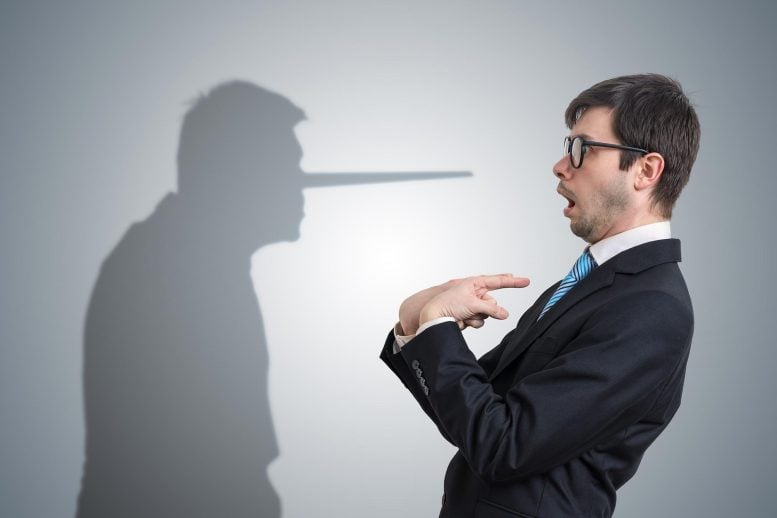
People may be willing to condone statements they know to be false and even spread misinformation on social media if they believe those statements could become true in the future, according to research published by the American Psychological Association.
Whether the situation involves a politician making a controversial statement, a business stretching the truth in an advertisement or a job seeker lying about their professional skills on a resume, people who consider how a lie might become true subsequently think it is less unethical to tell because they judge the lie’s broader message (or “gist”) as truer. The study was published in APA’s Journal of Personality and Social Psychology.
“The rise in misinformation is a pressing societal problem, stoking political polarization and eroding trust in business and politics. Misinformation in part persists because some people believe it. But that’s only part of the story,” said lead author Beth Anne Helgason, a doctoral student at the London Business School. “Misinformation also persists because sometimes people know it is false but are still willing to excuse it.”
This study was sparked by cases in which leaders in business and politics have used claims that “it might become true in the future” to justify statements that are verifiably false in the present.
Imagination and Ethical Perception
To explore why people might be willing to condone this misinformation, researchers conducted six experiments involving more than 3,600 participants. The researchers showed participants in each study a variety of statements, clearly identified as false, and then asked some participants to reflect on predictions about how the statements might become true in the future.
In one experiment, researchers asked 447 MBA students from 59 different countries who were taking a course at a UK business school to imagine that a friend lied on their resume, for example by listing financial modeling as a skill despite having no prior experience. The researchers then asked some participants to consider the possibility of the lie becoming true (e.g., “Consider that if the same friend enrolls in a financial modeling course that the school offers in the summer, then he could develop experience with financial modeling”). They found that students thought it was less unethical for a friend to lie when they imagined whether their friend might develop this skill in the future.
Political Bias and Misinformation
In another experiment, 599 American participants viewed six markedly false political statements designed to appeal to either conservatives or liberals, including, “Millions of people voted illegally in the last presidential election” and, “The average top CEO makes 500 times more than the average worker.” Each statement was clearly labeled as false by reputable, non-partisan fact-checkers. Participants were then asked to generate their own predictions about how each statement might become true in the future. For instance, they were told that “It’s a proven fact that the average top CEO currently makes 265 times more money than the average American worker,” then asked to respond to the open-ended prompt, “The average top CEO will soon make 500 times more money than the average American worker if …”
The researchers found that participants on both sides of the political aisle who imagined how false statements could eventually become true were less likely to rate the statement as unethical than those who did not because they were more likely to believe its broader meaning was true. This was especially the case when the false statement fit with their political views. Importantly, participants knew these statements were false, yet imagining how they might become true made people find them more excusable.
Even prompting the participants to think carefully before judging the falsehoods did not change how ethical the participants found the statements, said study co-author Daniel Effron, PhD, a professor of organizational behavior at the London Business School.
“Our findings are concerning, particularly given that we find that encouraging people to think carefully about the ethicality of statements was insufficient to reduce the effects of imagining a future where it might be true,” Effron said. “This highlights the negative consequences of giving airtime to leaders in business and politics who spout falsehoods.”
The Influence of Political Alignment on Sharing Misinformation
The researchers also found that participants were more inclined to share misinformation on social media when they imagined how it might become true, but only if it aligned with their political views. This suggests that when misinformation supports one’s politics, people may be willing to spread it because they believe the statement to be essentially, if not literally, true, according to Helgason.
“Our findings reveal how our capacity for imagination affects political disagreement and our willingness to excuse misinformation,” Helgason said. “Unlike claims about what is true, propositions about what might become true are impossible to fact-check. Thus, partisans who are certain that a lie will become true eventually may be difficult to convince otherwise.”
Reference: “It Might Become True: How Prefactual Thinking Licenses Dishonesty” by Beth Anne Helgason and Daniel Effron, PhD, London Business School, 14 April 2022, Journal of Personality and Social Psychology.
DOI: 10.1037/pspa0000308
Never miss a breakthrough: Join the SciTechDaily newsletter.
Follow us on Google and Google News.
6 Comments
My problem is when @ssholes who are out of touch with the rest of humanity start making the rules on the truth. You can sit back and judge because its does not cost you anything. Only the brave challenge the Status Quo. Not p*ssies sitting behind a computer with 0 life experience.
And you are the brave I suppose. You are the @sshole sitting behind a computer judging, in your own special category of advanced human awareness, spitting on the ones trying to make sense of life on a small planet. Congratulations!
Rice cakes have more nutritional value than that vague lump of mud.
Ah, the difference between lies and mistakes and between will and could and already has.
Rice cakes have more nutritional value than that vague lump of mud.
Reminds me of the “Climategate” email hack of Dr Phil Jones, about 2010 if memory serves, which exposed Jones’ belief that lying about (or glossing over, if you like) the uncertainties of long-range climate prediction — because the worst-case scenario COULD happen….