

In a fascinating dive into the strange world of quantum physics, scientists have shown that light can interact with itself in bizarre ways—creating ghost-like virtual particles that pop in and out of existence.
This “light-on-light scattering” isn’t just a theoretical curiosity; it could hold the key to solving long-standing mysteries in particle physics.
Quantum Light: Why Lasers Don’t Clash Like Lightsabers
Under normal conditions, light waves can pass through one another without any interference. Based on the principles of electrodynamics, two beams of light can occupy the same space without affecting each other. They simply merge and continue on their paths. This means that the dramatic laser duels seen in science fiction would be much less exciting in real life.
However, quantum physics introduces a twist. It predicts a phenomenon known as “light-on-light scattering.” This effect cannot be detected with typical laser systems, but it has been observed in high-energy environments like the CERN particle accelerator.
In this process, virtual particles can momentarily appear from the vacuum, interact with photons, and alter their trajectory. Although the effect is incredibly subtle, understanding it with precision is essential for testing particle physics theories, especially in sensitive experiments involving muons.
Researchers at TU Wien (Vienna) have now demonstrated that one overlooked factor plays a significant role in this process: the influence of particles known as tensor mesons. Their findings were recently published in Physical Review Letters.
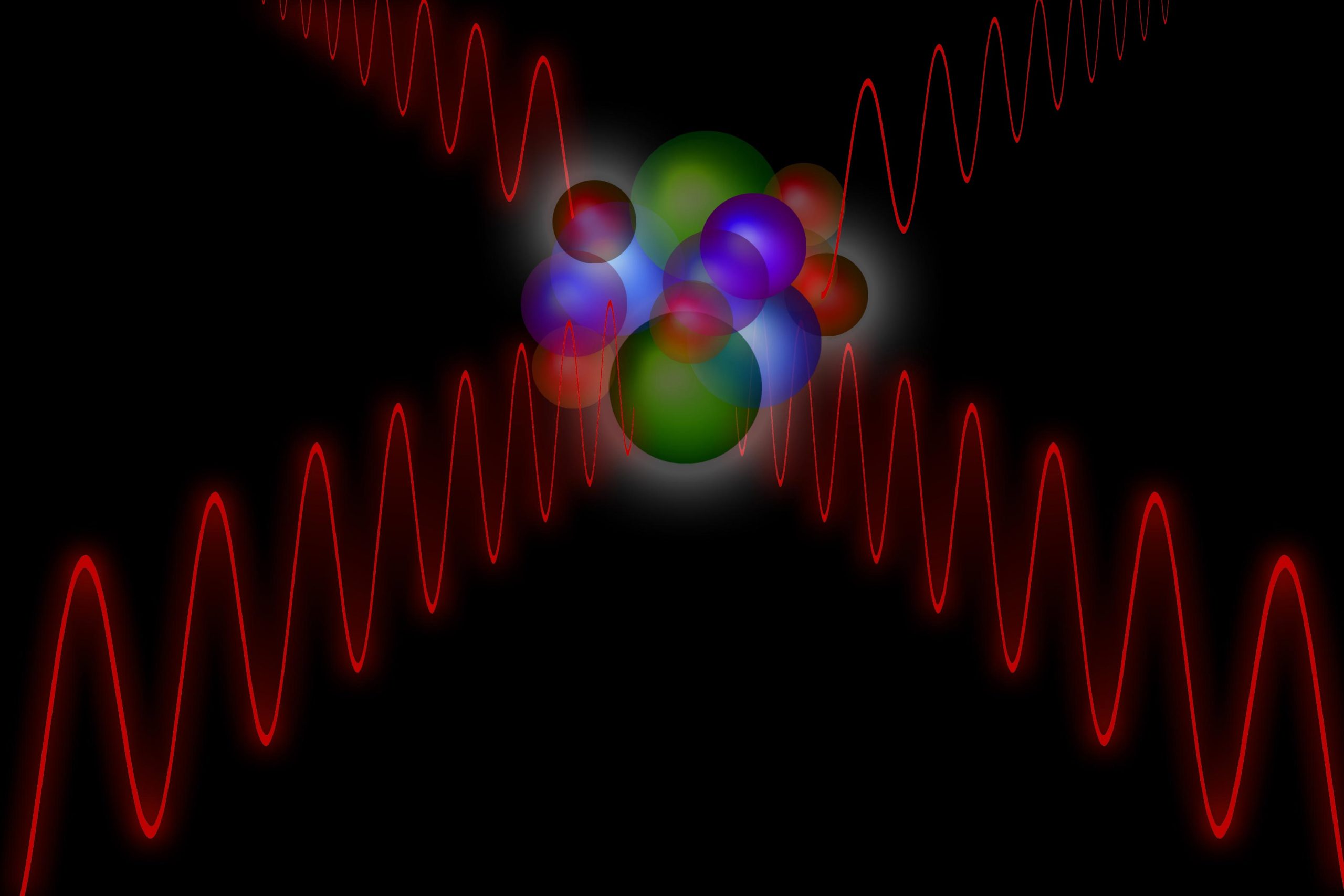
Ghost Particles That Leave Real Marks
When photons collide or interact, virtual particles can briefly come into existence. These particles vanish almost instantly and cannot be observed directly. In a strange way, they both exist and do not exist at the same time. Quantum mechanics allows for this kind of paradox, where different states can coexist even if they seem contradictory from a classical perspective.
“Even though these virtual particles cannot be observed directly, they have a measurable effect on other particles,” says Jonas Mager from the Institute of Theoretical Physics at TU Wien, lead author of the study. “If you want to calculate precisely how real particles behave, you have to take all conceivable virtual particles into account correctly. That’s what makes this task so difficult – but also so interesting.”
What Happens When Light Hits Light
When light scatters off light, a photon may transform, for example, into an electron-positron pair. Other photons can then interact with these two particles before the electron and positron annihilate each other and become a new photon. Things become more complicated when heavier particles are created that are also subject to strong nuclear forces – for example, mesons, which consist of a quark and an antiquark.
“There are different types of these mesons,” says Jonas Mager. “We have now been able to show that one of them, the tensor mesons, has been significantly underestimated. Through the effect of light-light scattering, they influence the magnetic properties of muons, which can be used to test the Standard Model of particle physics with extreme accuracy.” Tensor mesons did appear in earlier calculations, but with very rough simplifications. In the new evaluation, not only does their contribution turn out to be much stronger than previously assumed, but it also has a different sign than previously thought, thus influencing the results in the opposite direction.
Gravitons and Holograms: A 5D Approach
This result also resolves a discrepancy that arose last year between the latest analytical calculations and alternative computer simulations. “The problem is that conventional analytical calculations can describe the strong interactions of quarks only well in limiting cases,” says Anton Rebhan (TU Wien).
The TU Wien team, on the other hand, used an unconventional method – holographic quantum chromodynamics. This involves mapping processes in four dimensions (i.e., three spatial dimensions and one time dimension) onto a five-dimensional space with gravity. Some problems can then be solved more easily in this other space, and the results are then transformed back again. “The tensor mesons can be mapped onto five-dimensional gravitons, for which Einstein’s theory of gravity makes clear predictions,” explains Anton Rebhan. “We now have computer simulations and analytical results that fit well together but deviate from certain previous assumptions. We hope that this will also provide new impetus to accelerate already planned specific experiments on tensor mesons.”
Putting the Standard Model Under the Microscope
These analyses are important for one of the biggest questions in physics: How reliable is the Standard Model of particle physics? This is the generally accepted quantum physical theory that describes all known types of particles and all forces of nature – except gravity.
The accuracy of the Standard Model can be investigated particularly well in a few special test cases, for example, by measuring the magnetic moment of muons. For many years, scientists have been puzzling over whether certain discrepancies between theory and experiment point to “new physics” beyond the Standard Model, or whether they are simply inaccuracies or errors. The discrepancy in the muon magnetic moment has recently become much smaller – but in order to really search for new physics, the remaining theoretical uncertainties must also be understood as precisely as possible. This is exactly what the new work contributes to.
Reference: “Longitudinal short-distance constraints on hadronic light-by-light scattering and tensor-meson contributions to the muon 𝑔−2” by Jonas Mager, Luigi Cappiello, Josef Leutgeb, and Anton Rebhan, Accepted, Physical Review Letters.
DOI: 10.1103/dxwr-gpsl
Never miss a breakthrough: Join the SciTechDaily newsletter.
Follow us on Google and Google News.
7 Comments
I DID Complete Quantum Gravity Unification with Experimental Confirmation, sent to a lot of physicist and no one reply, but they did downloaded my files. The world is that way because of people like that. Here is the link to you all se what they are stealing from me. I GOT THIS EQUATION SINCE 20 OF JUNE!!!
doi_org/10_5281/zenodo_16501807
_=.
It’s called casting your pearls. Welcome to the club.
Mail it to yourself, multiple times. Then, if questioned to show your proof, you have it sealed and dated by your postal server.
Yeah. Good idea. Any email stamp should be good.
You know what not to do? Do not publish new Nobel-worthy ideas on an open forum … like this one.
These values are independent of any specific method, but have been internally validated against multiple high-precision structures. Use freely to test consistency in your analytical and numerical models. The generating framework can be discussed later if needed.
| Quantity | Symbol | Value |
| ——————————————— | ——– | ———————- |
| **Muon anomalous magnetic moment correction** | Δ(g–2)/2 | **9.1217 × 10⁻⁵** |
| **Tensor meson coupling strength** | λₜ | **0.0021356** |
| **Effective resonance scale of tensor meson** | Lₜ | **0.003988 fm** |
| **Canonical phase shift (light–light)** | φ | **π/40 ≈ 0.07854 rad** |
And Yes they are stealing, let me tell you the timeline, June 20 I got the equations, June 28 I draft the patent of negative energy propulsion system(couldn`t do it, didn`t have money) June 30 Googles buys “200 megawatts of fusion energy that doesn’t even exist yet” ref:https://edition.cnn.com/2025/06/30/climate/fusion-energy-google-commonwealth-agreement , FUSION ENERGY is the KEY to make negative propulsion engine.
Day 9 of July 7am in Brazil I validated Theta Theory with cmb-s4 preliminary data (confidencial so I can’t share), day 10 of July US Abandons CMB-S4. Why could that be? This data validate my theory with no excuse. https://www.science.org/content/article/u-s-abandons-hunt-signal-cosmic-inflation
Has been a month since I’m trying to upload, reddit, facebook, preprints, instagram and so on filters didn’t let me upload. If isn’t right why would you do that? for nothing? Suppressing me for what purpose? Could you explain ?
I used a gmail account, also used google colab, overleaf and other websites, they all COLLECT DATA.
I sent email to a lot of “Scientific people” no reply, but you all downloaded my data.
Just look at arXiv, the numbers of GR have grown, since 20 june we have more content submitted to arXiv that in previous months.
Here is Theta Theory, a theory I Renato Gori Rosa did with Deekseek AI.
https://doi.org/10.5281/zenodo.16501807
And for last, Everyone is Scientists of Themselves, no one can disagree.
Institutions will not last long if you all keep doing these things. We must unite.
Even this website is suppressing deleting my comments, what do you expect?
Thanks!
Under normal conditions, light waves can pass through one another without any interference. Based on the principles of electrodynamics, two beams of light can occupy the same space without affecting each other. Their findings were recently published in Physical Review Letters.
Ask the researchers:
How do you define the same space?
Is Physical Review Letters a publication that respects science?
The so-called peer-reviewed publications (including Physical Review Letters, Science, Nature, etc) deliberately ignore the core mathematical structures of general relativity’s geometric dynamics, quantum field theory’s renormalization framework, cosmic inflation models, and quantum gravity theories all implicitly rely on the uniformity, continuity, and isotropy of background space, obstinately cling to the ideal fluid characteristics of space—inviscid, incompressible, and isotropic are unverified. Ask to these so-called peer-reviewed publications (including Physical Review Letters, Science, Nature, etc): Where should things in space come from? Do things in space originate from the dynamic evolution of space itself, or from God, Demons, or Angels?
These so-called peer-reviewed publications collude to propagate and doggedly adhere to the notion that two sets of cobalt-60 rotating in opposite directions—whether symmetrical or not—constitute mirror images of each other. In the physical world they (including Physical Review Letters, Nature, Science, etc.) construct, different particles can be defined as the same particle, and topological vortices and their twin antivortices can be defined as two vortices with completely different spatiotemporal manifolds. God, Demons, Angels, and their pet Cats have always dominated the highly acclaimed physical world of these so-called peer-reviewed publications. Let us continue to witness with facts the dirtiest and ugliest epoch in the history of science and humanity.
Correct knowledge will benefit researchers. If researchers are interested in knowledge, please browse https://zhuanlan.zhihu.com/p/1933828835322856603.