
Why do certain materials emit electrons with a very specific energy? This has been a mystery for decades — scientists at TU Wien have found an answer.
It is something quite common in physics: electrons leave a certain material, they fly away and then they are measured. Some materials emit electrons, when they are irradiated with light. These electrons are then called “photoelectrons.” In materials research, so-called “Auger electrons” also play an important role — they can be emitted by atoms if an electron is first removed from one of the inner electron shells. But now scientists at TU Wien (Vienna) have succeeded in explaining a completely different type of electron emission, which can occur in carbon materials such as graphite. This electron emission had been known for about 50 years, but its cause was still unclear.
Strange electrons without explanation
“Many researchers have already wondered about this,” says Prof. Wolfgang Werner from the Institute of Applied Physics. “There are materials that consist of atomic layers that are held together only by weak Van der Waals forces, for example graphite. And it was discovered that this type of graphite emits very specific electrons, which all have exactly the same energy, namely 3.7 electron volts.”
No known physical mechanism could explain this electron emission. But at least the measured energy gave an indication of where to look: “If these atomically thin layers lie on top of each other, a certain electron state can form in between,” says Wolfgang Werner. “You can imagine it as an electron that is continuously reflected back and forth between the two layers until at some point it penetrates the layer and escapes to the outside.”
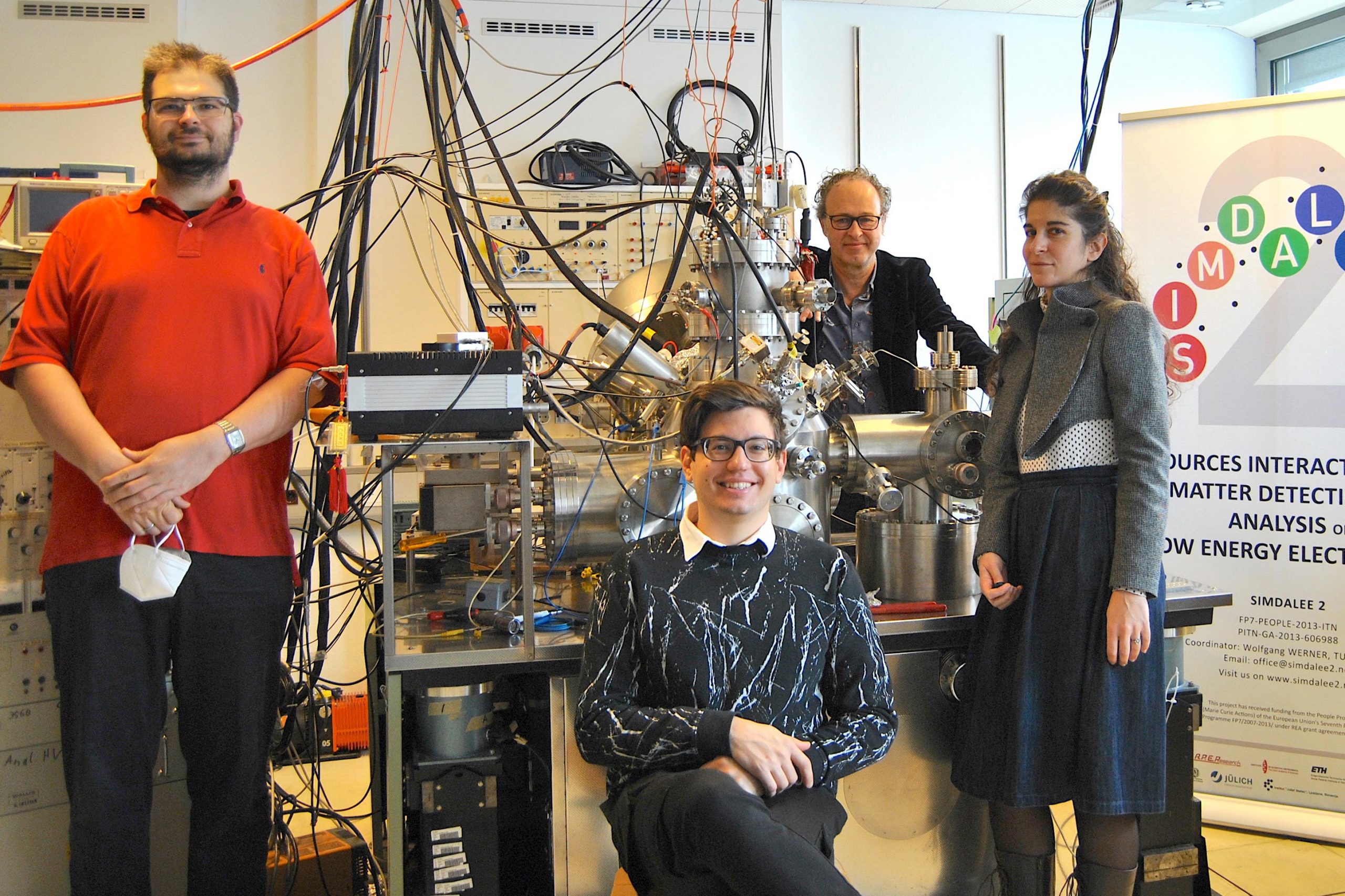
The energy of these states actually fits well with the observed data – so people assumed that there is some connection, but that alone was no explanation. “The electrons in these states should not actually reach the detector,” says Dr. Alessandra Bellissimo, one of the authors of the current publication. “In the language of quantum physics one would say: The transition probability is just too low.”
Skipping cords and symmetry
To change this, the internal symmetry of the electron states must be broken. “You can imagine this like rope skipping,” says Wolfgang Werner. “Two children hold a long rope and move the end points. Actually, both create a wave that would normally propagate from one side of the rope to the other. But if the system is symmetrical and both children behave the same way, then the rope just moves up and down. The wave maximum always remains at the same place. We don’t see any wave movement to the left or right, this is called a standing wave.” But if the symmetry is broken because, for example, one of the children moves backwards, the situation is different — then the dynamics of the rope change and the maximum position of the oscillation moves.
Such symmetry breaks can also occur in the material. Electrons leave their place and start moving, leaving a “hole” behind. Such electron-hole pairs disturb the symmetry of the material, and thus it can happen that the electrons suddenly have the properties of two different states simultaneously. In this way, two advantages can be combined: On the one hand, there is a large number of such electrons, and on the other hand, their probability of reaching the detector is sufficiently high. In a perfectly symmetrical system, only one or the other would be possible. According to quantum mechanics, they can do both at the same time, because the symmetry refraction causes the two states to “merge” (hybridize).
“In a sense, it is teamwork between the electrons reflected back and forth between two layers of the material and the symmetry-breaking electrons,” says Prof. Florian Libisch from the Institute of Theoretical Physics. “Only when you look at them together can you explain that the material emits electrons of exactly this energy of 3.7 electron volts.”
Carbon materials such as the type of graphite analyzed in this research work play a major role today — for example, the 2D material graphene, but also carbon nanotubes of tiny diameter, which also have remarkable properties. “The effect should occur in very different materials — wherever thin layers are held together by weak Van der Waals forces,” says Wolfgang Werner. “In all these materials, this very special type of electron emission, which we can now explain for the first time, should play an important role.”
Reference: “Secondary Electron Emission by Plasmon-Induced Symmetry Breaking in Highly Oriented Pyrolytic Graphite” by Wolfgang S. M. Werner, Vytautas Astašauskas, Philipp Ziegler, Alessandra Bellissimo, Giovanni Stefani, Lukas Linhart and Florian Libisch, 6 November 2020, Physical Review Letters.
DOI: 10.1103/PhysRevLett.125.196603
Never miss a breakthrough: Join the SciTechDaily newsletter.
Follow us on Google and Google News.
5 Comments
A “New Kind of Electrons” – poor grammar there. What were they thinking?
Thinking? Probably not.
This article has some interesting points concerning the behavior of electrons under certain conditions other than that bad grammar, misleading headlines, statements in the text, and a lack of coherent explanation as what it offers.
Sometimes it does not matter what it offers, it just matters that it was learned. Seriously, you just sound like you want to exploit natural sub-atomic resources. Also, what ‘misleading headlines’? Are you a scientist or are you an Homo Habilis?
Your consultant pioneering