
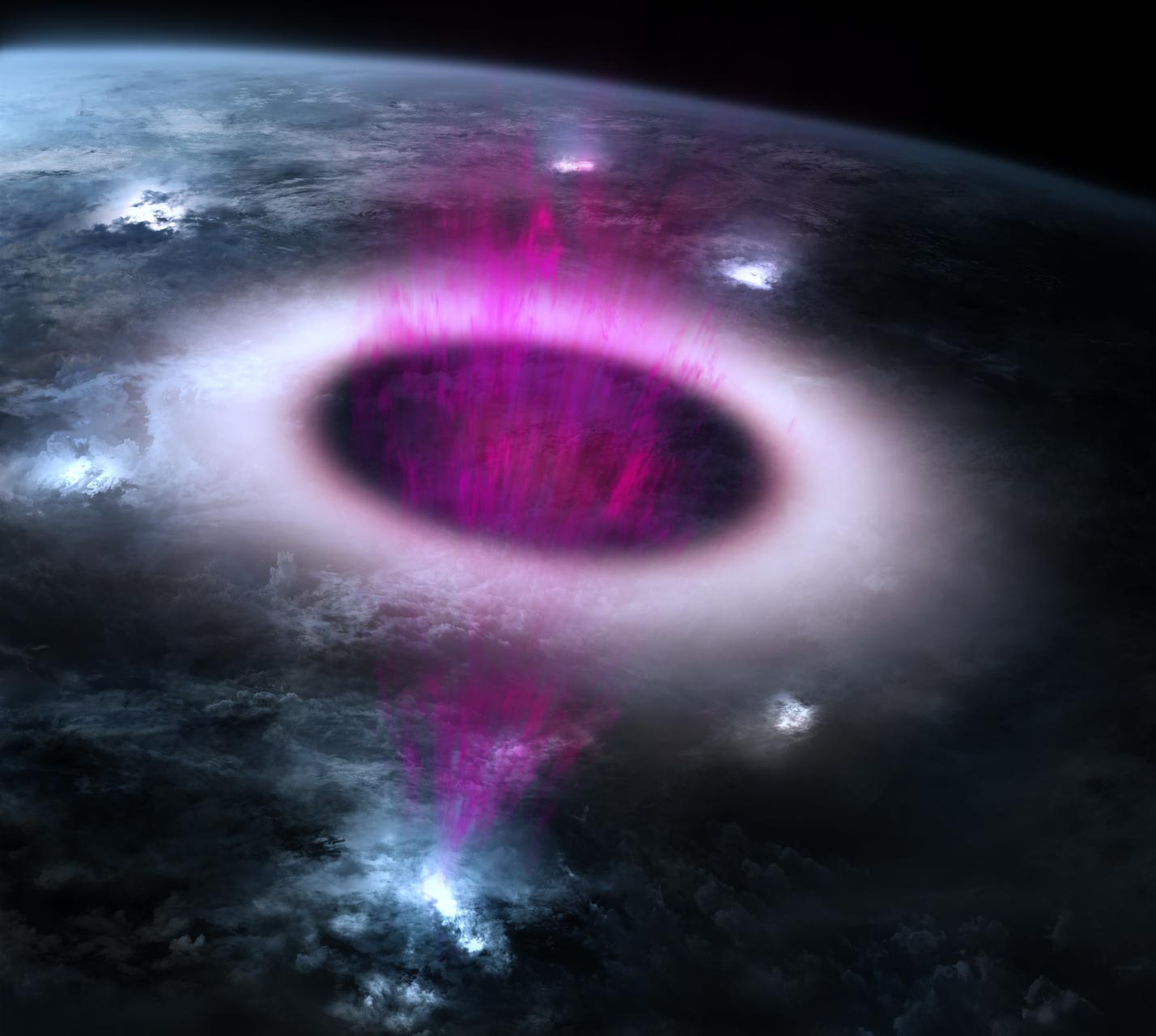
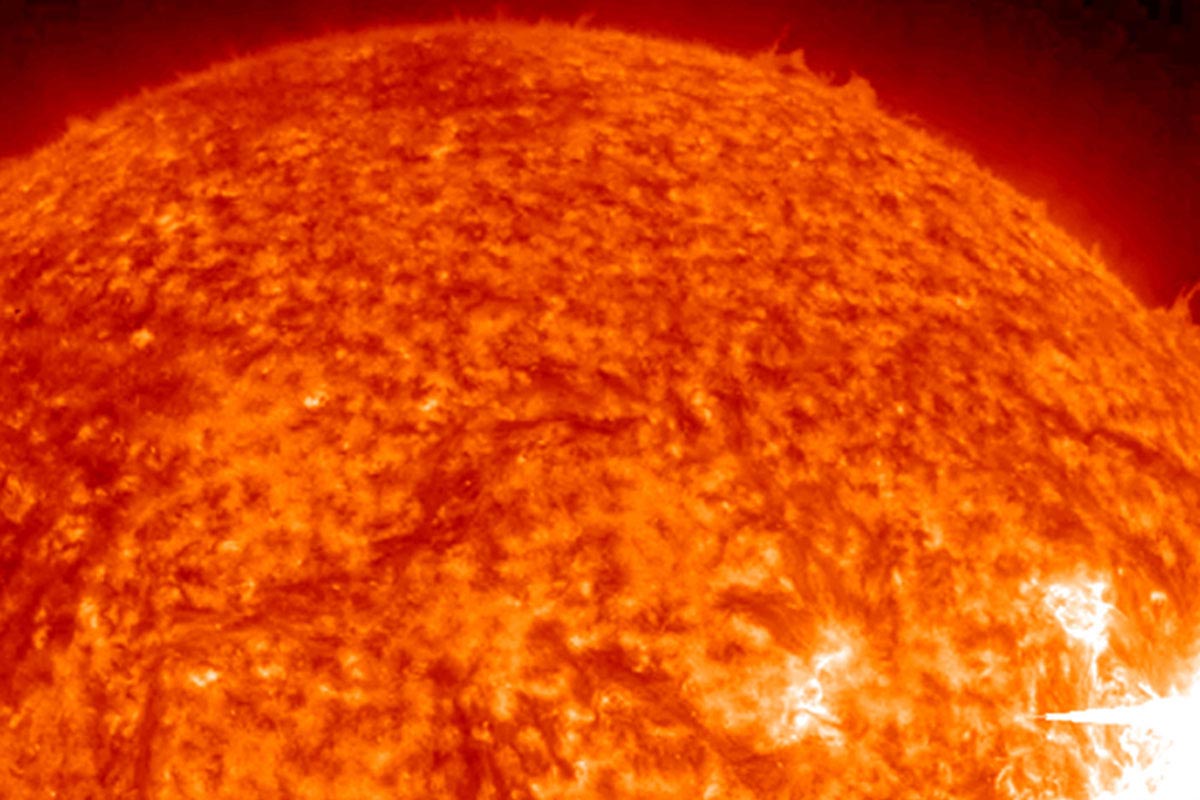
Solar flares jetting out from the sun and thunderstorms generated on Earth impact the planet’s ionosphere in different ways, which have implications for the ability to conduct long range communications.
A team of researchers working with data collected by the Incoherent Scatter Radar (ISR) at the Arecibo Observatory, satellites, and lightning detectors in Puerto Rico have for the first time examined the simultaneous impacts of thunderstorms and solar flares on the ionospheric D-region (often referred to as the edge of space).
In the first of its kind analysis, the team determined that solar flares and lightning from thunderstorms trigger unique changes to that edge of space, which is used for long-range communications such the GPS found in vehicles and airplanes.
The work, led by New Mexico Tech assistant professor of physics Caitano L. da Silva was published recently in the journal Scientific Reports, a journal of the Nature Publishing Group.
Lightning vs. Solar Flares
“These are really exciting results,” says da Silva. “One of the key things we showed in the paper is that lightning- and solar flare-driven signatures are completely different. The first tends to create electron density depletions, while the second enhancements (or ionization).”
While the AO radar used in the study is no longer available because of the collapse of AO’s telescope in December of 2020, scientists believe that the data they collected and other AO historical data will be instrumental in advancing this work.
Understanding Earth’s Atmospheric Energy Coupling
“This study helps emphasize that, in order to fully understand the coupling of atmospheric regions, energy input from below (from thunderstorms) into the lower ionosphere needs to be properly accounted for,” da Silva says. “The wealth of data collected at AO over the years will be a transformative tool to quantify the effects of lightning in the lower ionosphere.”
Better understanding of the impact on the Earth’s ionosphere will help improve communications.
da Silva worked with a team of researchers at the Arecibo Observatory (AO) in Puerto Rico, a National Science Foundation facility managed by the University of Central Florida under a cooperative agreement. The co-authors are AO Senior Scientist Pedrina Terra, Assistant Director of Science Operations Christiano G. M. Brum, and Sophia D. Salazar a student at NMT who spent her 2019 summer at the AO as part of the NSF-supported Research Undergraduate Experience. Salazar completed the initial analysis of the data as part of her internship with the senior scientists’ supervision.
“The Arecibo Observatory REU is hands down one of the best experiences I’ve had so far,” says the 21-year-old. “The support and encouragement provided by the AO staff and REU students made the research experience everything that it was. There were many opportunities to network with scientists at AO from all over the world, many of which I would likely never have met without the AO REU.”
AO’s Terra and Brum worked with Salazar taking her initial data analysis, refining it, and providing interpretation for the study.
“Sophia’s dedication and her ability to solve problems grabbed our attention from the very first day of the REU program,” Brum says. “Her efforts in developing this project resulted in publication in one of the most prestigious journals in our field.”
“Another remarkable result of this work is that for the first time, a mapping of the spatial and seasonal occurrence of lightning strike over the region of the Puerto Rico archipelago is presented,” Brum says. “Intriguing was also the detection of a lighting activity hotspot concentrated in the western part of La Cordillera Central mountain range of Puerto Rico.”
Reference: “Survey of electron density changes in the daytime ionosphere over the Arecibo Observatory due to lightning and solar flares” by Caitano L. da Silva, Sophia D. Salazar, Christiano G. M. Brum and Pedrina Terra, 13 May 2021, Scientific Reports.
DOI: 10.1038/s41598-021-89662-x
About the authors:
da Silva conducts research in the area of atmospheric sciences, geophysics, and plasma physics. He’s intrigued by space electricity; thunderstorms and their effects in the near-Earth space environment; lightning physics; modeling of electrical discharge plasmas; and development of computer-based tools for analysis of atmospheric and geophysical phenomena. He holds multiple degrees including a doctorate in electrical engineering from Penn State University and a master’s degree in geophysics and space physics from the National Institute for Space Research (INPE) in Brazil, which is the same alma mater of Brum and Terra. The three INPE alumni had a brief brainstorming session over coffee about this project in the AGU 2018 Fall Meeting, in San Francisco, California.
Terra who worked at AO since 2006, was a post-doctoral scholar at Cornell University. She has multiple degrees including an electrical engineering degree and both master’s and doctorate in space physics from the INPE Research in Brazil. Terra is a UCF’s graduate faculty member and is responsible for the passive optical laboratories at AO, including the remote facility at the island of Culebra.
Brum has been working at AO since 2007 and was a post-doctoral scholar at INPE, Utah State University, and Cornell University. He holds multiple degrees including a master’s and a doctorate degree in space geophysics from the INPE. Brum is the head of the AO Space and Atmospheric Department, Deputy Director of Science Operations, and a UCF graduate faculty member.
Never miss a breakthrough: Join the SciTechDaily newsletter.
Follow us on Google and Google News.