
Close Menu
    Facebook X (Twitter) Instagram
    SciTechDaily
    • Biology
    • Chemistry
    • Earth
    • Health
    • Physics
    • Science
    • Space
    • Technology
    Facebook X (Twitter) Pinterest YouTube RSS
    SciTechDaily
    Home»Space»Lost for Centuries: Scientists Discover Texts From an Ancient Astronomical Catalog
    Space

    Lost for Centuries: Scientists Discover Texts From an Ancient Astronomical Catalog

    By CNRSDecember 2, 2022No Comments4 Mins Read
    Facebook Twitter Pinterest Telegram LinkedIn WhatsApp Email Reddit
    Share
    Facebook Twitter LinkedIn Pinterest Telegram Email Reddit
    Folio From the Codex Climaci Rescriptus
    A folio from the Codex Climaci Rescriptus. Credit: Peter Malik

    Written over 2000 years ago, the Hipparchus Star Catalogue is the oldest known attempt to determine the precise position of fixed stars.

    Fragments of the Star Catalogue written by the Greek astronomer Hipparchus during the second century BC have recently been discovered by researchers from the French National Center for Scientific Research (CNRS), Sorbonne University, and Tyndale House (associated with the University of Cambridge). These texts were discovered using multispectral imaging methods after being wiped from a manuscript during the medieval period in order to reuse the pages. The study of these extracts, which was published in the Journal for the History of Astronomy, sheds new light on ancient astronomy.

    Even for the most Cartesian of minds, old grimoires often contain sought-after mysteries, such as the fragments of a lost astronomical treatise called the Hipparchus Star Catalogue. The Greek astronomer Hipparchus wrote it between 170 and 120 BC, making it the first documented effort to pinpoint the exact location of fixed stars by associating them with numerical coordinates.

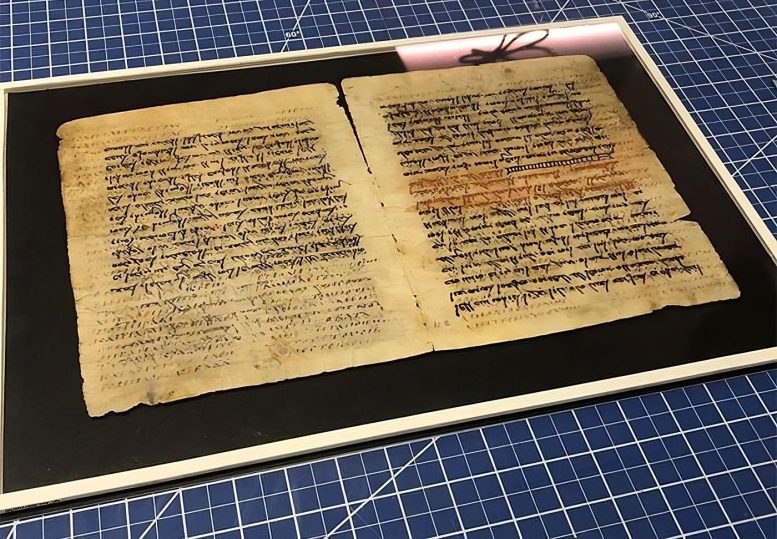
    Folio 53 Verso of the Codex Climaci Rescriptus
    Folio 53 verso of the Codex Climaci Rescriptus contains the portion of Hipparchus’s star catalog
    as a Greek text hidden beneath the Syriac overtext. Credit: Museum of the Bible Collection. All rights
    reserved. © Museum of the Bible, 2022

    This text was previously only known through the works of Claudius Ptolemy, another ancient astronomer who compiled his own catalog about 400 years after Hipparchus. The descriptions of four constellations from Hipparchus’ Star Catalogue have recently been deciphered by researchers from the Léon Robin Center for Research on Ancient Thought (CNRS/Sorbonne University) and their British colleague from Tyndale House in Cambridge.
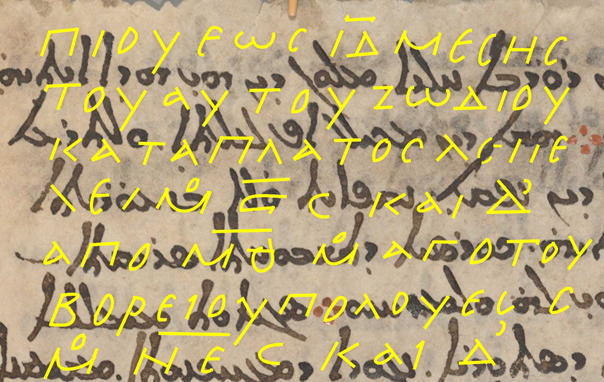
    Yellow Highlights Codex Climaci Rescriptus
    Detail of f. 53v, beginning of first column of undertext (color image; yellow tracings based on full set of multispectral images). Courtesy of Museum of the Bible Collection. © Museum of the Bible, 2021. Image shared under Creative Commons BY-SA 4.0 license, 2022. All conditions apply. Spectral imaging by the Early Manuscripts Electronic Library and the Lazarus Project of the University of Rochester.

    This discovery comes from the Codex Climaci Rescriptus ‒ a book made up of parchments that were erased and then rewritten, also known as a palimpsest. In the past, this Codex contained an astronomical poem in ancient Greek with, among elements of commentary on the poem, fragments of Hipparchus’ Catalogue. This palimpsest text, erased in medieval times, has been revealed through multispectral imaging by teams from the Early Manuscripts Electronic Library, the Lazarus Project, and the Rochester Institute of Technology.

    Folio 53 Recto of the Codex Climaci Rescriptus
    Folio 53 recto of the Codex Climaci Rescriptus. The published portion of Hipparchus’s star
    catalog is on the other side of this page. Credit: Museum of the Bible Collection. All rights reserved. ©
    Museum of the Bible, 2022

    The fragments of the Star Catalogue are the oldest known to date and bring major advances in its reconstruction. Firstly, they refute a widespread idea that Claudius Ptolemy’s Star Catalogue is merely a “copy” of Hipparchus’ as the observations of the four constellations are different. Furthermore, Hipparchus’ data are verified to the nearest degree, which would make his catalog much more accurate than Ptolemy’s, even though it was composed several centuries earlier.

    For the research team this major discovery sheds new light on the history of astronomy in antiquity and on the beginnings of the history of science. Above all, it illustrates the power of advanced techniques, such as multispectral imaging, whose application on illegible palimpsests could save numerous lost texts on philosophy, medicine, or horticulture from oblivion.

    Reference: “New evidence for Hipparchus’ Star Catalogue revealed by multispectral imaging” by Victor Gysembergh, Peter J. Williams and Emanuel Zingg, 18 October 2022, Journal for the History of Astronomy.
    DOI: 10.1177/00218286221128289

    Never miss a breakthrough: Join the SciTechDaily newsletter.
    Follow us on Google and Google News.

    Astronomy CNRS History Popular Rochester Institute of Technology University of Cambridge
    Share. Facebook Twitter Pinterest LinkedIn Email Reddit

    Related Articles

    Halley’s Comet Has the Wrong Name, New Research Suggests

    ALMA Opens a New Window to the Distant Universe, Reveals ‘Whirlpool’ Movement

    Astronomers Discover Smallest Star to Date, EBLM J0555-57Ab

    ALMA Observes a Black Hole Producing Star-Making Fuel

    Strangulation is the Primary Mechanism for Star Formation Shut Down

    Astronomers Discover Dwarf Galaxies Orbiting the Milky Way

    Simulations Re-Create the Complex Dynamics Near a Black Hole

    NASA Study Bridges the Gap Between Theory and Black Hole Observations

    Study Models Conditions Near to the Surface of a White Dwarf Star

    Leave A Reply Cancel Reply

    • Facebook
    • Twitter
    • Pinterest
    • YouTube

    Don't Miss a Discovery

    Subscribe for the Latest in Science & Tech!

    Trending News

    Scientists Warn That This Common Pet Fish Can Wreck Entire Ecosystems

    Scientists Make Breakthrough in Turning Plastic Trash Into Clean Fuel Using Sunlight

    This Popular Supplement May Interfere With Cancer Treatment, Scientists Warn

    Scientists Finally Solved One of Water’s Biggest Mysteries

    Could This New Weight-Loss Pill Disrupt the Entire Market? Here’s What You Should Know About Orforglipron

    Earth’s Crust Is Tearing Open in Africa, and It Could Form a New Ocean

    Breakthrough Bowel Cancer Trial Leaves Patients Cancer-Free for Nearly 3 Years

    Natural Compound Shows Powerful Potential Against Rheumatoid Arthritis

    Follow SciTechDaily
    • Facebook
    • Twitter
    • YouTube
    • Pinterest
    • Newsletter
    • RSS
    SciTech News
    • Biology News
    • Chemistry News
    • Earth News
    • Health News
    • Physics News
    • Science News
    • Space News
    • Technology News
    Recent Posts
    • The Most Effective Knee Arthritis Treatments Aren’t What You Expect
    • Scientists Develop Bioengineered Chewing Gum That Could Help Fight Oral Cancer
    • Popular Weight-Loss Drugs Found To Cut Heart Attack and Stroke Risk
    • After 37 Years, the World’s Longest-Running Soil Warming Experiment Uncovers a Startling Climate Secret
    • NASA Satellite Captures First-Ever High-Res View of Massive Pacific Tsunami
    Copyright © 1998 - 2026 SciTechDaily. All Rights Reserved.
    • Science News
    • About
    • Contact
    • Editorial Board
    • Privacy Policy
    • Terms of Use

    Type above and press Enter to search. Press Esc to cancel.