
Close Menu
    Facebook X (Twitter) Instagram
    SciTechDaily
    • Biology
    • Chemistry
    • Earth
    • Health
    • Physics
    • Science
    • Space
    • Technology
    Facebook X (Twitter) Pinterest YouTube RSS
    SciTechDaily
    Home»Health»Lowering Your Blood Insulin Levels Could Lower Risk of Getting COVID-19
    Health

    Lowering Your Blood Insulin Levels Could Lower Risk of Getting COVID-19

    By Osaka UniversityOctober 28, 20213 Comments4 Mins Read
    Facebook Twitter Pinterest Telegram LinkedIn WhatsApp Email Reddit
    Share
    Facebook Twitter LinkedIn Pinterest Telegram Email Reddit
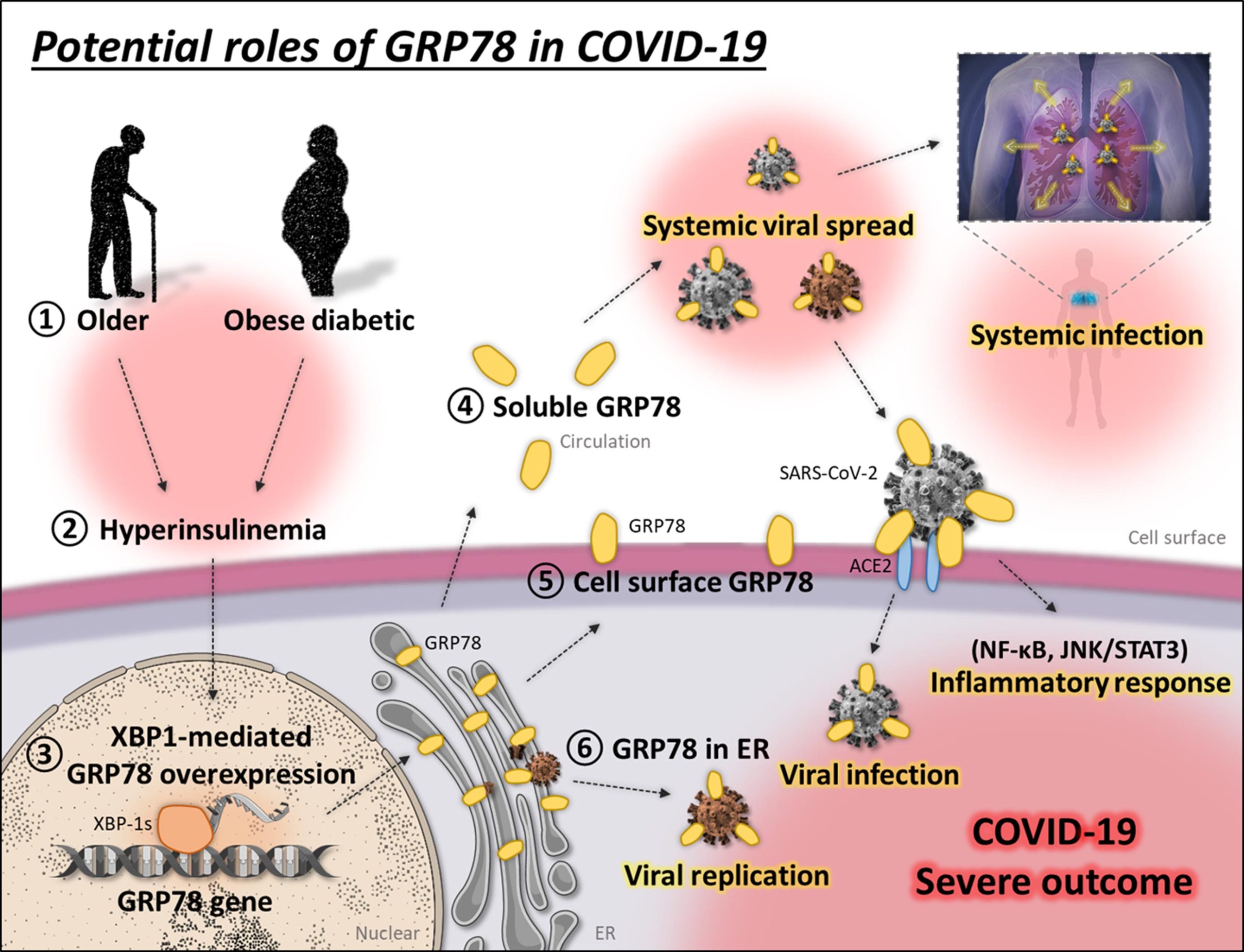
    Potential Roles of GRP78 in COVID 19
    In older and obese diabetic patients①, hyperinsulinemia② causes cellular stress and induces the XBP-1-mediated overexpression of GRP78③ in adipose tissue, which promotes localization of GRP78 to the circulation④ and cell surface⑤, not only to endoplasmic reticulum (ER)⑥. GRP78 physically interacts with the SARS-CoV-2 spike protein, which may play a number of crucial roles in the viral lifecycle. The interaction of the spike protein with soluble and cell surface GRP78 may facilitate the SARS-CoV-2 binding to and infection of ACE2-expressing host cells. Soluble GRP78 bound to SARS-CoV-2 in the circulation could induce the systemic viral spread and infection. Binding of SARS-CoV-2 to cell surface GRP78 or related stimuli could activate the NF-κB or JNK/STAT3 transcriptional pathway and induce cellular inflammatory responses. SARS-CoV-2 potentially exploits ER-located GRP78 as a molecular chaperone to produce and assemble viral particles, which enables successful viral replication (brown virus indicates newly replicated SARS-CoV-2). The high expression of GRP78 in older and obese diabetic patients may contribute to the COVID-19 progression and severe outcomes. Credit: The American Diabetes Association

    Researchers from Osaka University find that SARS-CoV-2 binds to a cell-surface protein whose expression is promoted by high blood insulin levels in older, obese, and diabetic individuals.

    Keeping blood insulin levels within strict, healthy parameters is a daily goal for people with diabetes. But now, researchers from Japan have found that regulating blood insulin levels may even help lower the risk of getting COVID-19.

    In a study published this month in Diabetes, researchers from Osaka University have revealed that a protein called GRP78 helps the virus that causes COVID-19 bind to and enter cells. GRP78 is a protein that is found in adipose tissue (i.e., fat). Older, obese, and diabetic people are all more vulnerable to COVID-19 and, while the reasons for this are still not completely clear, the team from Osaka University sheds some light on this issue.

    “It was recently suggested that adipose tissue might be a major reservoir for SARS-CoV-2, the virus that causes COVID-19,” says lead author of the study Jihoon Shin. “Because of this, we wanted to investigate whether there is any link between the excess adipose tissue in older, obese, and diabetic patients and their vulnerability to COVID-19.”

    Spike Protein, ACE2, and GRP78 Interaction

    To do this, the researchers looked at GRP78, which has recently been suggested to be involved in the interaction of SARS-CoV-2 with human cells. The major method by which SARS-CoV-2 enters human cells is by a spike protein on the viral surface binding to a human cell-surface protein called angiotensin-converting enzyme 2 (ACE2). Shin and colleagues discovered that the spike protein can also directly bind to GRP78, and that the presence of GRP78 increases the binding with ACE2. To get an idea of GRP78’s involvement in COVID-19 vulnerability they investigated how much GRP78 protein is present in tissues from older, obese, and diabetic patients.

    “The results were very clear,” explains senior author Iichiro Shimomura. “GRP78 gene expression was highly upregulated in adipose tissue, and was elevated with increasing age, obesity, and diabetes.”

    Insulin Directly Drives GRP78 Expression

    Aging, obesity, and diabetes are known to be associated with increased blood insulin levels. Therefore, the group wondered whether insulin was involved in GRP78 expression. They found that exposing cells to insulin did induce expression of GRP78. Importantly, they discovered that treatment using widely prescribed anti-diabetic drugs that reduce insulin levels successfully reduce expression level of GRP78. They went a step further and showed that exercise and calorie restriction in a mouse-model also worked to reduce GRP78 levels in adipose tissue.

    “Our findings suggest that a high blood insulin level is an important risk factor that can predispose older, obese, and diabetic individuals to COVID-19 infection. As such, controlling blood insulin with pharmacological interventions or with environmental interventions, such as exercise, could help lower these patients’ risk,” says Shin.

    Given the global impact of the SARS-CoV-2 pandemic, the results from this study provide important insights into how to lower the risk of infection in these vulnerable patients. Reducing GRP78 expression by pharmacological or environmental interventions may improve outcomes in these patients.

    Reference: “Possible Involvement of Adipose Tissue in Patients With Older Age, Obesity, and Diabetes With Coronavirus SARS-CoV-2 Infection (COVID-19) via GRP78 (BIP/HSPA5): Significance of Hyperinsulinemia Management in COVID-19” by Jihoon Shin, Shinichiro Toyoda, Shigeki Nishitani, Atsunori Fukuhara, Shunbun Kita, Michio Otsuki and Iichiro Shimomura, 6 October 2021, Diabetes.
    DOI: 10.2337/db20-1094

    Never miss a breakthrough: Join the SciTechDaily newsletter.
    Follow us on Google and Google News.

    COVID-19 Diabetes Infectious Diseases Popular Public Health University of Osaka
    Share. Facebook Twitter Pinterest LinkedIn Email Reddit

    Related Articles

    Why Aging Lungs Turn Mild Infections Into Life-Threatening Illness

    Scientists Identify “Good” Bacteria That May Prevent Long COVID

    Evidence Shows Cloth Masks May Help Against COVID-19 – Especially Those With Several Layers of Cotton Cloth

    Scientists Test Best Fabric Choices for Making a Homemade COVID Mask

    Vitamin D Determines Severity in COVID-19: Researchers Urge Government to Change Advice

    How COVID-19 Kills: New Study Explains the Mechanisms of the New Coronavirus

    Vitamin D Linked to Low Coronavirus Death Rate

    How Effective Are Cloth Masks Against Coronavirus? [Video]

    Key Insights on How Coronavirus Spreads From Chinese Megacity of Shenzhen

    3 Comments

    1. Tom E Coward on October 28, 2021 3:52 pm

      Your nuts!

      Reply
    Leave A Reply Cancel Reply

    • Facebook
    • Twitter
    • Pinterest
    • YouTube

    Don't Miss a Discovery

    Subscribe for the Latest in Science & Tech!

    Trending News

    Artificial Sweeteners May Harm Future Generations, Study Suggests

    Splashdown! NASA Artemis II Returns From Record-Breaking Moon Mission

    What If Consciousness Exists Beyond Your Brain

    Scientists Finally Crack the 100-Million-Year Evolutionary Mystery of Squid and Cuttlefish

    Beyond “Safe Levels”: Study Challenges What We Know About Pesticides and Cancer

    Researchers Have Found a Dietary Compound That Increases Longevity

    Scientists Baffled by Bizarre “Living Fossil” From 275 Million Years Ago

    Your IQ at 23 Could Predict Your Wealth at 27, Study Finds

    Follow SciTechDaily
    • Facebook
    • Twitter
    • YouTube
    • Pinterest
    • Newsletter
    • RSS
    SciTech News
    • Biology News
    • Chemistry News
    • Earth News
    • Health News
    • Physics News
    • Science News
    • Space News
    • Technology News
    Recent Posts
    • Scientists Break Optical Limits With Quantum Dot-Powered Nanoscopy
    • Scientists Shrink a Lab Spectrometer to the Size of a Grain of Sand
    • Quantum Reality Gets Stranger: Physicists Put a Lump of Metal in Two Places at Once
    • 34-Million-Year-Old Snake Found in Wyoming Rewrites Our Understanding of Evolution
    • Prehistoric “Vomit Fossil” Reveals Never-Before-Seen Flying Reptile
    Copyright © 1998 - 2026 SciTechDaily. All Rights Reserved.
    • Science News
    • About
    • Contact
    • Editorial Board
    • Privacy Policy
    • Terms of Use

    Type above and press Enter to search. Press Esc to cancel.