
University of California, Riverside, physics students design a table-top experiment for the classroom.
Physicists at University of California, Riverside, have designed an experiment to explain the concept of magnetic resonance. The project was carried out by undergraduate students in collaboration with local high school teachers.
A versatile technique employed in chemistry, physics, and materials research, magnetic resonance describes a resonant excitation of electron or atomic nuclei spins residing in a magnetic field by means of electromagnetic waves. Magnetic resonance also provides the basis for magnetic resonance imaging, or MRI — the central noninvasive tool in diagnostic medicine and medical research.
“Two of my undergraduate students developed the demonstration experiment based on a compass, an object everybody can relate to,” said Igor Barsukov, an assistant professor in the UC Riverside Department of Physics and Astronomy, who supervised the project.
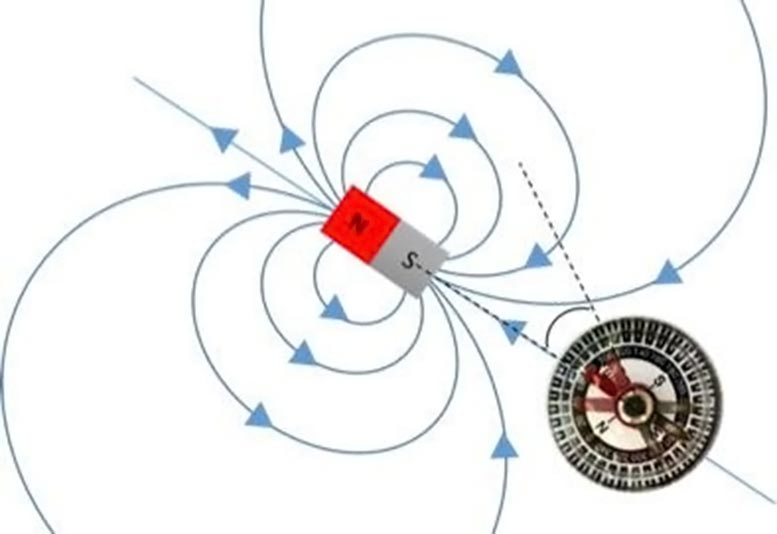
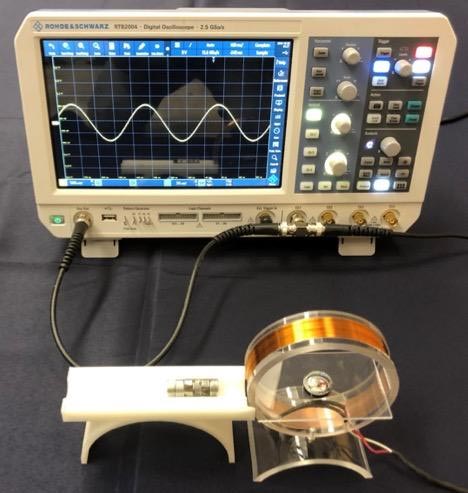
Barsukov explained the compass is placed in the middle of a wire coil that is fed with a small alternating voltage. A refrigerator magnet in the vicinity of the compass aligns its needle. When the fridge magnet is brought closer to the compass, the needle starts to oscillate at a “sweet spot.” When the magnet is moved away from the sweet spot, the oscillation stops. This oscillation corresponds to the magnetic resonance of the compass needle in the magnetic field of the fridge magnet.
“During outreach events for the broader public, people often share with us their concerns about MRI procedures they need to undergo in a hospital,” Barsukov said. “They associate it with radiation. We wanted to design a hands-on, table-top experiment to alleviate their concerns and to provide a visual explanation for the underlying physics.”
Barsukov’s team initiated a collaboration with the Physics Teacher Academy, a UCR-based program providing training for local high school teachers, to ensure it is also suitable for a high-school classroom.
“Close interaction with the teachers changed our perspective on what a good demonstration experiment aimed at improving scientific literacy should be,” Barsukov said. “We decided to employ 3D-printing techniques for the experimental setup and smartphone-based voltage generators. It reduces the time burden for instructors and makes the presentation more accessible and appealing to students.”
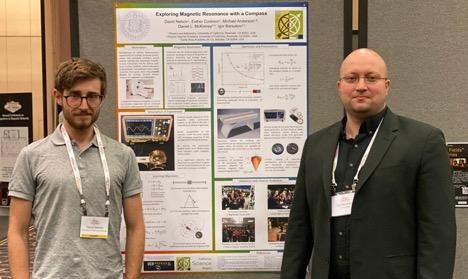
The project was recently published in The Physics Teacher and presented in early November 2019 in the educational section of Magnetism and Magnetic Materials, a major conference in magnetism research.
“The project turned out to be truly synergistic,” Barsukov said. “We learned a lot from the high school teachers we worked with and were able to design an exciting tool for outreach, which I can also use in my classes at UCR. Working on this project was a great lab experience for my students.”
Reference: “Exploring Magnetic Resonance with a Compass” by Esther Cookson, David Nelson, Michael Anderson, Daniel L. McKinney and Igor Barsukov, 26 November 2019, The Physics Teacher.
DOI: 10.1119/1.5135797
Barsukov and his students were joined in the project by Daniel L. McKinney, a local high school teacher; and Michael Anderson, an associate professor of physics education at UC Riverside.
The work was funded by the National Science Foundation. The Physics Teacher Academy is supported by the California Science Project.
Never miss a breakthrough: Join the SciTechDaily newsletter.
Follow us on Google and Google News.
1 Comment
Well, I love simple experiments, they clearly show the whole essence of the process. That’s why I recommend this https://melscience.com/US-en/physics/ experiment to all-new physics learners. Personally, it helped me a lot, I think it will help you too.