
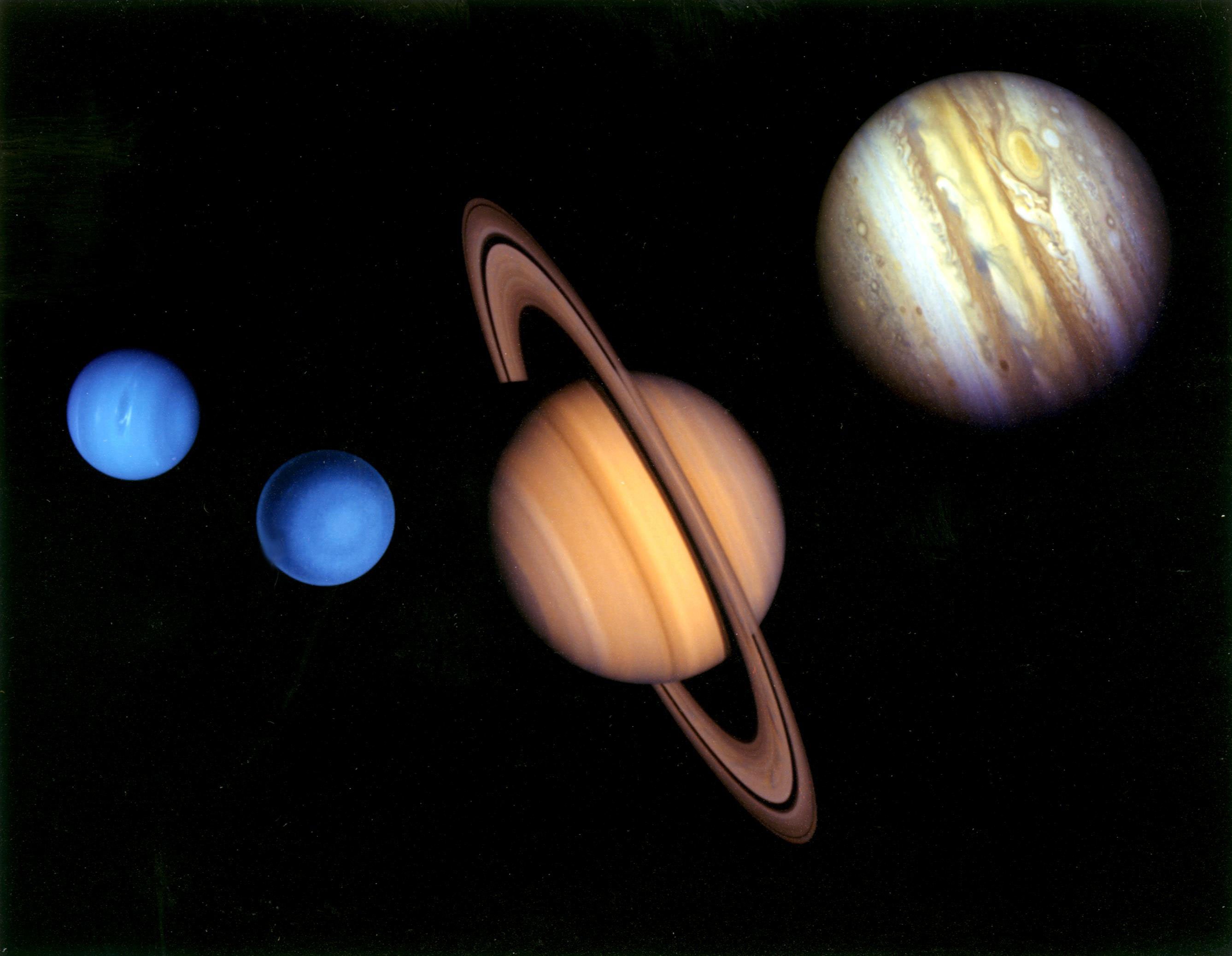
Below is a short list of the major accomplishments to date of NASA’s groundbreaking Voyager 1 and 2 Spacecraft during their 40 years of exploration.
Planetary Firsts
Launched in 1977, the Voyagers delivered many surprises and discoveries from their encounters with the gas giants of the outer solar system: Jupiter, Saturn, Uranus and Neptune. Between 1977 and 1990, the mission attained these distinctions:
- First spacecraft to fly by all four planets of the outer solar system (Voyager 2)
- First mission to discover multiple moons of the four outer planets (both spacecraft):
- 3 new moons at Jupiter
- 4 new moons at Saturn
- 11 new moons at Uranus
- 6 new moons at Neptune
- First spacecraft to fly by four different target planets (Voyager 2)
- First spacecraft to visit Uranus and Neptune (Voyager 2)
- First spacecraft to image the rings of Jupiter, Uranus and Neptune (Voyager 2)
- First spacecraft to discover active volcanoes beyond Earth (on Jupiter’s moon Io — Voyager 1)
- First spacecraft to detect lightning on a planet other than Earth (at Jupiter — Voyager 1)
- First spacecraft to find suggestions of an ocean beyond Earth (at Jupiter’s moon Europa — both spacecraft)
- First spacecraft to detect a nitrogen-rich atmosphere found beyond our home planet (at Saturn’s moon Titan — Voyager 1)
Heliophysics Firsts
After Voyager 1 departed from Saturn in November 1980, it began a journey to where no human-made object had ever gone before: the space between the stars. On August 25, 2012, it crossed over into interstellar space, leaving behind the heliosphere — the enormous magnetic bubble encompassing our Sun, planets, and solar wind. Voyager 2 set course for interstellar space after departing from Neptune in August 1989, and is expected to enter interstellar space in the next few years. Together the Voyagers have taught us a great deal about the extent of our sun’s influence and the very nature of the space that lies beyond our planets.
- First spacecraft to leave the heliosphere and enter interstellar space (Voyager 1)
- First spacecraft to measure full intensity of cosmic rays — atoms accelerated to nearly the speed of light — in interstellar space (Voyager 1)
- First spacecraft to measure magnetic field in interstellar space (Voyager 1)
- First spacecraft to measure density of interstellar medium — material ejected by ancient supernovae (Voyager 1)
- First spacecraft to measure solar wind termination shock — the boundary where solar wind charged particles slow below the speed of sound as they begin to press into the interstellar medium (Voyager 2)
Engineering and Computing Firsts and Records
The Voyagers, which launched with nearly identical configurations and instruments, were designed to withstand the harsh radiation environment of Jupiter — the greatest physical challenge they would ever encounter. Preparations for the peril at Jupiter ensured that the Voyagers would be well-equipped for the rest of their journeys, too. Engineering and computing advances that the Voyagers debuted set the stage for future missions.
- First spacecraft extensively protected against radiation, which also set the standard for radiation design margin still in use for space missions today
- First spacecraft protected against external electrostatic discharges
- First spacecraft with programmable computer-controlled attitude and articulation (which means the pointing of the spacecraft)
- First spacecraft with autonomous fault protection, able to detect its own problems and take corrective action
- First use of Reed-Solomon code for spacecraft data — an algorithm to reduce errors in data transmission and storage, which is widely used today
- First time engineers linked ground communications antennas together in an array to be able to receive more data (for Voyager 2’s Uranus encounter)
Beyond that, the Voyager spacecraft continue setting endurance and distance records:
- Longest continuously operating spacecraft (Voyager 2, which passed Pioneer 6’s record on August 13, 2012)
- Most distant spacecraft from the Sun (Voyager 1, which passed Pioneer 10’s distance on February 17, 1998 and is currently about 13 billion miles, or 21 billion kilometers, away)
The Voyager spacecraft were built by NASA’s Jet Propulsion Laboratory, Pasadena, California, which continues to operate both. JPL is a division of Caltech in Pasadena. The Voyager missions are a part of the NASA Heliophysics System Observatory, sponsored by the Heliophysics Division of the Science Mission Directorate in Washington.
Never miss a breakthrough: Join the SciTechDaily newsletter.
Follow us on Google and Google News.
1 Comment
Great Craft ! Great contribution..
The twin Voyager 1 and 2 spacecraft are exploring where nothing from Earth has flown before. Continuing on their more-than-40-year journey
Regards
Dav