

Close Menu
    Facebook X (Twitter) Instagram
    SciTechDaily
    • Biology
    • Chemistry
    • Earth
    • Health
    • Physics
    • Science
    • Space
    • Technology
    Facebook X (Twitter) Pinterest YouTube RSS
    SciTechDaily
    Home»Chemistry»Make Like a Leaf: ‘Carbon Photosynthesis’ With Nanotechnology to Convert CO2 Into Fuels
    Chemistry

    Make Like a Leaf: ‘Carbon Photosynthesis’ With Nanotechnology to Convert CO2 Into Fuels

    By University of SydneyOctober 27, 20197 Comments3 Mins Read
    Facebook Twitter Pinterest Telegram LinkedIn WhatsApp Email Reddit
    Share
    Facebook Twitter LinkedIn Pinterest Telegram Email Reddit

    Carbon Photosynthesis Artists Concept
    Researchers develop process for carbon dioxide conversion.

    University of Sydney researchers are drawing inspiration from leaves to reduce carbon emissions, using nanotechnology to develop a method for ‘carbon photosynthesis’ that they hope will one day be adopted on an industrial scale.

    Professor Jun Huang from the University of Sydney Nano Institute and the School of Chemical and Biomolecular Engineering is developing a carbon capture method that aims to go one step beyond storage, instead converting and recycling carbon dioxide (CO2) into raw materials that can be used to create fuels and chemicals.
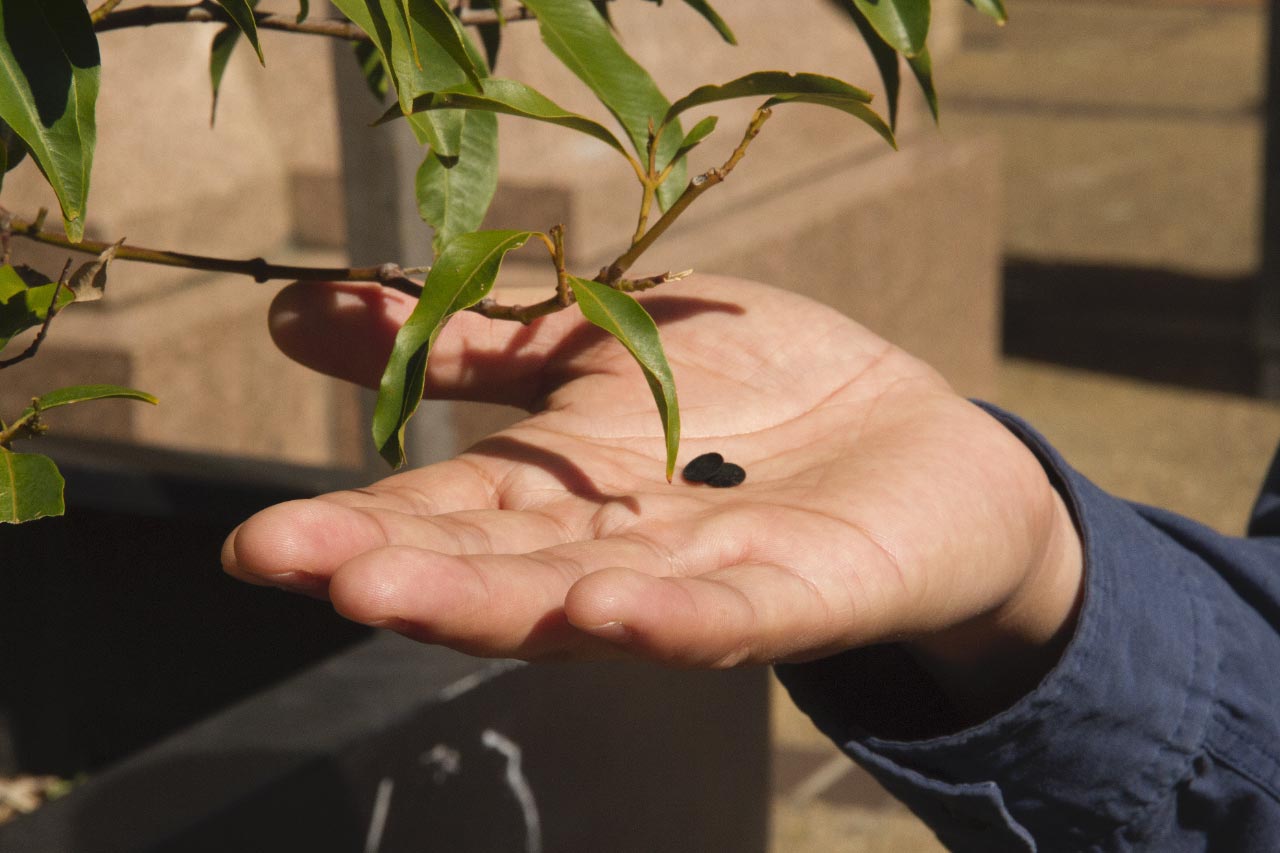
    Small Plates Capture and Convert CO2
    Professor Huang has developed small plates that capture and convert CO2 (pictured in his hand). Photo credit: Luisa Low/University of Sydney

    “Drawing inspiration from leaves and plants, we have developed an artificial photosynthesis method,” said Professor Huang.

    “To simulate photosynthesis, we have built microplates of carbon layered with carbon quantum dots with tiny pores that absorb CO2  and water.

    “Once carbon dioxide and water are absorbed, a chemical process occurs that combines both compounds and turns them into hydrocarbon, an organic compound that can be used for fuels, pharmaceuticals, agrichemicals, clothing, and construction.

    “Following our most recent findings, the next phase of our research will focus on large-scale catalyst synthesis and the design of a reactor for large-scale conversion,” he said.

    While the research has been conducted on a nanoscale, Professor Huang hopes the technology will be used by power stations to capture emissions from burning fossil fuels.

    “Our CO2 absorbent plates may be small, but our goal is to now create large panels, similar to solar panels, that would be used by industry to absorb and convert large volumes of CO2 ,” said Professor Huang.
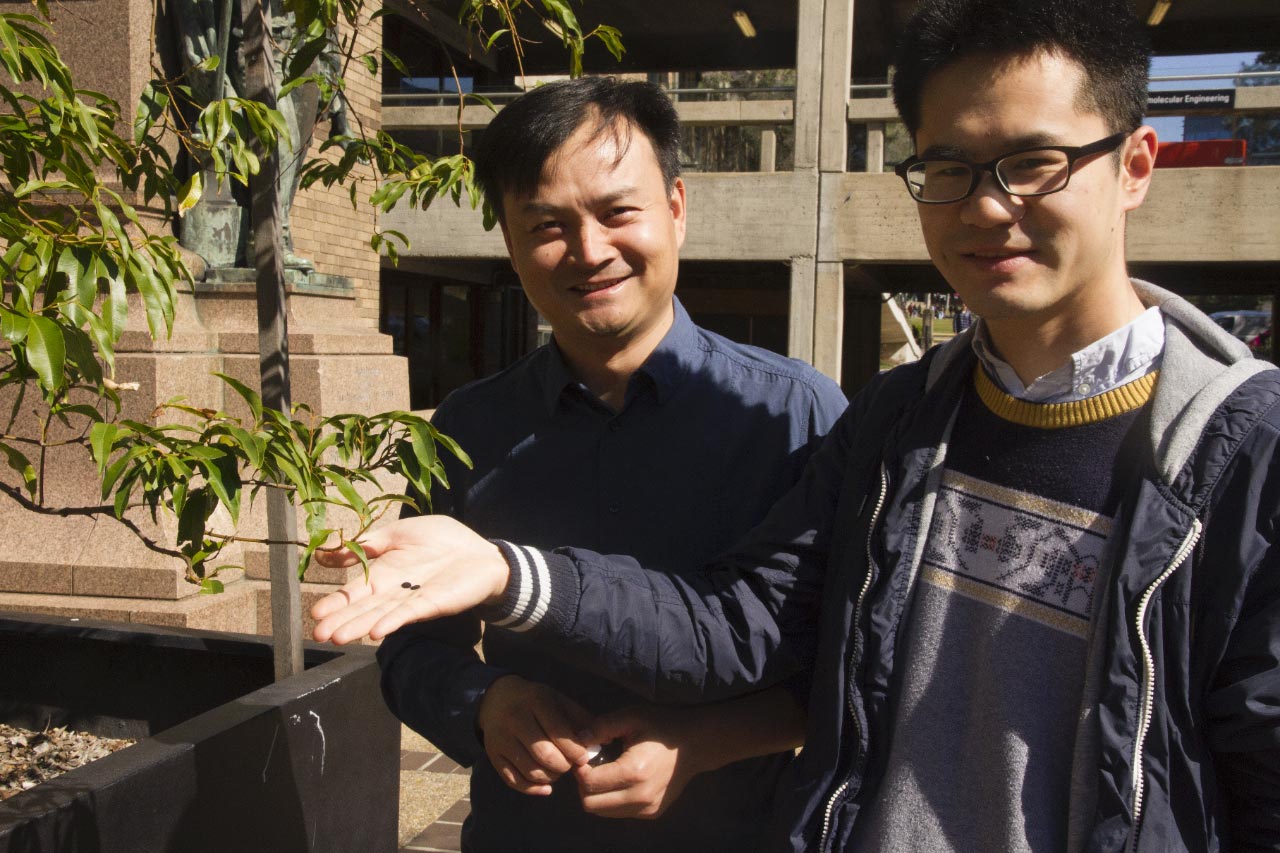
    Plants Absorb Carbon Dioxide
    Plants absorb carbon dioxide and ‘breathe’ out oxygen. Photo credit: Luisa Low/University of Sydney

    CO2 emissions from the burning of fossil fuels and transport are the main cause of global warming, contributing up to 65 percent of the total global greenhouse gas emissions.

    While plants ‘breathe’ in CO2 , a process called photosynthesis, deforestation and development have decreased their overall capacity to restore oxygen levels.

    As nations attempt to curb emissions and divest from fossil fuels, Dr. Huang feels there should also be an increased focus on carbon capture and reuse to minimize the harmful impact of increased atmospheric CO2.

    “The current global commitment to cut carbon emissions by 30 percent by 2030 is an enormous challenge, and one that will be difficult to achieve given that energy needs are accelerating,” said Professor Huang.

    Carbon capture technologies have been around for over 10 years. However, they require carbon to be held in deep underground chambers.

    “Carbon conversion could be a financially viable alternative as it would allow for the generation of industrial quantities of materials, such as methanol, which is a useful material for the production of fuels and other chemicals,” he concluded.

    DISCLOSURE

    Professor Jun Huang’s research is supported by the Australian Research Council (DP180104010, the Sydney Research Accelerator Prizes (SOAR), and the University of Sydney Nano Institute Grand Challenge program.

    The paper was authored by Dr. Haitao Li, Dr. Yadan Deng, Dr. Youdi Liu, Dr. Xin Zeng, Professor Dianne Wiley, and Professor Jun Huang.

    Reference: “Carbon quantum dots and carbon layer double protected cuprous oxide for efficient visible light CO2 reduction” by Haitao Li, Yadan Deng, Youdi Liu, Xin Zeng, Dianne Wiley and Jun Huang, 19 March 2019, Chemical Communications.
    DOI: 10.1039/C9CC00830F

    Never miss a breakthrough: Join the SciTechDaily newsletter.
    Follow us on Google and Google News.

    Carbon Dioxide Climate Change Green Energy Nanotechnology Quantum Dots University of Sydney
    Share. Facebook Twitter Pinterest LinkedIn Email Reddit

    Related Articles

    MIT Breakthrough Makes Carbon Capture 6x More Efficient

    Carbon Dioxide Reactor Synthesizes Martian Fuel

    Using Sunlight to Alleviate Global Warming: Breakthrough in Decomposing CO2 With High Efficiency

    New Material Captures Carbon Dioxide – Is Sustainable, Low-Cost & Efficient

    Researchers Find New Way to Convert Carbon Dioxide Into Usable Fuel

    New ‘Artificial Leaf’ Converts Harmful Carbon Dioxide Into Fuel

    New Material Captures Carbon Dioxide and Efficiently Converts It to Useful Organic Materials

    MIT Chemists Develop a Quantum-Dot Spectrometer

    Researchers Study Zeolite for Filtering Out Carbon Dioxide

    7 Comments

    1. amel fs on November 16, 2019 6:39 am

      nice post

      Reply
    2. amel snv on November 16, 2019 6:39 am

      beau partage

      Reply
    3. samiha_FS on November 21, 2019 12:32 am

      thanks for this publication

      Reply
    4. insaf on November 21, 2019 12:35 am

      thanks for this publication

      Reply
    5. isra on November 21, 2019 12:36 am

      thanks for this publication

      Reply
    6. ikhlas on November 21, 2019 12:38 am

      thanks for this publication

      Reply
    7. Billy James on December 10, 2019 1:45 am

      If this happens, Carbon emission, well done. Wish you luck!

      Reply
    Leave A Reply Cancel Reply

    • Facebook
    • Twitter
    • Pinterest
    • YouTube

    Don't Miss a Discovery

    Subscribe for the Latest in Science & Tech!

    Trending News

    Breakthrough Bowel Cancer Trial Leaves Patients Cancer-Free for Nearly 3 Years

    Natural Compound Shows Powerful Potential Against Rheumatoid Arthritis

    100,000-Year-Old Neanderthal Fossils in Poland Reveal Unexpected Genetic Connections

    Simple “Gut Reset” May Prevent Weight Gain After Ozempic or Wegovy

    2.8 Days to Disaster: Scientists Warn Low Earth Orbit Could Suddenly Collapse

    Common Food Compound Shows Surprising Power Against Superbugs

    5 Simple Ways To Remember More and Forget Less

    The Atomic Gap That Could Cost the Semiconductor Industry Billions

    Follow SciTechDaily
    • Facebook
    • Twitter
    • YouTube
    • Pinterest
    • Newsletter
    • RSS
    SciTech News
    • Biology News
    • Chemistry News
    • Earth News
    • Health News
    • Physics News
    • Science News
    • Space News
    • Technology News
    Recent Posts
    • After 37 Years, the World’s Longest-Running Soil Warming Experiment Uncovers a Startling Climate Secret
    • NASA Satellite Captures First-Ever High-Res View of Massive Pacific Tsunami
    • ADHD Isn’t Just a Deficit: Study Reveals Powerful Hidden Strengths
    • Scientists Uncover “Astonishing” Hidden Property of Light
    • Scientists Discover Stem Cells That Could Regrow Teeth and Bone
    Copyright © 1998 - 2026 SciTechDaily. All Rights Reserved.
    • Science News
    • About
    • Contact
    • Editorial Board
    • Privacy Policy
    • Terms of Use

    Type above and press Enter to search. Press Esc to cancel.