
Close Menu
    Facebook X (Twitter) Instagram
    SciTechDaily
    • Biology
    • Chemistry
    • Earth
    • Health
    • Physics
    • Science
    • Space
    • Technology
    Facebook X (Twitter) Pinterest YouTube RSS
    SciTechDaily
    Home»Chemistry»Making Stickier, Safer Glues From Food
    Chemistry

    Making Stickier, Safer Glues From Food

    By Purdue UniversityDecember 10, 2019No Comments3 Mins Read
    Facebook Twitter Pinterest Telegram LinkedIn WhatsApp Email Reddit
    Share
    Facebook Twitter LinkedIn Pinterest Telegram Email Reddit
    Field Inspired
    A group of scientists at Purdue University has taken inspiration from the field, kitchen and the ocean to create strong glues. Credit: Purdue University

    You cannot make glue out of a ham sandwich – but you may be able to use the components of that food to create a strong adhesive.

    That’s the thinking behind technology developed by a group of scientists at Purdue University, who have taken inspiration from the kitchen and the ocean to create strong glues. The team’s work is published in the October 8, 2019, edition of Advanced Sustainable Systems.

    “Adhesives are used in almost every consumer product that we touch each day,” said Gudrun Schmidt, an associate professor of practice in Purdue’s College of Science, who helped lead the research team. “We would love to leave this planet a better place for the future generations. It turns out creating new adhesives is one way that we will get there.”
    Purdue University Strong Adhesives
    Purdue University scientists have used food components to create high-performance, tunable adhesives that are nontoxic and degradable. Credit: Gudrun Schmidt/Purdue University

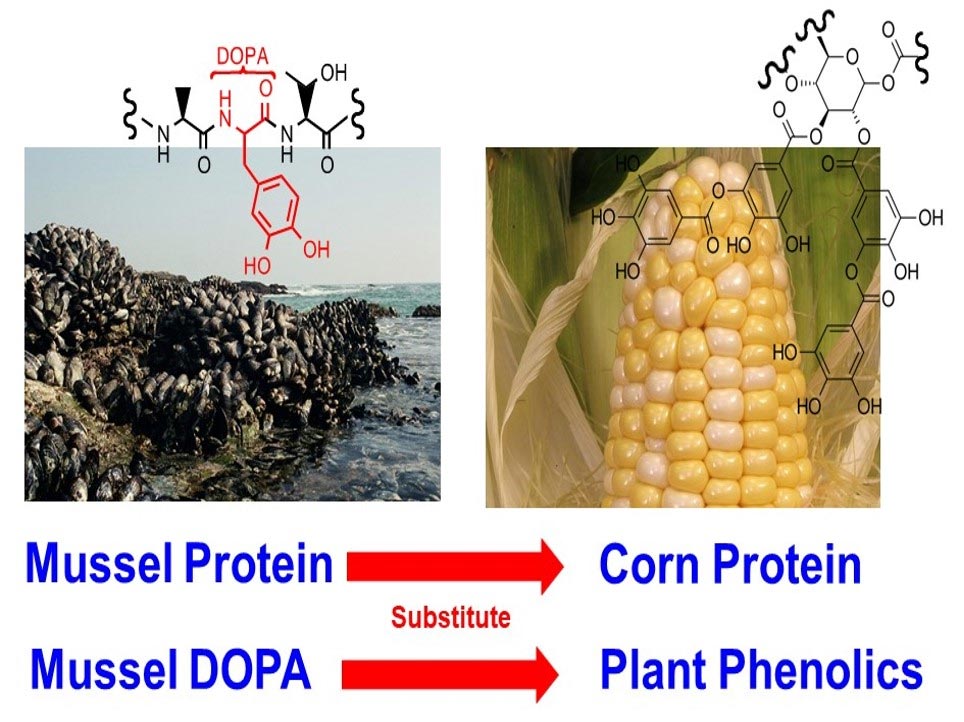
    Schmidt said almost all of the glues used in electronics and other consumer products are petroleum-derived, permanent and often toxic. The Purdue team chose compounds in foods, like nuts, fruits, and plants, all of which might have similar chemistry to the adhesives seen in shellfish that stick to rocks.

    The team included Jonathan Wilker, a Purdue professor of chemistry and materials engineering, who studies mussels and oysters to create adhesives based on how those shellfish stick to rocks.

    “We have created high-performance, tunable adhesives that are nontoxic and degradable,” Schmidt said. “We found that some combinations of zein protein and tannic acid could be reacted together in order to generate high-performance adhesives that could be alternatives to carcinogenic formaldehyde used in the glues that hold lots of furniture and other household items together. It would be a big health benefit if we could switch over to bio-based or even food-based adhesives.”

    Schmidt said other potential applications for the adhesives include cardboard packaging, cosmetics, and construction materials like plywood.

    Reference: “Strong Adhesives from Corn Protein and Tannic Acid” by Gudrun Schmidt, Jessyca T. Woods, Lawrence X.‐B. Fung, Christopher J. Gilpin, Bruce R. Hamaker and Jonathan J. Wilker, 8 October 2019, Advanced Sustainable Systems.
    DOI: 10.1002/adsu.201900077

    The researchers have worked on patenting their technologies with the Purdue Research Foundation Office of Technology Commercialization. Ongoing efforts include potential development of a startup company based upon these new adhesives.

    Never miss a breakthrough: Join the SciTechDaily newsletter.
    Follow us on Google and Google News.

    Purdue University
    Share. Facebook Twitter Pinterest LinkedIn Email Reddit

    Related Articles

    Mercury’s Mysterious Journey: Unveiling Its Secret Hideout in Mammalian Brains

    The Fountain of Life: Scientists Uncover the “Chemistry Behind the Origin of Life”

    New and Improved Cherry Flavor Thanks to the Petunia Flower

    Plant Scientists Find Recipe for Anti-Cancer Compound in Herbs Like Thyme and Oregano

    Artificial Photosynthesis Promises Clean, Sustainable Source of Energy

    AI Machine Learning Innovation to Develop Chemical Library for Drug Discovery

    New Technologies to Extract, Purify Critical Rare Earth Metals a ‘Game Changer’

    Highly Efficient Solar Cells Possible With Hybrid Perovskite Breakthrough

    Leave A Reply Cancel Reply

    • Facebook
    • Twitter
    • Pinterest
    • YouTube

    Don't Miss a Discovery

    Subscribe for the Latest in Science & Tech!

    Trending News

    The Universe Is Expanding Too Fast and Scientists Can’t Explain Why

    “Like Liquid Metal”: Scientists Create Strange Shape-Shifting Material

    Early Warning Signals of Esophageal Cancer May Be Hiding in Plain Sight

    Common Blood Pressure Drug Shows Surprising Power Against Deadly Antibiotic-Resistant Superbug

    Scientists Uncover Dangerous Connection Between Serotonin and Heart Valve Disease

    Scientists Discover a “Protector” Protein That Could Help Reverse Hair Loss

    Bone-Strengthening Discovery Could Reverse Osteoporosis

    Scientists Uncover Hidden Trigger Behind Stem Cell Aging

    Follow SciTechDaily
    • Facebook
    • Twitter
    • YouTube
    • Pinterest
    • Newsletter
    • RSS
    SciTech News
    • Biology News
    • Chemistry News
    • Earth News
    • Health News
    • Physics News
    • Science News
    • Space News
    • Technology News
    Recent Posts
    • Scientists Overcome Major Quantum Bottleneck, Potentially Transforming Teleportation and Computing
    • Quantum Physics’ Strangest Problem May Hold the Key to Time Itself
    • Scientists Create “Liquid Gears” That Spin Without Touching
    • The Simple Habit That Could Help Prevent Cancer
    • Forgotten Medicinal Plant Shows Promise in Fighting Dangerous Superbugs
    Copyright © 1998 - 2026 SciTechDaily. All Rights Reserved.
    • Science News
    • About
    • Contact
    • Editorial Board
    • Privacy Policy
    • Terms of Use

    Type above and press Enter to search. Press Esc to cancel.