
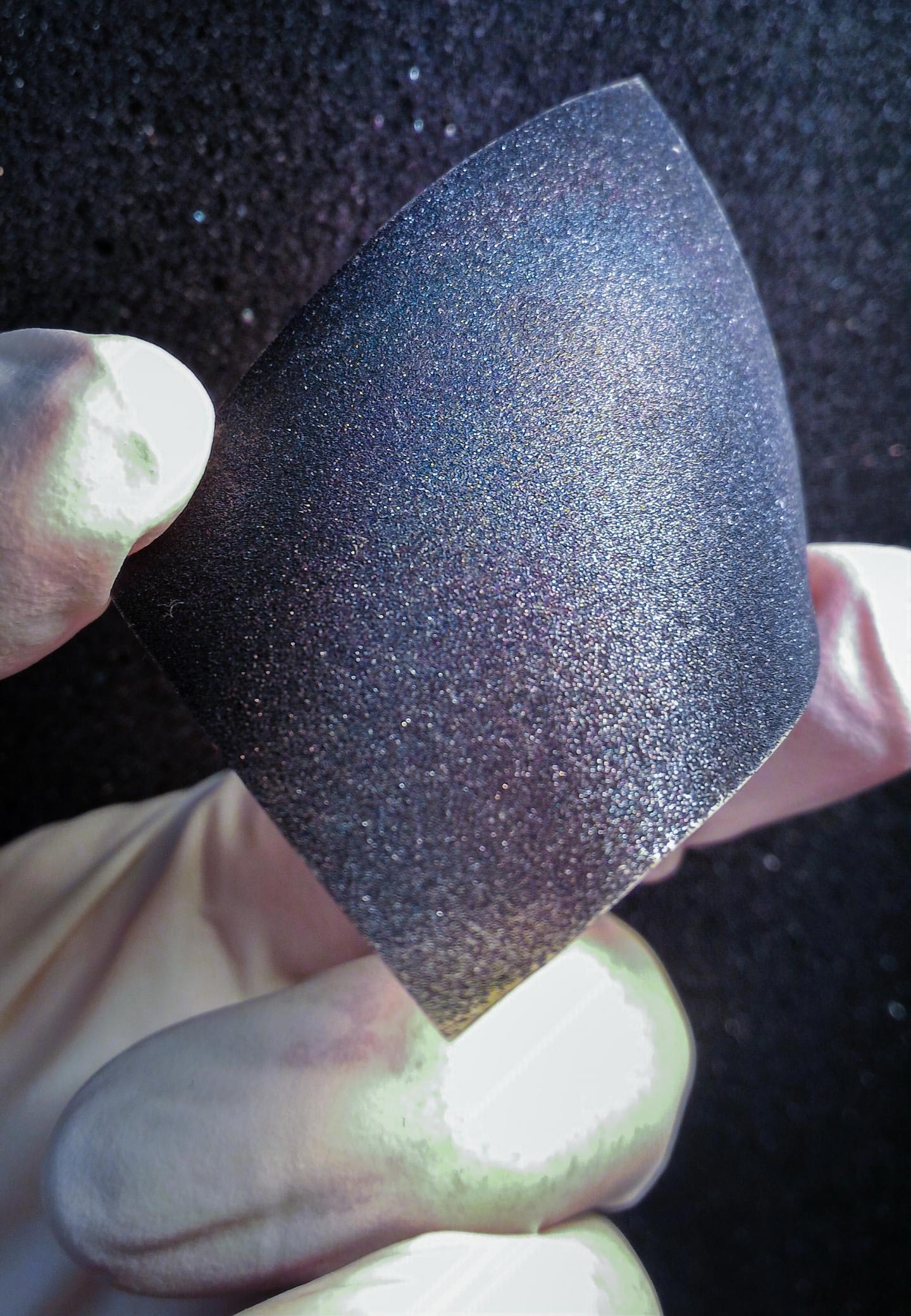
As a result of their two-year joint project, the materials researchers of Tallinn University of Technology have improved the efficiency of next generation solar cells by partial substitution of copper with silver in absorber material.
Economic development and the general growth in energy consumption have led to an increased demand for environmentally friendly energy production at lower cost. Most viable solutions can be found in the renewable energy sector. New technologies for energy production should provide clean, low cost, environmentally friendly solutions with versatile applications, making solar energy the best solution today. TalTech’s material researchers are working on the development of the next-generation photovoltaics — monograin layer solar cells.
Senior Researcher at TalTech Laboratory of Photovoltaic Materials Marit Kauk-Kuusik says, “The production of traditional silicon solar cells that started back in the 1950s is still very resource and energy consuming. Our research is focused on the development of the next generation of solar cells, i.e. thin-film solar cells based on compound semiconductors.”

A thin-film solar cell consists of several thin layers of semiconductor materials. For efficient thin-film solar cells, semiconductor with very good light-absorbing properties must be used as absorber. Silicon absorber is not suitable candidate for thin-film solar cells due to non-optimal light absorption leading to rather thick absorber layer. TalTech researchers are developing compound semiconductor materials named kesterites (Cu2ZnSn(Se,S)4), which in addition to excellent light absorption contain earth abundant and low cost chemical elements (e.g. copper, zinc, tin, sulphur and selenium). To produce kesterites, TalTech researchers use a monograin powder technology, which is unique in the world.
“The monograin powder technology we are developing differs from other similar solar cell manufacturing technologies used in the world in terms of its method. Compared to vacuum evaporation or sputtering technologies, which are widely used to produce thin-film structures, the monograin powder technology is less expensive,” Marit Kauk-Kuusik says.
Powder growth technology is the process of heating chemical components in a special chamber furnace at 750 degrees for four days. Thereafter the mass obtained is washed and sieved in special machines. The synthesized high-quality microcrystalline powder, monograin powder, is used for the production of solar cells. The powder technology differs from other production methods in particular due to its low cost, since it does not require any expensive high vacuum equipment.
The monograin powder consists of unique microcrystals that form parallel connected miniature solar cells in a large module (covered with an ultra-thin buffer layer). This, however, provides major advantages over the photovoltaic modules of the previous generation, i.e. silicon-based solar panels: the photovoltaics cells are lightweight, flexible, can be transparent, while being environmentally friendly and significantly less expensive.
The indicator of the quality of photovoltaics is the efficiency. Efficiency depends not only on the properties of the materials used and the structure of the solar cell, but also on solar radiation intensity, angle of incidence and temperature.
The ideal conditions for achieving the maximum efficiency are in cold sunny mountains, not in a hot desert, as one would expect, because heat does not improve solar cell’s efficiency. It is possible to calculate the maximum theoretical efficiency for each solar panel, which, unfortunately, has so far been impossible to achieve in reality, but it is an objective to pursue.
“We have reached the point in our development where partial replacement of copper with silver in kesterite absorber materials can increase efficiency by 2%. This is because copper is highly mobile in nature, causing unstable solar cell efficiency. The replacement of 1% copper with silver improved the efficiency of monograin layer solar cells from 6.6% to 8.7%,” Marit Kauk-Kuusik says.
The two TalTech’s groups of material researchers: photovoltaic materials and optoelectronic materials physics research groups published an article “The effect of Ag alloying of Cu2(Zn,Cd)SnS4 on the monograin powder properties and solar cell performance” in a high-quality scientific journal Journal of Materials Chemistry A.
The monograin layer solar cell technology is implemented by the Estonian-Austrian joint venture Crystalsol GmbH. In order to commercialize the photovoltaic technology developed by our researchers, the solar cell efficiency should be increased to 15%.
Reference: “The effect of Ag alloying of Cu2(Zn,Cd)SnS4 on the monograin powder properties and solar cell performance” by Kristi Timmo, Mare Altosaar, Maris Pilvet, Valdek Mikli, Maarja Grossberg, Mati Danilson, Taavi Raadik, Raavo Josepson, Jüri Krustokb and Marit Kauk-Kuusik, 8 October 2019, Journal of Materials Chemistry A.
DOI: 10.1039/C9TA07768E
Never miss a breakthrough: Join the SciTechDaily newsletter.
Follow us on Google and Google News.
1 Comment
great article!