
A New Artificial Intelligence System Reads Live Camera Footage and Adapts the Lights To Compensate
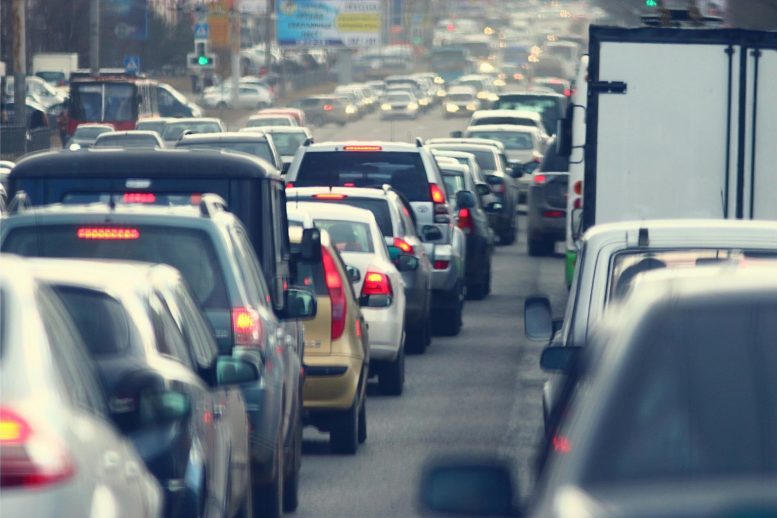
In 2014, Americans spent 6.9 billion hours trapped in traffic. During traffic jams, the average commuter used an extra 19 gallons (72 liters) of gas. This amounts to $160 billion in lost time and fuel each year.
In many big US cities, traffic may waste over 100 hours per year for the typical driver. At a typical workplace, that’s enough time to take two and a half weeks off. Fortunately, researchers are working to reduce traffic congestion, whether via the development of driverless cars or the use of artificial intelligence in traffic lights.
For example, long lines at traffic signals might be a thing of the past thanks to Aston University researchers’ new artificial intelligence technology (AI). The first-of-its-kind system scans live video footage and adjusts the lights to compensate, keeping traffic moving and decreasing congestion.
Deep Reinforcement Learning for Traffic Management
The method utilizes deep reinforcement learning, in which software recognizes when it is not doing well and attempts a new approach – or continues to improve when it is making progress. The system surpassed all other approaches in testing, which often depend on manually-designed phase transitions. Inadequate traffic signal timing is a major cause of congestion.

The researchers built a state-of-the-art photo-realistic traffic simulator, Traffic 3D, to train their program, teaching it to handle different traffic and weather scenarios. When the system was tested on a real junction, it subsequently adapted to real traffic intersections despite being trained entirely on simulations. It could therefore be effective in many real-world settings.
How the AI System Works
Dr. Maria Chli, a reader in Computer Science at Aston University, explained: “We have set this up as a traffic control game. The program gets a ‘reward’ when it gets a car through a junction. Every time a car has to wait or there’s a jam, there’s a negative reward. There’s actually no input from us; we simply control the reward system.”
At present, the main form of traffic light automation used at junctions depends on magnetic induction loops; a wire sits on the road and registers cars passing over it. The program counts that and then reacts to the data. Because the AI created by the Aston University team ‘sees’ high traffic volume before the cars have gone through the lights and makes its decision then, it is more responsive and can react more quickly.
Dr. George Vogiatzis, senior lecturer in Computer Science at Aston University, said: “The reason we have based this program on learned behaviors is so that it can understand situations it hasn’t explicitly experienced before. We’ve tested this with a physical obstacle that is causing congestion, rather than traffic light phasing, and the system still did well. As long as there is a causal link, the computer will ultimately figure out what that link is. It’s an intensely powerful system.”
The program can be set up to view any traffic junction – real or simulated – and will start learning autonomously. The reward system can be manipulated, for example, to encourage the program to let emergency vehicles through quickly. But the program always teaches itself, rather than being programmed with specific instructions.
The researchers hope to begin testing their system on real roads this year.
Reference: “Fully-Autonomous, Vision-based Traffic Signal Control: from Simulation to Reality” by Deepeka Garg, Maria Chli and George Vogiatzis, 2022, Proceedings of the 21st International Conference on Autonomous Agents and Multi-agent Systems.
PDF
Never miss a breakthrough: Join the SciTechDaily newsletter.
Follow us on Google and Google News.