
Time is running out for balancing issues of safety, integrity, and access.
Many states continue to lack the policies and preparations needed to address safety concerns of holding elections in November, despite the lessons learned in recent 2020 primary elections that were disrupted by the coronavirus pandemic, according to new research from the RAND Corporation.
Nine states have none of the policies that researchers judged as being most important to encourage safer voter participation during the 2020 elections. Meanwhile, 12 states and the District of Columbia — encompassing about one-third of registered voters in the U.S. — have embraced some form of each of the three strategies, according to the reports.
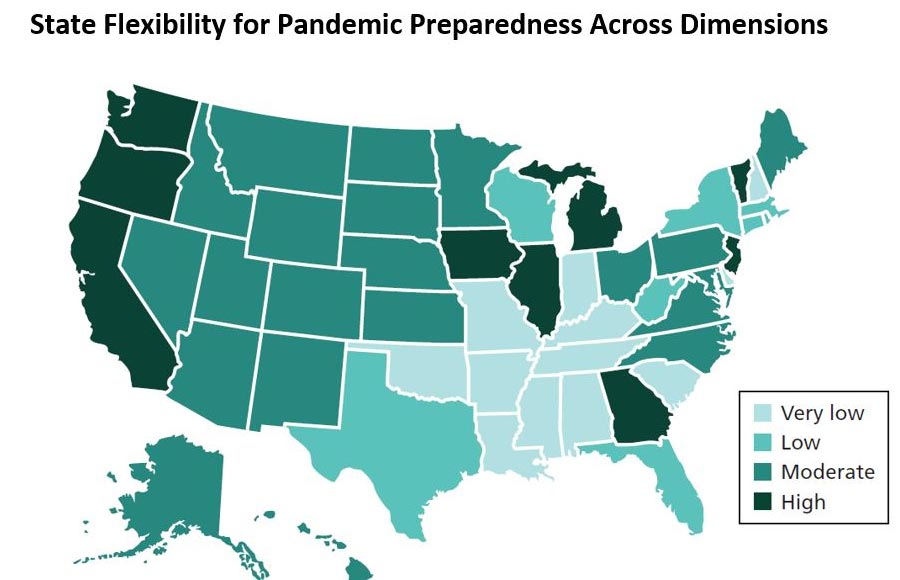
To consider whether states have the flexible policies needed to support safety measures for elections in 2020, researchers considered whether states had programs such as online registration that make registering to vote more accessible, whether states had flexible remote voting options such as vote-by-mail (without a required excuse), whether states require witness or notary signatures for mail-in ballots, and whether states had an early voting period.
Geographically, Western states generally have more flexible policies on these dimensions and so may be best positioned to address safety concerns through remote and distributed procedures, while states in the South and some in the Northeast have less-flexible policies that may make it more difficult to adapt to challenges such as the need for social distancing.
Researchers say that some of these states have begun to respond to these challenges by temporarily modifying voting processes, such as relaxing excuse requirements for absentee ballots. These temporary changes may address the near-term challenge, but will not increase longer-term resilience during similar disruptions in the future.
“The COVID-19 pandemic presents a severe threat to states’ 2020 election plans, which will have higher turnout and higher stakes since this is a presidential election year,” said Jennifer Kavanagh, co-leader of the research team and a senior political scientist at RAND, a nonprofit, nonpartisan research organization. “To be prepared to conduct elections during a pandemic, states will need registration and voting options that reduce crowds, minimize direct personal contact, and limit common access to high-touch surfaces.”
The RAND report is intended to inform state legislatures and election officials as they work to prepare for the 2020 general election and consider how to navigate the challenges created by COVID-19 by mitigating health risks and protecting the election’s legitimacy.
The COVID-19 pandemic already has disrupted elections during 2020, with officials in some states extending access to mail-in ballots and offering other accommodations during primaries.
RAND researchers assessed policies in place in all 50 states to determine where each one stands across three dimensions of the election process — remote voting, early voting, and voter registration — that can be used by state legislatures and election officials to conduct safe and secure elections despite the threat posed by the pandemic.
The project includes a report assessing efforts in all 50 states, an interactive map that allows users to quickly review a state’s election practices, and a second report that addresses in detail issues of access and integrity for each of the approaches available to increase voting safety.
Forty states have early voting options, with an additional six having a limited early voting option for those with qualifying reasons. Of this group, eight have early voting periods that extend beyond 30 days, while 13 states have early voting periods that last 16 days to 30 days.
Researchers conclude that all the options available to improve safety during the 2020 election have a low risk of threatening the integrity of balloting, although vote-by-mail options pose a slightly elevated risk compared to in-person voting.
“For some states, integrity may be the priority while others will emphasize safety,” said Quentin E. Hodgson, co-leader of the project and a senior researcher at RAND. “Ultimately the options chosen by a given state will reflect the priorities of state policymakers and elections officials, as well as the constraints of existing policies and laws.”
Researchers say states will need to act quickly to ensure in-person registration and voting is conducted safely, which will require evaluating existing registration offices and polling places for suitability to promote social distancing and sanitation, identifying new polling places, and recruiting and training poll workers.
For states planning for increased absentee ballots and vote-by-mail, they will need to purchase equipment and recruit additional workers to process a greater volume of ballots than they have done previously. The researchers found that they will also need to plan for potential delays in postal delivery of ballots and engage in a robust public communications effort to ensure voters know when and how they can register and vote this fall.
The researchers conclude that implementing online voting carries significant cybersecurity risks and is not a viable option for the 2020 election.
The reports are “An Assessment of State Voting Processes: Preparing for Elections During a Pandemic” and “Options for Ensuring Safe Elections: Preparing for Elections During a Pandemic.” They are available at http://www.
Other authors of the report are C. Ben Gibson, Samantha Cherney, Anusree Garg, Edward W. Chan and Christine Sovak.
Funding for the reports was provided by a gift from Joel and Joanne Mogy, as well as by gifts from RAND supporters and income from operations.
The project is a part of the RAND’s Truth Decay initiative, which is exploring the diminishing role of facts and analysis in American public life.
Never miss a breakthrough: Join the SciTechDaily newsletter.
Follow us on Google and Google News.