
Close Menu
    Facebook X (Twitter) Instagram
    SciTechDaily
    • Biology
    • Chemistry
    • Earth
    • Health
    • Physics
    • Science
    • Space
    • Technology
    Facebook X (Twitter) Pinterest YouTube RSS
    SciTechDaily
    Home»Earth»Mapping Intermittent Methane Emissions Across the Permian Basin – The Largest Oil- and Gas-Producing Region in the U.S.
    Earth

    Mapping Intermittent Methane Emissions Across the Permian Basin – The Largest Oil- and Gas-Producing Region in the U.S.

    By American Chemical SocietyJune 2, 2021No Comments3 Mins Read
    Facebook Twitter Pinterest Telegram LinkedIn WhatsApp Email Reddit
    Share
    Facebook Twitter LinkedIn Pinterest Telegram Email Reddit
    Flaring Methane Emissions
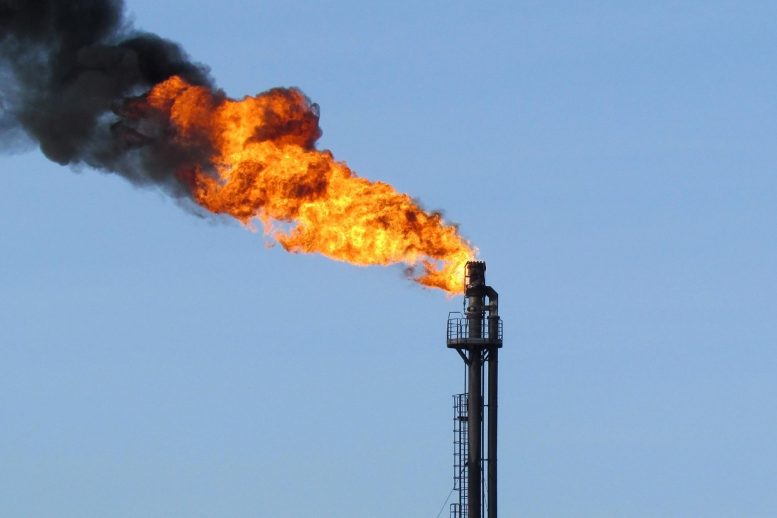
    Researchers have mapped large, intermittent sources of methane emissions (shown flaring here) across the Permian Basin.

    Aerial imaging identified 1,100 methane emitters in the Permian Basin, many of which were intermittent. However, a small fraction of persistent emitters contributed nearly 30% of emissions.

    The Permian Basin, located in western Texas and southeastern New Mexico, is the largest oil- and gas-producing region in the U.S. The oilfield operations emit methane, but quantifying the greenhouse gas is difficult because of the large area and the fact that many sources are intermittent emitters. Now, researchers reporting in ACS’ Environmental Science & Technology Letters have conducted an extensive airborne campaign with imaging spectrometers and identified large methane sources across this area.

    According to the U.S. Energy Information Administration, 38% of the nation’s total oil and 17% of natural gas production took place in the Permian Basin in 2020. Therefore, quantifying emissions from these operations, which continue to expand rapidly, is of great interest to environmental scientists. Previous studies have tried to estimate methane leakage in the Permian Basin through satellite images or mobile field studies, but either the spatial resolution was too coarse to quantify methane coming from individual sources, or the studies were limited to small areas or timeframes. So Daniel Cusworth and colleagues from the NASA Jet Propulsion Laboratory, the University of Arizona and Arizona State University formed a collaboration. They wanted to quantify strong methane point source emissions (greater than 22-44 pounds or 10-20 kilograms of methane per hour) in the Permian Basin using airborne imaging spectrometry, a technology that would allow high-resolution mapping of those sources across large areas and multiple overflights.

    From September to November 2019, the researchers conducted repeated flights in airplanes carrying imaging spectrometers, covering about 21,000 square miles (54,000 square kilometers) and 60,000 active wells in the Permian Basin. The spectrometers detected 1,100 unique large methane point sources that were sampled at least three times. Most of these sources were highly intermittent (detected 25% or fewer of the times sampled). However, sources that were routinely persistent (detected 50-100% of the time) comprised 11% of the methane emitters but 29% of the total detected emissions, possibly indicating leaking equipment that needs repair. Half of the detected methane came from oil and gas production wells, 38% from pipelines and other equipment used to collect and transport oil and gas, and 12% from processing plants.

    These results show that frequent, high-resolution monitoring is necessary to understand intermittent methane emitters across large areas and to pinpoint persistent leaks for mitigation, the researchers say.

    Reference: “Intermittency of Large Methane Emitters in the Permian Basin” by Daniel H. Cusworth, Riley M. Duren, Andrew K. Thorpe, Winston Olson-Duvall, Joseph Heckler, John W. Chapman, Michael L. Eastwood, Mark C. Helmlinger, Robert O. Green, Gregory P. Asner, Philip E. Dennison and Charles E. Miller, 2 June 2021, Environmental Science & Technology Letters.
    DOI: 10.1021/acs.estlett.1c00173

    The authors acknowledge funding from NASA, the University of Arizona, Carbon Mapper Inc. and the High Tide Foundation.

    Never miss a breakthrough: Join the SciTechDaily newsletter.
    Follow us on Google and Google News.

    American Chemical Society Atmospheric Science Energy Methane Pollution
    Share. Facebook Twitter Pinterest LinkedIn Email Reddit

    Related Articles

    Concerning – New Detection Method Uncovers Massive Amount of Methane

    You and Your 27 Friends Will Kill Someone – Premature Deaths Caused by Consumption

    Ozone Pollution Has Increased in Antarctica – From Both Natural and Human Sources

    Catalytic Converter Theft Is on the Rise – Here’s Why

    Methane Emissions From Oil and Natural Gas Production Higher Than Previously Thought

    Shuttering Fossil Fuel Power Plants by 2035 May Cost Less Than Expected

    Brown Carbon “Tarballs” Detected in Himalayan Atmosphere – May Accelerate Melting of Glaciers

    New Technique to Capture CO2 More Efficiently Could Reduce Power Plant Greenhouse Gases

    Mapping Methane Emissions on a Global Scale

    Leave A Reply Cancel Reply

    • Facebook
    • Twitter
    • Pinterest
    • YouTube

    Don't Miss a Discovery

    Subscribe for the Latest in Science & Tech!

    Trending News

    Black Hole Shredded a Massive Star in the Most Powerful Stellar Explosion Ever Seen

    Building the Brain Requires Millions of Dangerous DNA Breaks

    Endless Supply of Cancer-Fighting Immune Cells Unlocked by USC Scientists

    XRISM Reveals Galaxy-Shaping Winds Erupting From a Supermassive Black Hole

    New Molecule Restores the Brain’s Natural Defenses Against Alzheimer’s

    Could Creatine Boost More Than Muscles? It May Also Help Depression

    Scientists Discover a Natural Molecule That Could Help Prevent Vision Loss

    Scientists Thought Royal Jelly Made Queen Bees. They Were Wrong

    Follow SciTechDaily
    • Facebook
    • Twitter
    • YouTube
    • Pinterest
    • Newsletter
    • RSS
    SciTech News
    • Biology News
    • Chemistry News
    • Earth News
    • Health News
    • Physics News
    • Science News
    • Space News
    • Technology News
    Recent Posts
    • Neanderthals Nearly Vanished 75,000 Years Ago – Then One Group Repopulated Europe
    • AI Detects Hidden Warning Signs Before Major Earthquakes
    • Quantum Mechanics May Not Need Imaginary Numbers After All
    • Scientists Have Found Evidence That Dark Matter May Not Be Playing by the Rules
    • Could Invisible Planet Flybys Have Triggered Earth’s Mass Extinctions?
    Copyright © 1998 - 2026 SciTechDaily. All Rights Reserved.
    • Science News
    • About
    • Contact
    • Editorial Board
    • Privacy Policy
    • Terms of Use

    Type above and press Enter to search. Press Esc to cancel.