
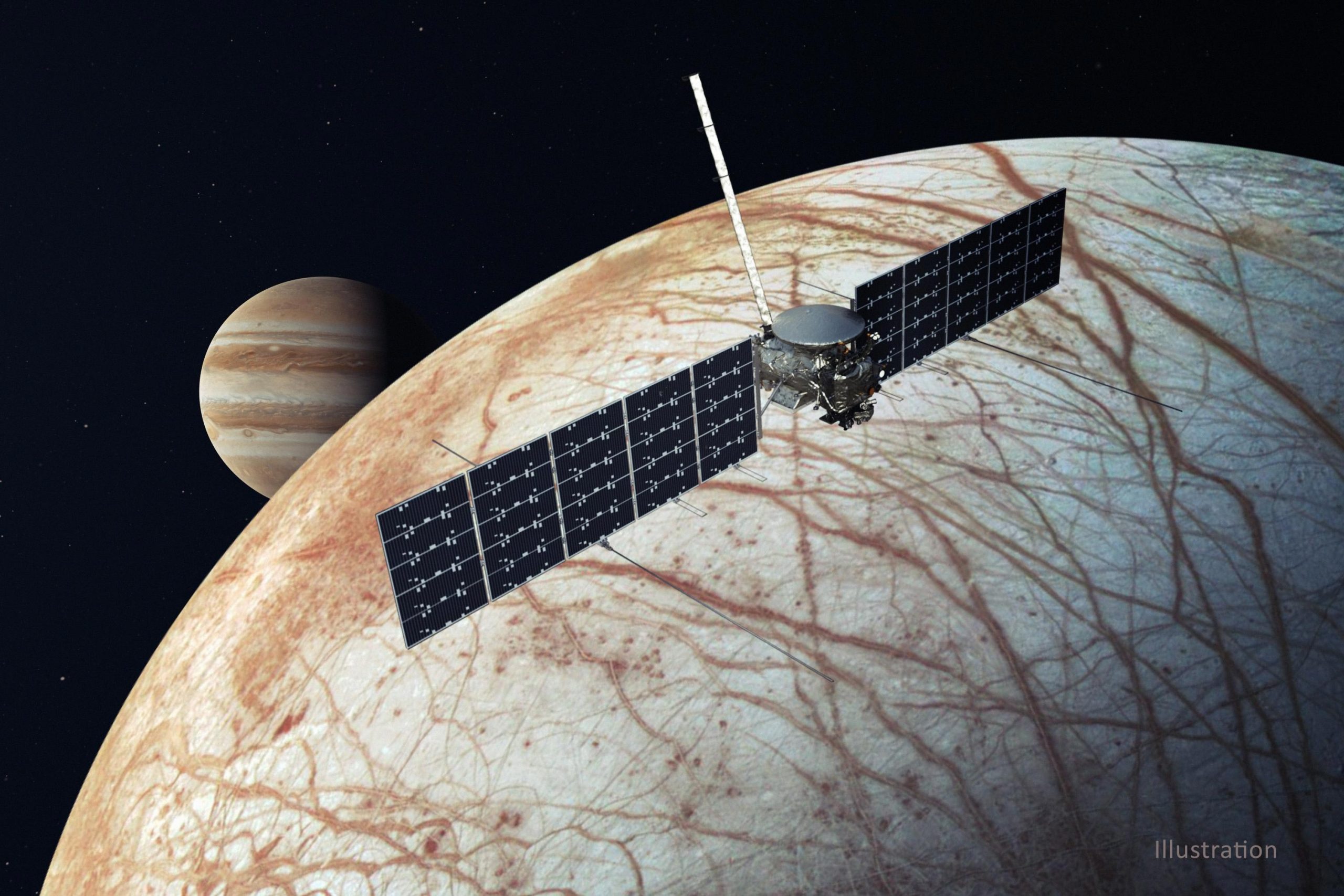
Scientists simulated deep space to study amorphous ice, aiding the Europa Clipper mission in evaluating potential life on Europa.
The search for life beyond Earth typically focuses on first looking for water, the basis for life as we know it. Whether the water is a gas, liquid, or solid, its presence and composition can tell researchers a lot about the planet, moon, comet, or asteroid on which it is detected and whether it could support life.
Because interstellar space is so cold and is primarily a vacuum, the water we detect from Earth is usually in the form of amorphous ice, meaning its atomic structure is not arranged neatly into a crystalline lattice like ice on Earth. How the transition between the crystalline and amorphous ice phases occurs on icy bodies like Europa or on Kuiper Belt Objects beyond Pluto, is difficult to study—unless you can mimic the cold, dark vacuum of outer space, under intense radiation, in a laboratory.
Creating and Studying Amorphous Ice
That’s exactly what scientists from the US Department of Energy’s (DOE’s) Oak Ridge National Laboratory (ORNL) and NASA’s Jet Propulsion Laboratory in Pasadena, California, are working on at the ORNL Spallation Neutron Source (SNS). They lowered the temperature of a single crystal sapphire plate to 25 K (about minus 414° F), placed it in a vacuum chamber, and added just a few molecules at a time of water–in this case, heavy water (D2O)–to the plate. Then they observed how the ice structure changed with varying temperature before it finally formed crystalline ice. The team next plans to simulate the solar system’s icy bodies by bombarding the sample with electron radiation to determine how this influences the ice structure.
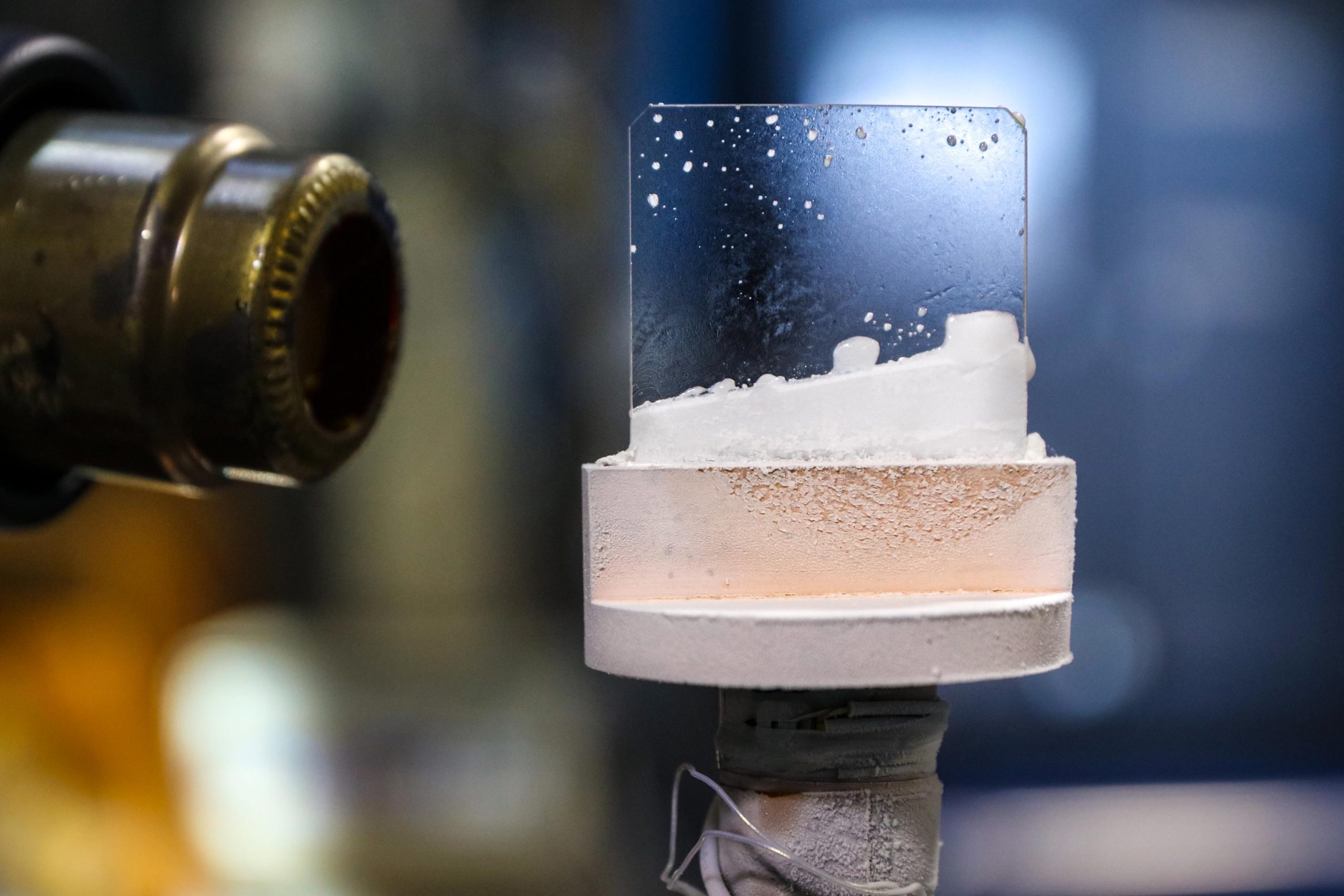
“The experiment produced a layer of amorphous ice similar to the ice that makes up most of the water throughout the universe,” said Chris Tulk, ORNL neutron scattering scientist. “This is the same type of ice that could have formed on the extremely cold permanently shadowed regions of the Moon, on the polar regions of Jupiter’s moon Europa, and within the material between the stars in our galaxy, known as dense molecular clouds. Although much of the ice has by now probably crystallized on the warmer bodies, the fresh ice on colder bodies and in deep space is likely still amorphous.”
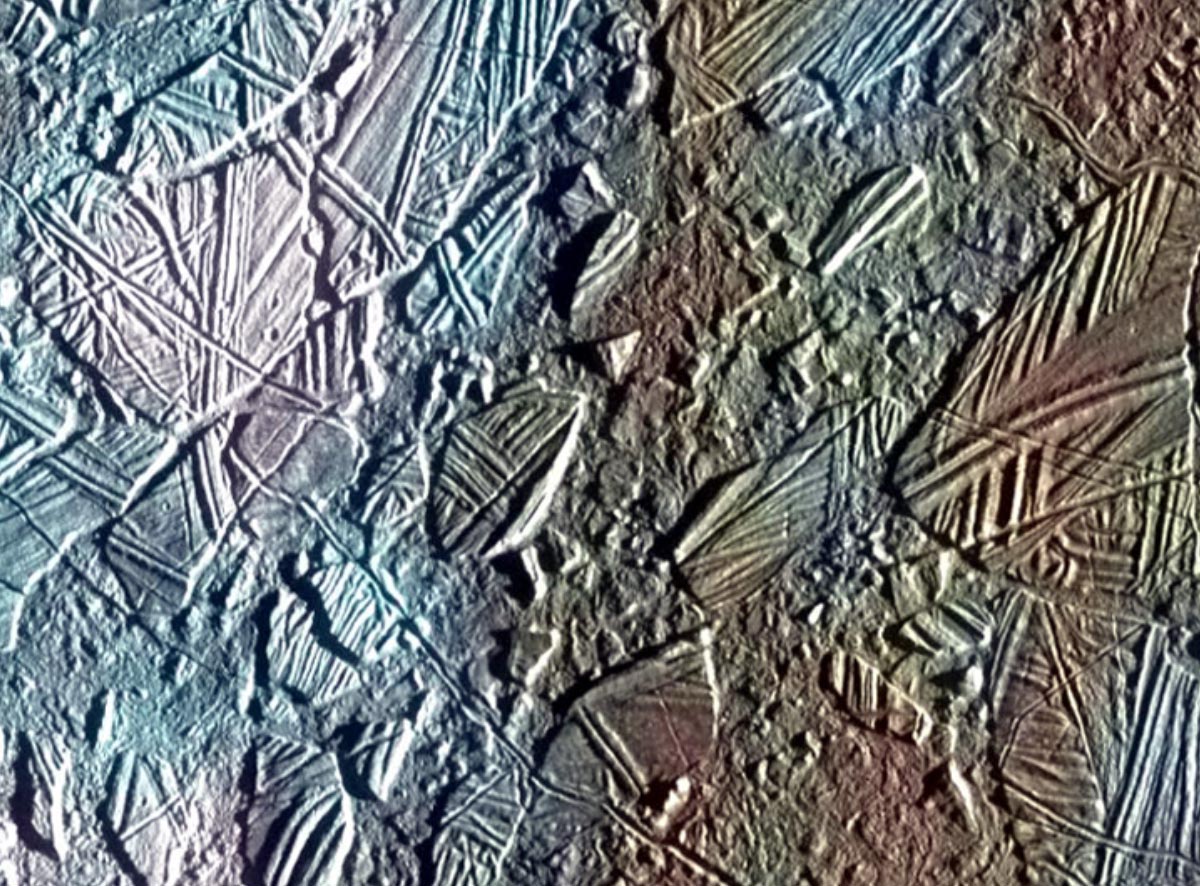
The scientists hope to answer questions such as how much of the ice on the surface of Europa, Jupiter’s second smallest moon, could be amorphous ice as a result of the surface being irradiated by charged particles produced by Jupiter’s magnetic field.
“This information could help us better interpret the science data from the Europa Clipper spacecraft and also provide some clues about how water ice evolves in various parts of the Universe,” said Murthy Gudipati, senior research scientist at JPL. “With a launch date planned for 2024, the goal of the Europa Clipper mission is to assess Europa’s habitability by studying its atmosphere, surface, and interior, including liquid water beneath the icy crust that could potentially support life.”
Neutron Scattering Opens New Ice Frontiers
The team’s initial experiments were performed on the Spallation Neutrons and Pressure (SNAP) diffractometer at SNS, an instrument typically used for high-pressure experiments, but which the scientists configured to mimic the low-pressure, extreme cold and high radiation environment of space. Future experiments will employ inelastic neutron scattering on the VISION instrument to study the dynamics of the amorphous ice as it forms. The experiments will also employ electron bombardment to study the changes in these exotic ice forms in a space radiation environment.
The research is supported by the DOE’s Office of Science and NASA’s Jet Propulsion Laboratory’s internal funding.
This research is partly carried out at the Jet Propulsion Laboratory, California Institute of Technology, under a contract with the National Aeronautics and Space Administration.
SNS is a DOE Office of Science user facility. UT-Battelle LLC manages ORNL for the DOE Office of Science. The Office of Science is the single largest supporter of basic research in the physical sciences in the United States and is working to address some of the most pressing challenges of our time.
Never miss a breakthrough: Join the SciTechDaily newsletter.
Follow us on Google and Google News.
4 Comments
If other planets have ice cream, I am there
Of course silly goose, The North Pole sells it year round. And it’s not from Earth lol
So instead of creating a cure for deadly illnesses, looking into a better way to detect astroids about to fling to earth, instead of creating something that advances us as a human race, they created “space” ice…🙄
It’s probably ice-9.