
Close Menu
    Facebook X (Twitter) Instagram
    SciTechDaily
    • Biology
    • Chemistry
    • Earth
    • Health
    • Physics
    • Science
    • Space
    • Technology
    Facebook X (Twitter) Pinterest YouTube RSS
    SciTechDaily
    Home»Technology»Cellular Computing: “Logic Gate” Paves Way for Nanoscale Computers To Treat Cancer and Other Diseases
    Technology

    Cellular Computing: “Logic Gate” Paves Way for Nanoscale Computers To Treat Cancer and Other Diseases

    By Penn State UniversityNovember 16, 2021No Comments4 Mins Read
    Facebook Twitter Pinterest Telegram LinkedIn WhatsApp Email Reddit
    Share
    Facebook Twitter LinkedIn Pinterest Telegram Email Reddit
    Nano Computing Agent
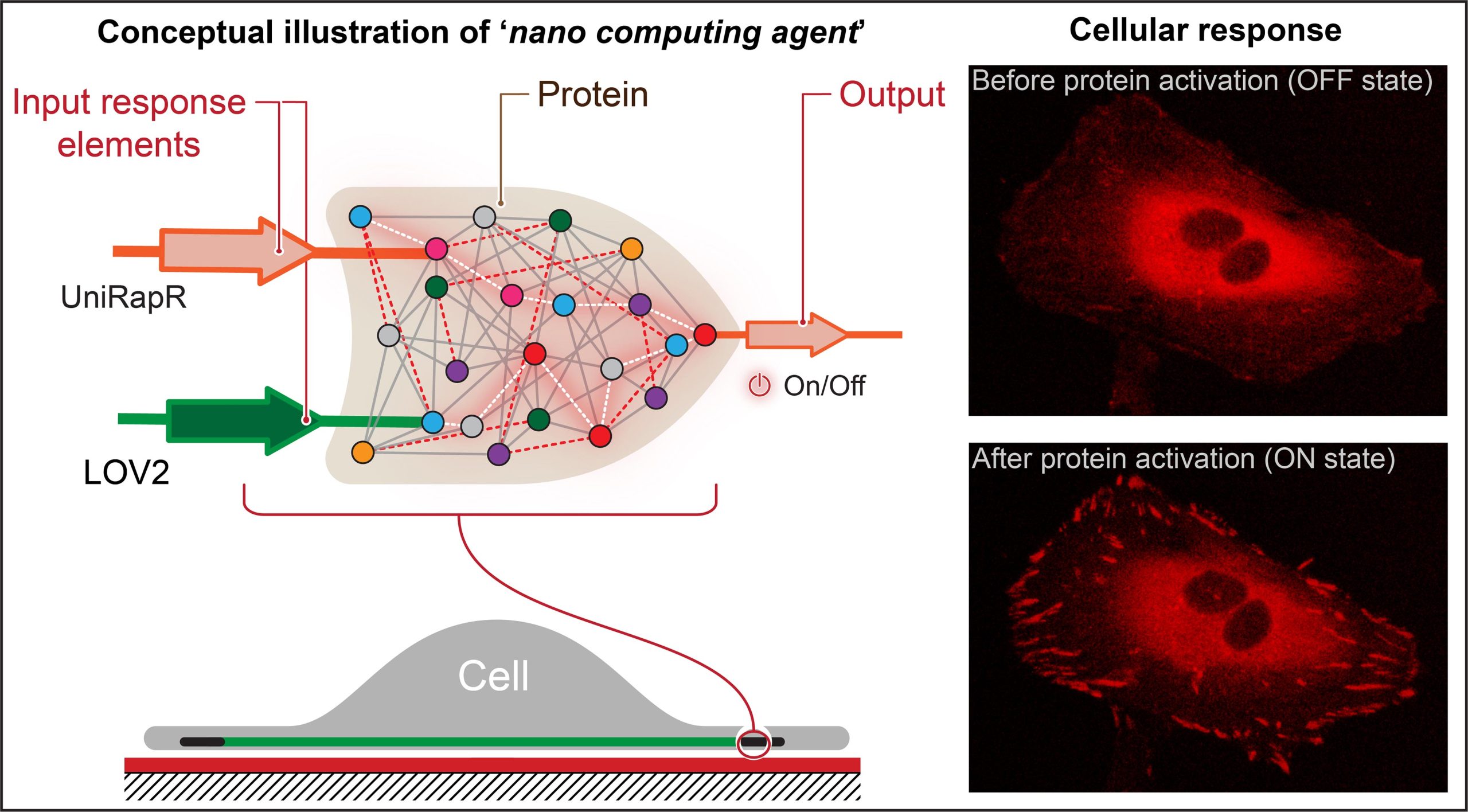
    Researchers created a transistor-like ‘logic gate,’ which is a type of computational operation in which multiple inputs control an output, and embedded it into a protein. They found that not only could they rapidly activate the protein using light and the drug rapamycin, but also that this activation resulted in the cells undergoing internal changes that enhanced their adhesive capabilities, which ultimately decreased their motility. Credit: Penn State

    Scientists built the first cellular nanocomputer, controlling cancer-linked protein activity with light and drugs.

    The creation of nanoscale computers for use in precision health care has long been a dream of many scientists and health care providers. Now, for the first time, researchers at Penn State have produced a nanocomputing agent that can control the function of a particular protein that is involved in cell movement and cancer metastasis. The research paves the way for the construction of complex nanoscale computers for the prevention and treatment of cancer and other diseases.

    Embedding Logic Gates Into Proteins

    Nikolay Dokholyan, G. Thomas Passananti Professor, Penn State College of Medicine, and his colleagues — including Yashavantha Vishweshwaraiah, postdoctoral scholar in pharmacology, Penn State — created a transistor-like ‘logic gate,’ which is a type of computational operation in which multiple inputs control an output.

    “Our logic gate is just the beginning of what you could call cellular computing,” he said, “but it is a major milestone because it demonstrates the ability to embed conditional operations in a protein and control its function, said Dokholyan. “It will allow us to gain a deeper understanding of human biology and disease and introduces possibilities for the development of precision therapeutics.”

    The team’s logic gate comprised two sensor domains designed to respond to two inputs — light and the drug rapamycin. The team targeted the protein focal adhesion kinase (FAK) because it is involved in cell adhesion and movement, which are initial steps in the development of metastatic cancer.

    Targeting Cancer-Linked Protein FAK

    “First, we introduced a rapamycin-sensitive domain, called uniRapr, which the lab had previously designed and studied, into the gene that encodes FAK,” said Vishweshwaraiah. “Next, we introduced the domain, LOV2, which is sensitive to light. Once we optimized both domains, we combined them into one final logic-gate design.”

    The team inserted the modified gene into HeLa cancer cells and, using confocal microscopy, observed the cells in vitro. They studied the effects of each of the inputs separately, as well as the combined effects of the inputs, on the cells’ behavior.

    They discovered that not only could they rapidly activate FAK using light and rapamycin, but also that this activation resulted in the cells undergoing internal changes that enhanced their adhesive capabilities, which ultimately decreased their motility.

    Their results were published today (November 16, 2021) in the journal Nature Communications.

    A Milestone for Cellular Nanocomputing

    “We show for the first time that we can build a functioning nanocomputing agent within living cells that can control cell behavior,” said Vishweshwaraiah. “We also discovered some interesting features of the FAK protein, such as the changes it triggers in cells when it is activated.”

    Dokholyan noted that the team hopes to eventually test these nanocomputing agents in vivo within living organisms.

    Reference: “Two-input protein logic gate for computation in living cells” by Yashavantha L. Vishweshwaraiah, Jiaxing Chen, Venkat R. Chirasani, Erdem D. Tabdanov and Nikolay V. Dokholyan, 16 November 2021, Nature Communications.
    DOI: 10.1038/s41467-021-26937-x

    Other Penn State authors on the paper include Jiaxing Chen, graduate student; Venkat R. Chirasani, postdoctoral fellow; and Erdem D. Tabdanov, assistant professor of pharmacology.

    The National Institutes of Health and the Passan Foundation supported this research.

    Never miss a breakthrough: Join the SciTechDaily newsletter.
    Follow us on Google and Google News.

    Biotechnology Nanotechnology Penn State University
    Share. Facebook Twitter Pinterest LinkedIn Email Reddit

    Related Articles

    Programmable Biofilm-Based Materials That Self-Assemble

    A*STAR Researchers Develop High-Capacity Method to Purify Monoclonal Antibodies

    Scientists Develop Artificial Cilia

    Scientists Develop Super-Stretchable Yarn Made of Graphene

    Researchers Use Sound Waves to Precisely Position Nanowires

    Nanoparticle Triggers Chemical Reaction that Generates Hydrogen from Water

    Triangular Layers of Tungsten Disulfide May Have Applications in Optical Technology

    New Class of Synthetic Vaccines Piggyback on 3-D DNA Nanostructures

    Nanosponges May Help With Environmental Cleanup

    Leave A Reply Cancel Reply

    • Facebook
    • Twitter
    • Pinterest
    • YouTube

    Don't Miss a Discovery

    Subscribe for the Latest in Science & Tech!

    Trending News

    Scientists Discover How Coffee Impacts Memory, Mood, and Gut Health

    Why Did the Neanderthals Disappear? Scientists Reveal Humans Had a Hidden Advantage

    Physicists Propose Strange Experiment Where Time Goes Quantum

    Magnesium Magic: New Drug Melts Fat Even on a High-Fat, High-Sugar Diet

    Weight-Loss Drugs Like Ozempic May Come With an Unexpected Cost

    Mezcal “Worm” in a Bottle Mystery: DNA Testing Reveals a Surprise

    New Research Reveals That Your Morning Coffee Activates an Ancient Longevity Switch

    This Is What Makes You Irresistible to Mosquitoes

    Follow SciTechDaily
    • Facebook
    • Twitter
    • YouTube
    • Pinterest
    • Newsletter
    • RSS
    SciTech News
    • Biology News
    • Chemistry News
    • Earth News
    • Health News
    • Physics News
    • Science News
    • Space News
    • Technology News
    Recent Posts
    • Harvard Scientists Reveal Secret Structure Behind How You Smell
    • Scientists Just Discovered the Hidden Trick That Keeps Your Cells Alive
    • This Simple Movement Could Be Secretly Cleaning Your Brain
    • Male Birth Control Breakthrough: Scientists Find Way To Turn Sperm Production Off and Back On
    • A Common Vitamin Could Hold the Key to Treating Fatty Liver Disease
    Copyright © 1998 - 2026 SciTechDaily. All Rights Reserved.
    • Science News
    • About
    • Contact
    • Editorial Board
    • Privacy Policy
    • Terms of Use

    Type above and press Enter to search. Press Esc to cancel.