
What3words maps locations using unique three-word combinations, and this method is also being adapted for secure password creation.
It’s difficult to imagine that three random words have the power to both map the globe and protect your private data. The secret behind this amazing power is just a little bit of math.
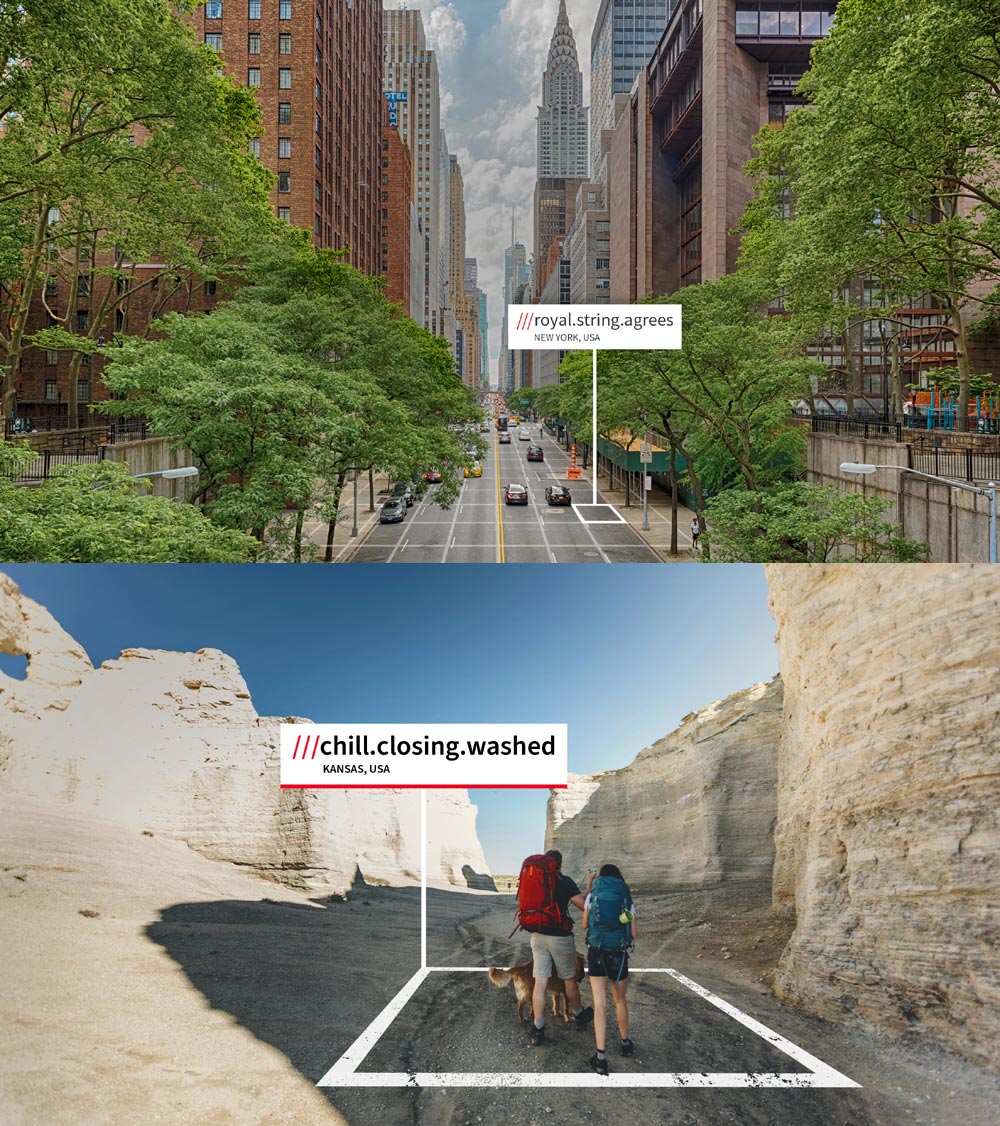
What3words is an app and web-based service that provides a geographic reference for every 3-meter-by-3-meter square on Earth using three random words. If your brain operates more naturally in the Imperial measurement system, 3 meters is about 9.8 feet. So, you could think of them as approximately 10-foot-by-10-foot squares, which is about the size of a small home office or bedroom. As an example, there’s a square in the middle of the Rochester Institute of Technology Tigers Turf Field coded to brilliance.bronze.inputs.
This new approach to geocoding is quite useful for several reasons. First, it’s more precise than regular street addresses. In addition, three words are easier for humans to remember and communicate to one another than, say, detailed latitude and longitude measurements. Because of this, the system is well suited for emergency services. With these advantages, some car manufacturers are even starting to integrate what3words into their navigation systems.
Ordered Triples
Here’s how three random words in English or any other language can identify such precise locations across the entire planet. The key concept is ordered triples.
Start with the basic assumption that the Earth is a sphere, recognizing that this is an approximate truth, and that its radius is approximately 3,959 miles (6,371 kilometers). To compute the surface area of the Earth, use the formula 4πr2. With r = 3,959 (6,371), this works out to approximately 197 million square miles (510 million square kilometers). Remember: What3words is using 3-meter-by-3-meter squares, each of which contains 9 square meters of surface area. Therefore, working in the metric system, Earth’s surface area is equivalent to 510 trillion square meters. Dividing 510 trillion by 9 reveals that uniquely identifying each square on Earth requires around 57 trillion ordered triples of three random words.
An ordered triple is just a list of three things in which the order matters. So “brilliance.bronze.inputs” would be considered a different ordered triple than “bronze.brilliance.inputs.” In fact, in the what3words system, bronze.brilliance.inputs is in fact on a mountain in Alaska, not in the middle of the RIT Tigers Turf Field, like brilliance.bronze.inputs.
Finding out how many words are used in a language and whether there are enough ordered triples to map the entire world are the next steps. According to some scholars, there are more than a million English words. However, many of them are very rare. Yet even using only common English words, there are still plenty to go around. Many word lists are available online.
The developers at what3words came up with a list of 40,000 English words. (The what3words system works in 50 different languages with independently assigned words.) The next question is determining how many ordered triples of three random words can be made from a list of 40,000 words. If you allow repeats, as what3words does, it is quite straightforward: there would be 40,000 possibilities for the first word, 40,000 possibilities for the second word, and 40,000 possibilities for the third word. The number of possible ordered triples would therefore be 40,000 times 40,000 times 40,000, which is 64 trillion. That provides plenty of “three random word” triples to cover the globe. The excess combinations also allow them to eliminate offensive words and words that would be easily confused for one another.
Passwords You Can Actually Remember
While the power of three random words is being used to map the Earth, the U.K. National Cyber Security Center (NCSC) is also championing their use as passwords. Password selection and related security analysis are more complicated than attaching three words to small squares of the globe. However, a similar calculation is illuminating. If you string together an ordered triple of words – such as brilliancebronzeinputs – you get a nice long password that a human should be able to remember far more easily than a random string of letters, numbers, and special characters designed to meet a set of complexity rules.
If you increase your word list beyond 40,000, you’ll get even more possible passwords. Using the “Corncob list” of 58,000 English words, you could generate more than 195 trillion “three random word”-style passwords.
It’s important to note that there are numerous trade-offs among the different approaches to password selection and complexity rules. So, while “three random words” doesn’t give you a fail-safe for password security, the complexity of language does provide some incredible power in this realm as well.
Written by Mary Lynn Reed, Professor of Mathematics, Rochester Institute of Technology.
This article was first published in The Conversation.
Never miss a breakthrough: Join the SciTechDaily newsletter.
Follow us on Google and Google News.
1 Comment
<<>>