
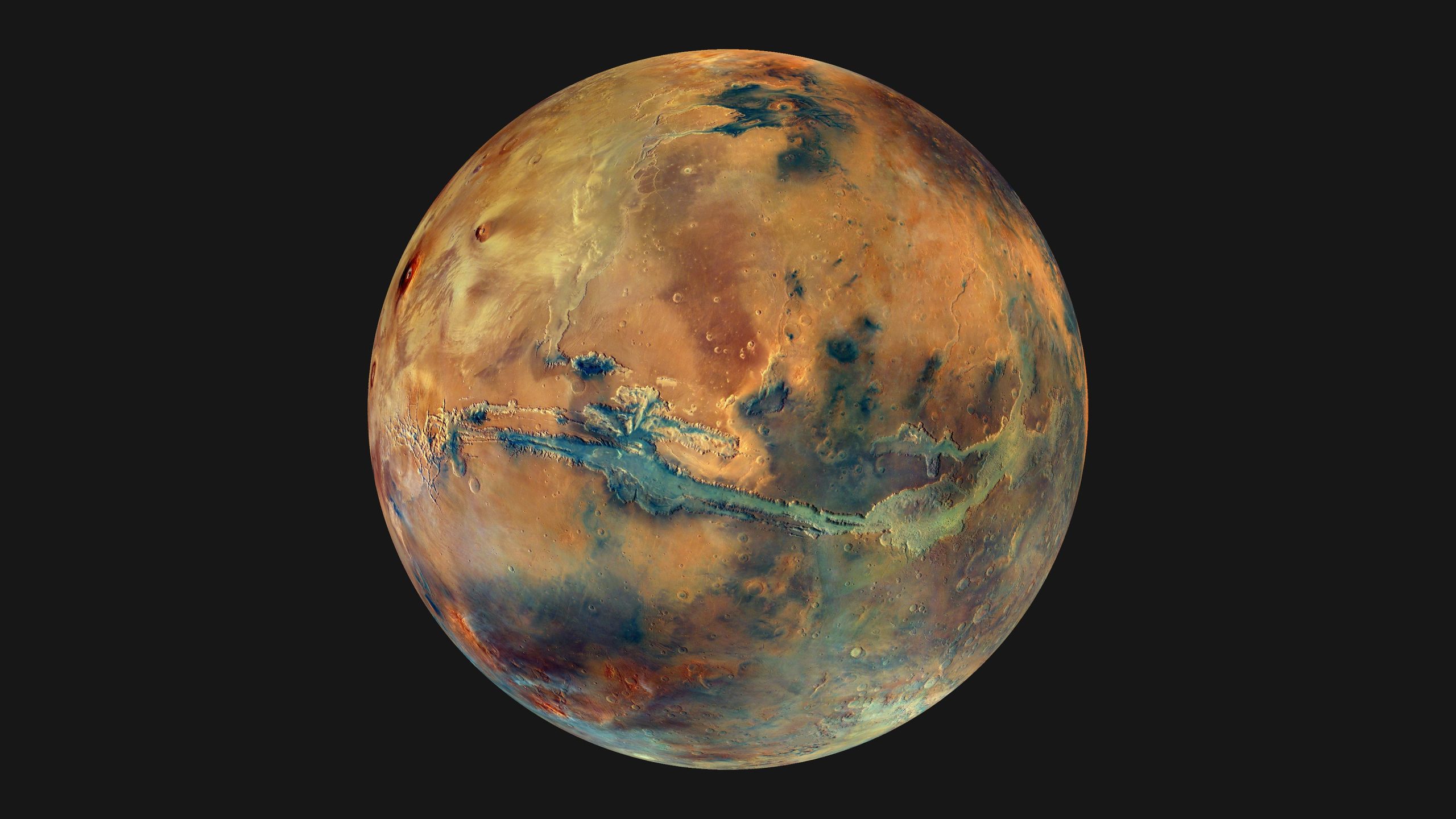
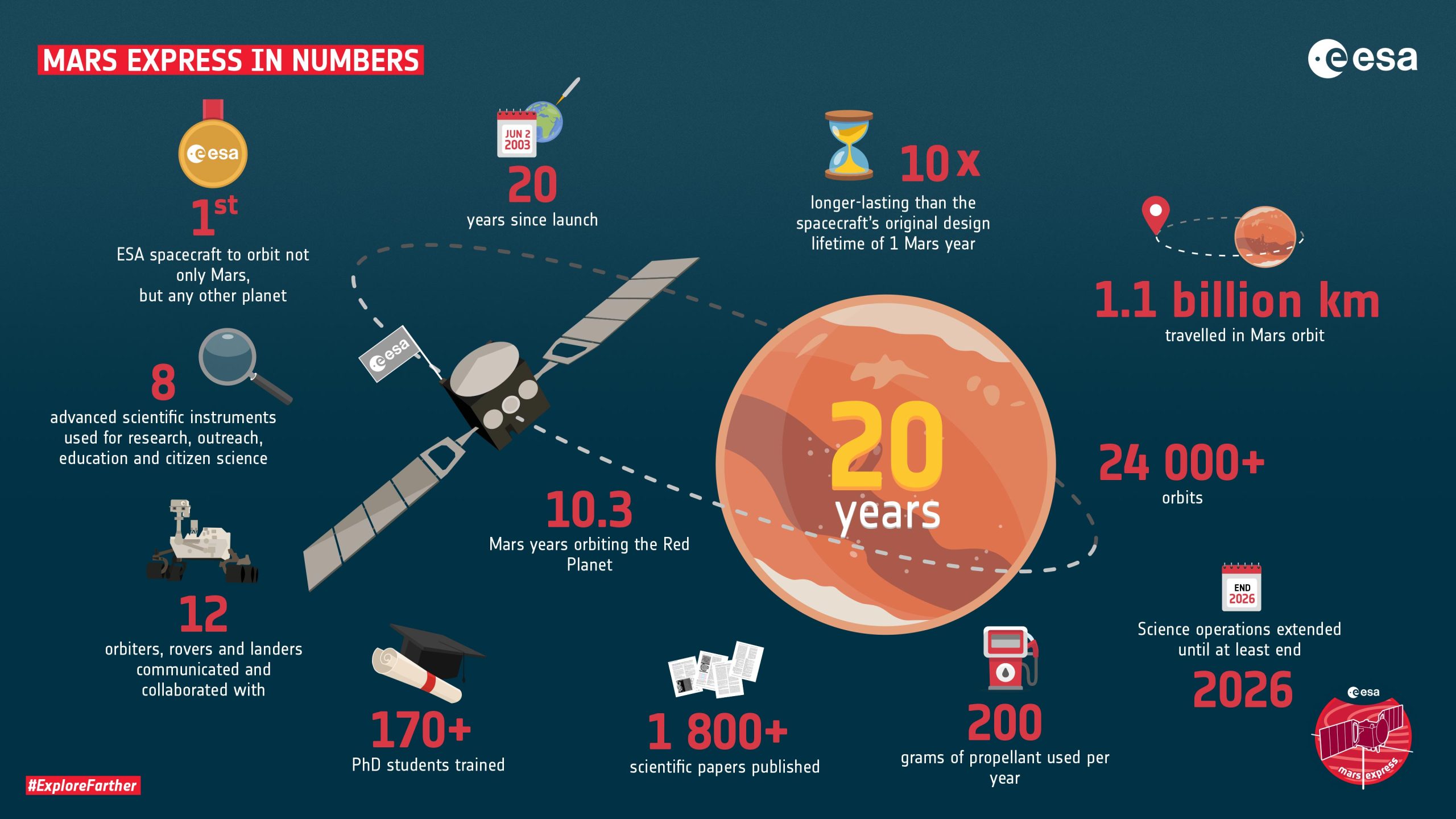
ESA’s Mars Express mission has released a color-rich, detailed mosaic of Mars to mark its 20th anniversary, using high-altitude images that reveal unprecedented color variations and the planet’s diverse composition. The mosaic highlights reddish oxidized iron, dark volcanic basaltic sands, and bright areas suggesting the past presence of liquid water. The mission will continue until at least 2026.
A new mosaic of Mars marks 20 years since the launch of ESA’s Mars Express, and reveals the planet’s color and composition in spectacular detail.
The mosaic was created using data from Mars Express’s High Resolution Stereo Camera (HRSC).
HRSC normally photographs Mars’s surface from an altitude of about 300 km – the closest the spacecraft gets to Mars in its elliptical orbit – with the resulting images covering areas about 50 km across. However, the mosaic presented here uses a slightly different approach. To view the planet more widely, HRSC gathered 90 images at higher altitudes (of 4000 to 10,000 km), thus capturing areas of around 2500 km wide. These images were then put together to form a full global view.
Such large-scale images are typically obtained to observe weather patterns on Mars – but even in the absence of atmospheric phenomena, they offer wonderful views of the planet’s surface.
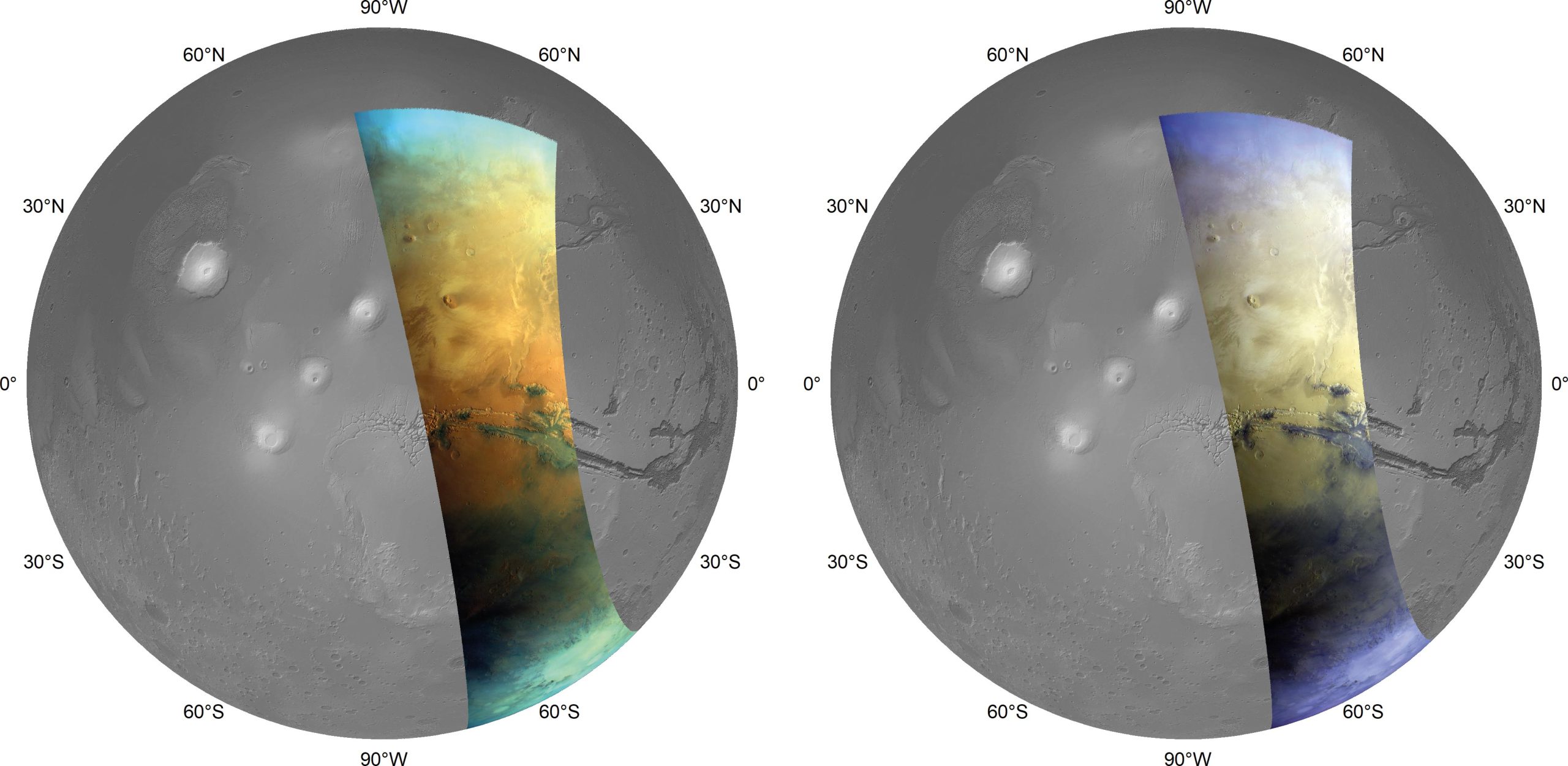
Left: A red-green-blue composite showing how the surface looks in visible light. Note the light blue color of the northern and southern limbs, caused by the camera having a shallower view through the Martian atmosphere (which therefore had a stronger influence on the images). Such regions were excluded from the global mosaic.
Right: An infrared-red-green composite. Such unusual views (those including the infrared channel) offer a possible way to examine Mars’ surface reflectivity in various wavelengths, and have also been inspected to detect artifacts or holes in the data comprising the global mosaic. Credit: ESA/DLR/FU Berlin/MOLA Science Team, CC BY-SA 3.0 IGO
A Richer Color View
This new view highlights variation across Mars’s surface by enhancing local color and contrast.
Thanks to its nine imaging channels, HRSC can visualize Mars not only in three dimensions but also in color. However, the ever-changing opacity of the Martian atmosphere makes it difficult to determine accurate surface colors from orbit. Dust scatters and reflects light, causing colors to shift between images and creating a patchwork-like effect when assembling a mosaic.
Until now, suppressing this effect during image processing has reduced variations in color between different parts of Mars. But to create this mosaic, the HRSC team instead color-referenced each constituent image to a color model derived from high-altitude observations, allowing them to preserve color variations and reveal a far richer color view of Mars than has been seen before.
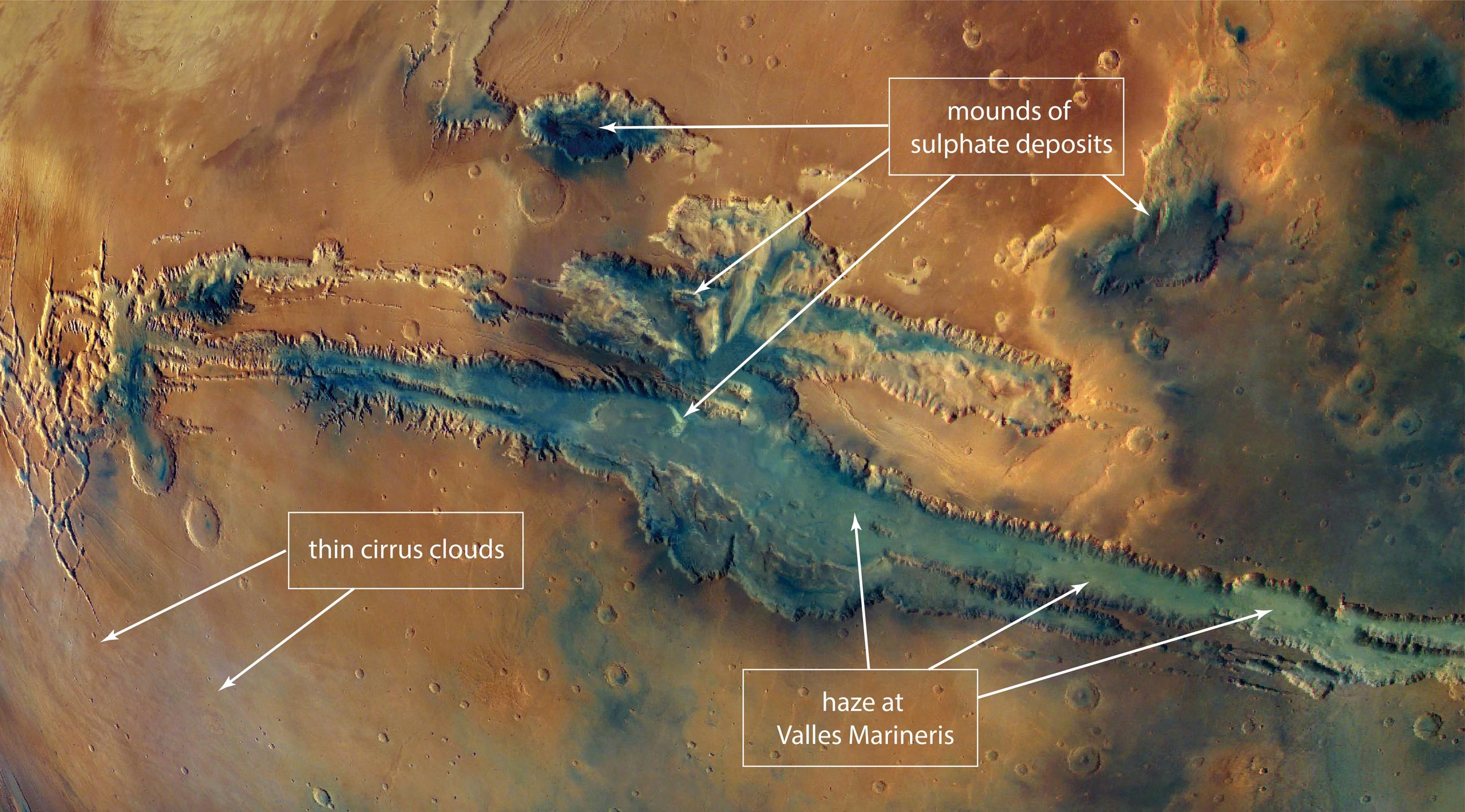
Faint bright-to-light blue areas show clouds in the atmosphere. The depths of Valles Marineris are also covered by the fog and haze that likes to form in Martian surface depressions at this time of year. Credit: ESA/DLR/FU Berlin/G. Michael, CC BY-SA 3.0 IGO
Each Color a Different Material
While beautiful in its own right, the mosaic also provides fascinating information about Mars’s composition, revealing an unprecedented variety and detail of colors across its surface.
Mars is famous for its reddish color, which is caused by high levels of oxidized iron. However, large parts of the planet appear to be rather dark and blue-toned here. These are grey-black basaltic sands of volcanic origin that form far-reaching, dark layers of sand across Mars. They pile up as they move in the wind, creating imposing sand dunes and dune fields within impact craters.
Material weathered by water, on the other hand, tends to look lighter. The two most common water-weathered minerals on Mars, clay and sulfate minerals, appear particularly bright on such color composites; their presence was established by the OMEGA spectrometer on Mars Express. The presence of these minerals signals that liquid water existed on Mars for a long time, weathering and altering rock over time to form significant clay deposits such as Mawrth Vallis (a former outflow channel not shown in this view but previously observed by HRSC).
Sulphate minerals are visible here within the Valles Marineris canyon system, as seen most clearly in the annotated image. Here, however, they are covered by a thin veneer of dark sand, but their impressive color variations can be seen on closer look. Unlike clay deposits, sulfate minerals indicate more acidic environmental conditions that would be less friendly to life.
Two Decades of Exploring Mars
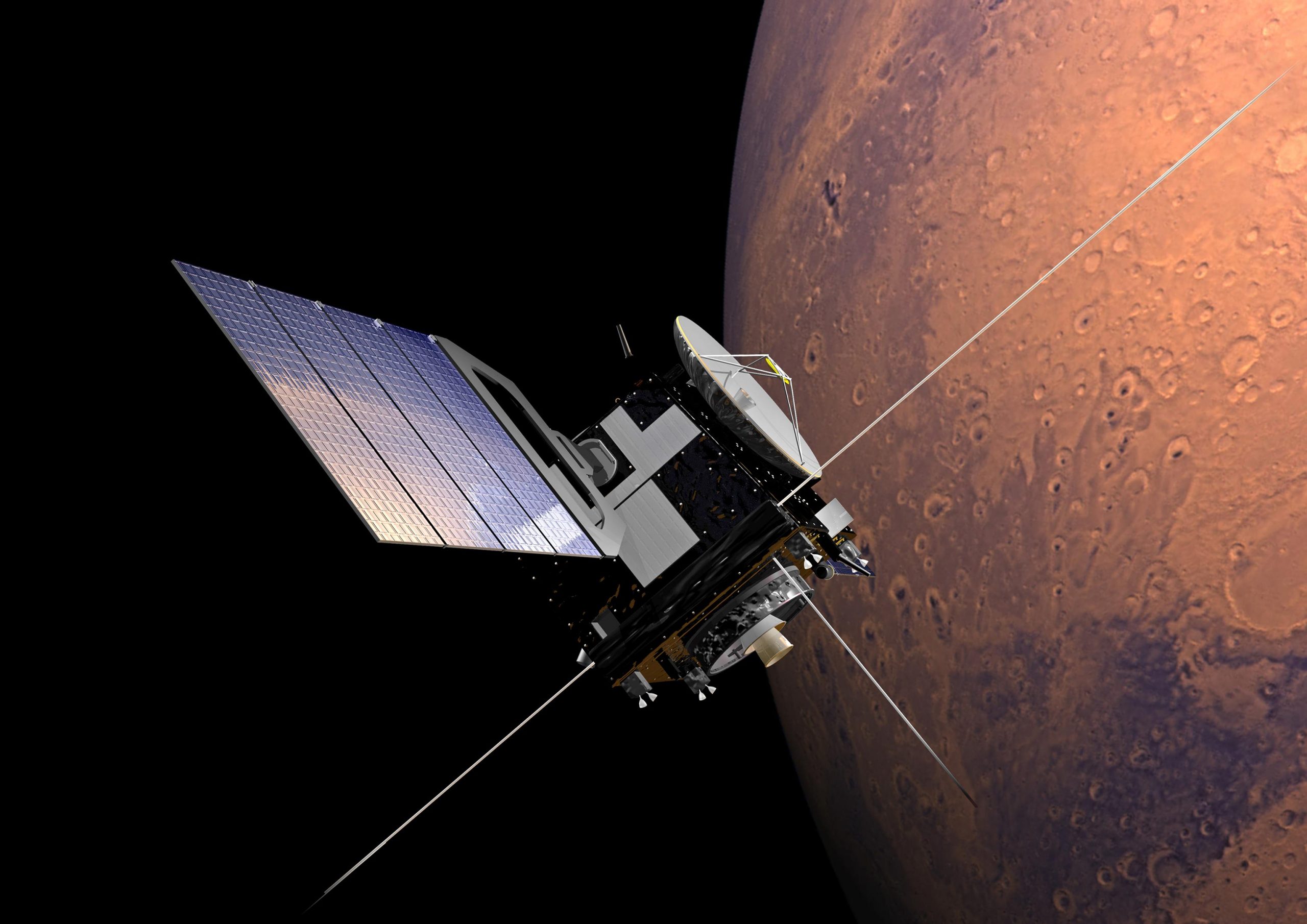
Mars Express launched and has been orbiting the Red Planet since 2003 – 20 years ago! The orbiter is imaging Mars’ surface, mapping its minerals, identifying the composition and circulation of its tenuous atmosphere, probing beneath its crust, and exploring how various phenomena interact in the Martian environment.
The spacecraft’s HRSC, the camera responsible for these images, has revealed much about Mars’ diverse surface features in the past 20 years. Its images show everything from Mars’ second-tallest volcano, Ascraeus Mons and the mighty Valles Marineris canyon system to deep fractures and water-carved valleys and impact craters, tectonic faults, river channels, and ancient lava pools.
The mission has been immensely productive in its two decades of life, creating a far fuller and more accurate understanding of our planetary neighbor than ever before. It was initially planned to last for one Martian year, or around 687 Earth days, but has continued to meet and exceed its objectives. As the mission has been extended until at least the end of 2026, we can anticipate many more beautiful and insightful snapshots of Mars in the years to come.
The mission’s High Resolution Stereo Camera (HRSC) was developed and is operated by the German Aerospace Center (Deutsches Zentrum für Luft- und Raumfahrt; DLR).
The development of the color model method and processing of the mosaic was performed by Greg Michael of the HRSC team at Freie Universität Berlin. The acquisition and planning of the high-altitude images were the responsibility of the camera operations team at the German Aerospace Center (DLR) at Berlin-Adlershof. On publication of the upcoming scientific paper on the mosaic, the georeferenced dataset will be made available through the ESA guest storage facility.
Never miss a breakthrough: Join the SciTechDaily newsletter.
Follow us on Google and Google News.
1 Comment
Hello, thank you for your scientific content. I always enjoy your content
I think that all the heavenly bodies were created from the earth. The earth was in the form of a very large gas, which may have been separated from the earth due to the mass or type of molecule or… and became a sphere. .
So the earth is the mother of all heavenly bodies.
Because the structure of each celestial sphere consists of one or two materials, all of which exist on earth.
I think Mendeleev’s table can help us