
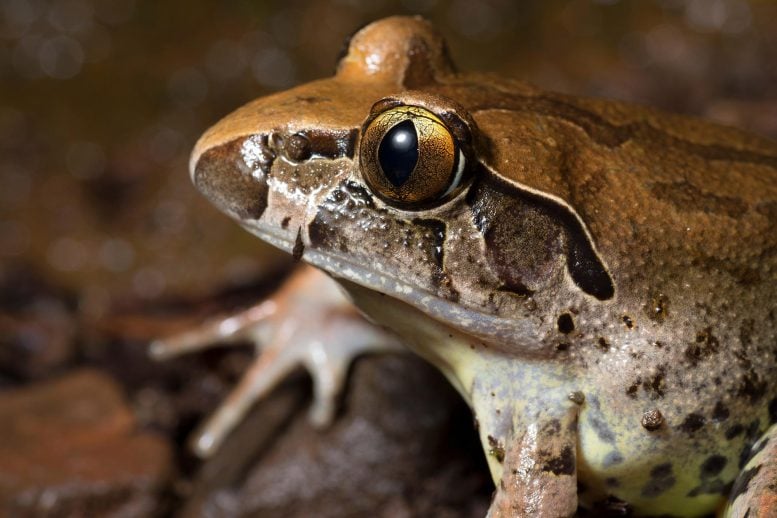
New study suggests some vaccines could induce a protective shift in the microorganisms that live with a host organism.
A human or animal’s microbiome — the collection of often beneficial microorganisms, including as bacteria and fungi, that live on or within a host organism — can play an important role in the host’s overall immune response, but it is unclear how vaccines against harmful pathogens impact the microbiome. A new study led by researchers at Penn State found that a new vaccine against the deadly chytrid fungus in frogs can shift the composition of the microbiome, making frogs more resilient to future exposure to the fungus. The study, published June 12 in a special issue of the journal Philosophical Transactions of the Royal Society B, suggests that the microbiome response could be an important, overlooked part of vaccine efficacy.
“The microorganisms that make up an animal’s microbiome can often help defend against pathogens, for example by producing beneficial substances or by competing against the pathogens for space or nutrients,” said Gui Becker, associate professor of biology at Penn State and leader of the research team. “But what happens to your microbiome when you get a vaccine, like a COVID vaccine, a flu shot, or a live-attenuated vaccine like the yellow fever vaccine? In this study, we used frogs as a model system to start exploring this question.”
Frogs and other amphibians are threatened by the chytrid fungus, which has led to extinctions of some species and severe population declines in hundreds of others across several continents. In susceptible species, the fungus causes sometimes-lethal skin disease.
“Chytrid is one of the worst, if not the worst, pathogen for wildlife conservation in recent history, and there is a critical need to develop tools to control its spread,” said Becker, who is also a member of the One Health Microbiome Center and the Center for Infectious Disease Dynamics at Penn State. “We found that, in some cases, vaccines can induce a protective shift in the microbiome, which suggests that carefully manipulating the microbiome could be used as part of a broader strategy to help amphibians, and perhaps other vertebrates, deal with emerging pathogens.”
A New Vaccine for Frogs: Shifting Microbiome Composition
The researchers applied a vaccine, in this case a non-lethal dosage of a metabolic product created by the chytrid fungus to tadpoles. After five weeks, they observed how the composition of the microbiome had changed, identifying individual species of bacteria and their relative proportions. The researchers also cultured each species of bacteria in the lab and tested whether bacteria-specific products facilitated, inhibited, or had no effect on chytrid growth, adding to and comparing results with a large database of this information.
“Increasing the concentration and duration of exposure to the chytrid product prophylaxis significantly shifted the composition of the microbiome so that there was a higher proportion of bacteria producing anti-chytrid substances,” said Samantha Siomko, a master’s student in the Becker Lab at the University of Alabama at the time of the research and first author of the paper. “This protective shift suggests that, if an animal were exposed to the same fungus again, its microbiome would be better capable of fighting the pathogen.”
Previous attempts to induce a protective change in the microbiome have relied on adding one or multiple species of bacteria known to make potent antifungal metabolites, i.e. probiotics. However, according to the researchers, the bacteria must compete with other species in the microbiome and is not always successful at establishing itself as a permanent member of the microbiome.
“These frogs have hundreds of bacteria species on their skin that they pick up from their environment, and the composition changes regularly, including with season,” said Becker. “Attempting to manipulate the community, for example by adding a bacterial probiotic, is challenging, because the dynamics in the community are so complex and unpredictable. Our results are promising because we have essentially manipulated the entire bacterial community in a direction that is more effective against fighting the fungal pathogen without adding a living thing that needs to compete for resources to survive.”
Maintaining Microbiome Diversity While Enhancing Protection
Notably, the overall number of species — the diversity — within the microbiome was not impacted, only the composition and relative proportions of species. The researchers believe this is positive, as declines in the diversity of the frog microbiome can often lead to illness or death, and it is generally accepted that maintaining a diverse microbiome allows the community of bacteria and microbe species to respond to threats more dynamically and with higher functional redundancy.
The researchers suggest that this adaptive shift in the microbiome composition, which they call the “microbiome memory,” could play an important role in vaccine efficacy. In addition to understanding the mechanisms behind the shift, the research team hopes to study the idea of microbiome memory in adult frogs as well as other vertebrate species in the future.
“Our collaborative team implemented a prophylaxis technique that relied on metabolic product derived from the chytrid fungus,” said Becker. “It’s possible that vaccines based on mRNA or live cells — like those often used to protect against bacterial or viral infections — may differently affect the microbiome, and we are excited to explore this possibility.”
Reference: “Selection of an anti-pathogen skin microbiome following prophylaxis treatment in an amphibian model system” by Samantha A. Siomko, Sasha E. Greenspan, K. M. Barnett, Wesley J. Neely, Stanislava Chtarbanova, Douglas C. Woodhams, Taegan A. McMahon and C. Guilherme Becker, 12 June 2023, Philosophical Transactions of the Royal Society B Biological Sciences.
DOI: 10.1098/rstb.2022.0126
In addition to Becker and Siomko, the research team includes Teagan McMahon — who developed the prophylaxis method—at the University of Connecticut; Sasha Greenspan, Wesley Neely, and Stanislava Chtarbanova at the University of Alabama; Douglas Woodhams at the University of Massachusetts; and K. M. Barnett at Emory University. This work was supported by the National Science Foundation, the National Institutes of Health, The University of Alabama, and The University of Tampa.
Never miss a breakthrough: Join the SciTechDaily newsletter.
Follow us on Google and Google News.