
Close Menu
    Facebook X (Twitter) Instagram
    SciTechDaily
    • Biology
    • Chemistry
    • Earth
    • Health
    • Physics
    • Science
    • Space
    • Technology
    Facebook X (Twitter) Pinterest YouTube RSS
    SciTechDaily
    Home»Space»Mars – Or Arrakis? Perseverance Is Currently Winding Through a Maze of Towering Sand Dunes
    Space

    Mars – Or Arrakis? Perseverance Is Currently Winding Through a Maze of Towering Sand Dunes

    By Erin Gibbons, McGill UniversityNovember 17, 20211 Comment4 Mins Read
    Facebook Twitter Pinterest Telegram LinkedIn WhatsApp Email Reddit
    Share
    Facebook Twitter LinkedIn Pinterest Telegram Email Reddit
    HiRISE Spots Perseverance in South Séítah
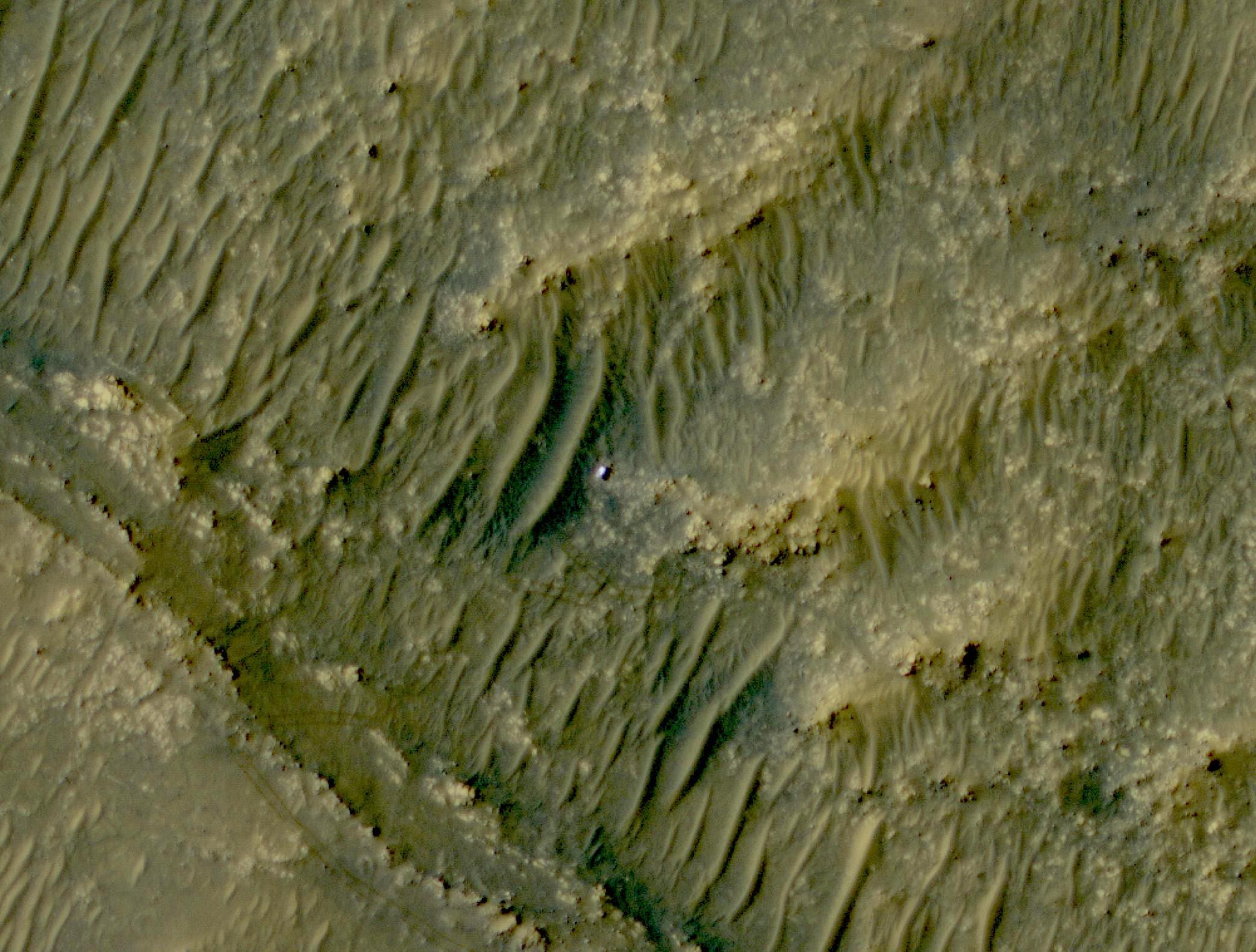
    HiRISE Spots Perseverance in ‘South Séítah’: The white dot in the centre is our beloved Perseverance rover, dwarfed by the large sand dunes in the Séítah region. This image was acquired on September 24th, 2021, by the High-Resolution Imaging Science Experiment on the Mars Reconnaissance Orbiter. Credit: NASA/JPL-Caltech/University of Arizona

    Perseverance is exploring Séítah’s perilous dunes to study layered rocks thought to be the oldest in Jezero crater. By analyzing freshly abraded surfaces like Brac, scientists hope to uncover how these rocks formed and whether Mars was once habitable.

    Who hates deep sand traps more than golfers?

    Mars rover drivers (and probably Fremen too).

    When your vehicle is well over 50 million kilometers (31 million miles) away from the nearest tow company, getting your wheels stuck in sand can be a mission-critical problem. Such a predicament ended the Spirit rover’s mission in 2009.

    Yet Perseverance is currently winding her way through the maze of towering sand dunes that characterize the Séítah region of Jezero crater (“Séítah” means “amidst the sand” in the Navajo language, a well-fitting name). A recent photo beamed back from the HiRISE camera (High-Resolution Imaging Science Experiment) on the Mars Reconnaissance Orbiter shows the extent to which the nearby dunes dwarf the rover, which itself is the size of a small SUV.

    What enticed the Science Team into this treacherous zone laden with sand traps? The answer lies in our observations. After Perseverance landed and turned her eyes (cameras) towards Séítah, the Science Team was treated to a compelling view of diversely layered rocks. We saw thin layers and thick layers, planar layers and tilted layers, featureless layers and layers with protrusions. These observations garnered excitement amongst us because we know, from studying Earth, that an outcrop of layered rocks serves as a geological time-line. Each layer records information about the environmental conditions present when the rock formed and changes in layer thicknesses or textural expressions indicates an environmental change. Further, by studying the directions that the layers tilted, we determined that the rocks of Séítah are likely the most ancient rocks exposed in all of Jezero crater. Séítah therefore represents the beginning of the accessible geologic record and offers a once-in-a-mission opportunity to explore the full breadth of landscape evolution.
    Mars Perseverance Sol 248
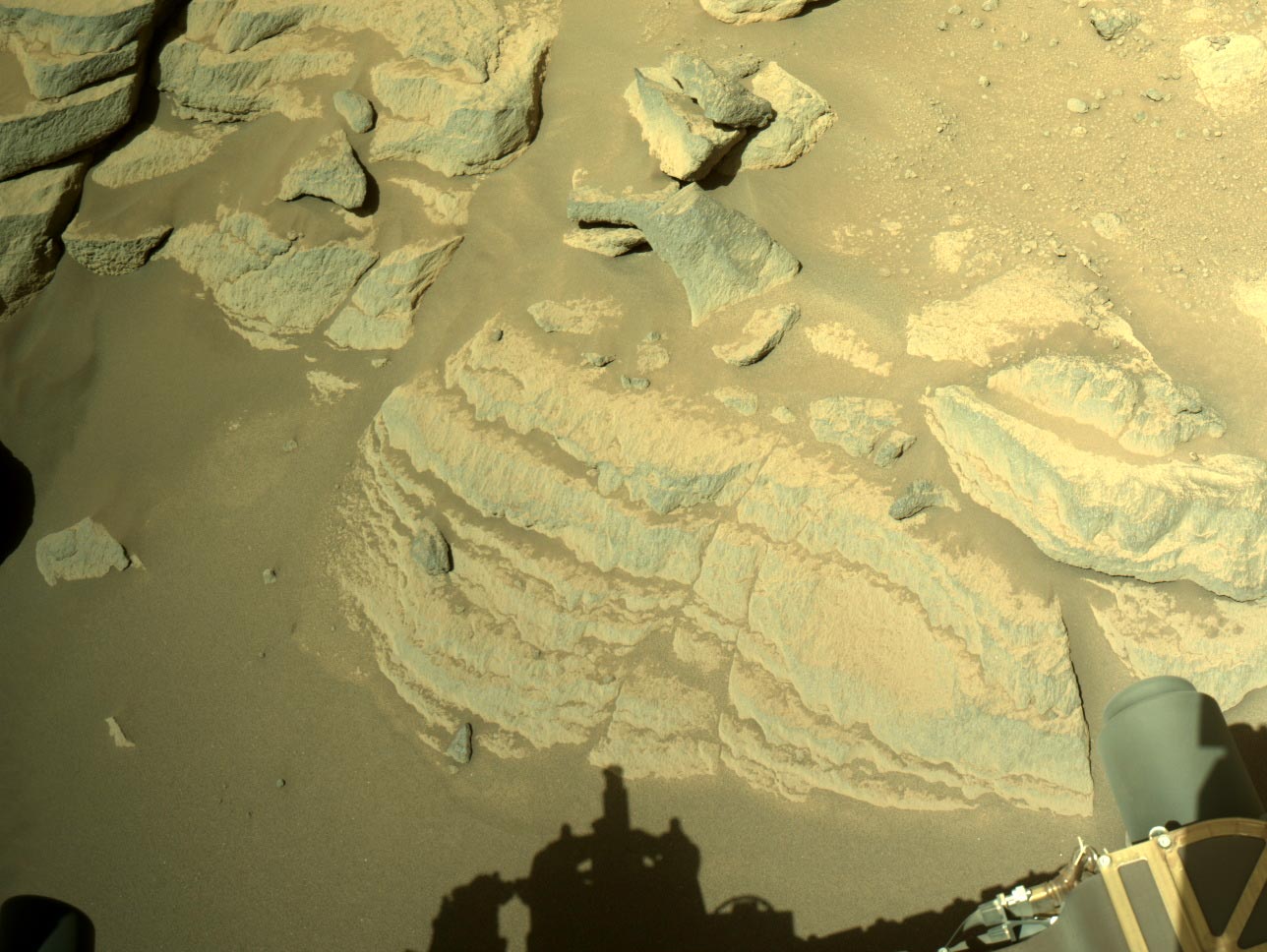
    Mars Perseverance Sol 248 – Left Navigation Camera: Photograph of the Brac rock target located in front of the Perseverance rover. This rock caught our eye for the series of stacked layers with variable thicknesses. Perseverance acquired this image on sol 248 using its onboard Left Navigation Camera (Navcam). Credit: NASA/JPL-Caltech

    However, from a distance, it is difficult to determine what that evolving landscape actually looked like. Numerous hypotheses have been proposed for the origin of the layered rocks in Séítah, including sedimentation in an ancient lake or river with varying flow energy, airfall of volcanic ash, airfall of material dislodged by an impact event, cooled lava flows, or a magmatic intrusion. Each one of these possibilities carries with it a (very) different interpretation of how habitable Jezero crater was in the deep past and deciphering which scenario is most correct requires a closer look.

    Which is why we braved the sand. As of this writing, the rover is parked in front of one of the captivating layered rocks that we spied from a distance, informally named Brac. On sol 253 (November 5th, 2021, Earth time) Perseverance reached out and used the abrader drill bit and the Gaseous Dust Removal Tool to scrape a few millimeters of rock off the surface of Brac to expose the fresh, un-weathered surface for study. The Science Team is currently poring over the images and planning follow-up analyses that will bring us one step closer to unraveling how these rocks formed and whether that environment could have been favorable for life. 

    Written by Erin Gibbons, Student Collaborator at McGill University.

    Never miss a breakthrough: Join the SciTechDaily newsletter.
    Follow us on Google and Google News.

    JPL Mars Mars 2020 Perseverance Rover McGill University Planets
    Share. Facebook Twitter Pinterest LinkedIn Email Reddit

    Related Articles

    NASA Perseverance Rover: Drilling Into Mars With Lasers

    Spectacular Panoramic Martian Image: The Ridges of “South Séítah”

    NASA’s Perseverance Rover Collects Puzzle Pieces of Mars’ History – Reveal “Potentially Habitable Sustained Environment”

    NASA’s Perseverance Rover Collects First Mars Rock Sample – “Truly a Historic Moment”

    After Its Last Rock Sample Crumbled Into Powder, NASA’s Mars Rover Is Going To Try Again

    NASA’s Ingenuity Helicopter Sees Potential Martian “Road” Ahead

    NASA to Brief Early Science Results From Perseverance Mars Rover

    NASA’s Mars Helicopter Spots Intriguing Terrain for Perseverance Rover to Explore

    Jezero Crater’s “Delta Scarp” – A NASA Perseverance Rover Scientist’s Favorite Martian Image

    1 Comment

    1. Tom E Coward on November 17, 2021 4:14 pm

      awesome stuff

      Reply
    Leave A Reply Cancel Reply

    • Facebook
    • Twitter
    • Pinterest
    • YouTube

    Don't Miss a Discovery

    Subscribe for the Latest in Science & Tech!

    Trending News

    Breakthrough Bowel Cancer Trial Leaves Patients Cancer-Free for Nearly 3 Years

    Natural Compound Shows Powerful Potential Against Rheumatoid Arthritis

    100,000-Year-Old Neanderthal Fossils in Poland Reveal Unexpected Genetic Connections

    Simple “Gut Reset” May Prevent Weight Gain After Ozempic or Wegovy

    2.8 Days to Disaster: Scientists Warn Low Earth Orbit Could Suddenly Collapse

    Common Food Compound Shows Surprising Power Against Superbugs

    5 Simple Ways To Remember More and Forget Less

    The Atomic Gap That Could Cost the Semiconductor Industry Billions

    Follow SciTechDaily
    • Facebook
    • Twitter
    • YouTube
    • Pinterest
    • Newsletter
    • RSS
    SciTech News
    • Biology News
    • Chemistry News
    • Earth News
    • Health News
    • Physics News
    • Science News
    • Space News
    • Technology News
    Recent Posts
    • Scientists Discover Stem Cells That Could Regrow Teeth and Bone
    • Scientists Discover Natural Molecule That Stops Alzheimer’s Protein Clumps From Forming
    • Early Cannabis Use May Stall Key Brain Skills in Teens
    • Popular Vitamin D Supplement Has “Previously Unknown” Negative Effect, Study Finds
    • Powerful Antioxidant Found To Play a Key Role in Proper Protein Folding
    Copyright © 1998 - 2026 SciTechDaily. All Rights Reserved.
    • Science News
    • About
    • Contact
    • Editorial Board
    • Privacy Policy
    • Terms of Use

    Type above and press Enter to search. Press Esc to cancel.