
Close Menu
    Facebook X (Twitter) Instagram
    SciTechDaily
    • Biology
    • Chemistry
    • Earth
    • Health
    • Physics
    • Science
    • Space
    • Technology
    Facebook X (Twitter) Pinterest YouTube RSS
    SciTechDaily
    Home»Science»‘Marsquakes’ Provide a Potential Microbial Energy Source on Mars
    Science

    ‘Marsquakes’ Provide a Potential Microbial Energy Source on Mars

    By Jim Shelton, Yale UniversitySeptember 19, 20161 Comment2 Mins Read
    Facebook Twitter Pinterest Telegram LinkedIn WhatsApp Email Reddit
    Share
    Facebook Twitter LinkedIn Pinterest Telegram Email Reddit
    Evidence for a Potential Microbial Energy Source on Earth and Mars
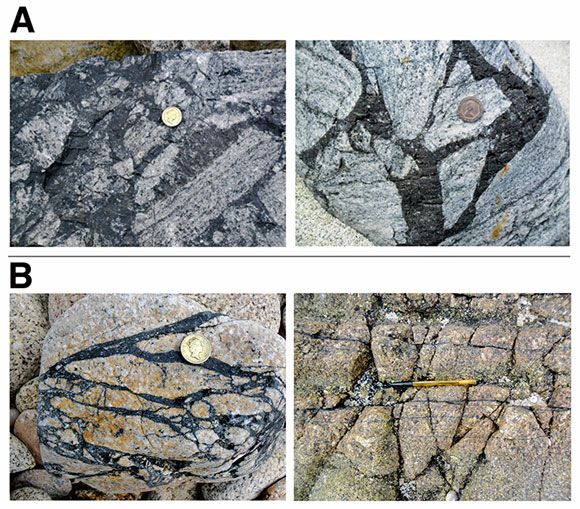
    These pseudotachylites — fine-grained rocks — are from the British Isles.

    New research from Yale University shows that rocks formed by the grinding together of other rocks during earthquakes are rich in trapped hydrogen — a finding that suggests similar seismic activity on Mars may produce enough hydrogen to support life.

    Researchers from Yale, the University of Aberdeen, and Brock University studied rock formations around active fault lines in the Outer Hebrides, off the coast of Scotland. Their analysis appears in the journal Astrobiology.

    “Previous work has suggested that hydrogen is produced during earthquakes when rocks fracture and grind together. Our measurements suggest that enough hydrogen is produced to support the growth of microorganisms around active faults,” said Yale geologist Sean McMahon, first author of the study.

    While humans and other animals get their energy mainly from the reaction between oxygen and sugar, bacteria use a wide array of alternative reactions to obtain energy. The oxidation of hydrogen gas, for example, generates enough energy for bacteria deep in the Earth’s subsurface.

    “Mars is not very seismically active, but our work shows that ‘Marsquakes’ could produce enough hydrogen to support small populations of microorganisms, at least for short periods of time,” McMahon said. “This is just one part of the emerging picture of the habitability of the Martian subsurface, where other sources of energy for life may also be available. The best way to find evidence of life on Mars may be to examine rocks and minerals that formed deep underground around faults and fractures, which were later brought to the surface by erosion.”

    Co-authors of the paper are John Parnell of the University of Aberdeen and Nigel Blamey of Brock University.

    “NASA has plans to measure seismic activity on Mars during its 2018 InSight mission, and our data will make those measurements all the more interesting,” Parnell said.

    Reference: “Evidence for Seismogenic Hydrogen Gas, a Potential Microbial Energy Source on Earth and Mars” by Sean McMahon, John Parnell and Nigel J.F. Blamey, 1 September 2016, Astrobiology.
    DOI: 10.1089/ast.2015.1405

    Never miss a breakthrough: Join the SciTechDaily newsletter.
    Follow us on Google and Google News.

    Astrobiology Earth Science Mars Planetary Science Yale University
    Share. Facebook Twitter Pinterest LinkedIn Email Reddit

    Related Articles

    Scientists Discover Evidence of Methane in Martian Meteorites

    Yale Study Reveals Parts of Ancient Antarctica Were as Warm as Today’s California Coast

    Scientists Discover New Process that Protects Earth from Space Weather

    Interplanetary Dust Particles Can Deliver Water and Organics to Terrestrial Planets

    Cloud-Chamber Experiments Show How Martian Clouds Form

    Study Reveals Climate Change is Occurring at an Increased Pace

    Martian Meteorite Almost 4 Billion Years Younger Than Previously Thought

    Martian Meteorite Contains Chemical Implicated in the Origin of Life

    Phobos May Provide Evidence of Life on Mars

    1 Comment

    1. Sage on the Hudson on September 19, 2016 1:18 pm

      “These pseudotachylites — fine grained rocks — are from the British Isles.”

      Really? And I’d thought the Americans had simply dropped some £1 coins on Mars to be cheeky.

      Reply
    Leave A Reply Cancel Reply

    • Facebook
    • Twitter
    • Pinterest
    • YouTube

    Don't Miss a Discovery

    Subscribe for the Latest in Science & Tech!

    Trending News

    Millions Take These IBS Drugs, But a New Study Finds Serious Risks

    Scientists Unlock Hidden Secrets of 2,300-Year-Old Mummies Using Cutting-Edge CT Scanner

    Bread Might Be Making You Gain Weight Even Without Eating More Calories

    Scientists Discover Massive Magma Reservoir Beneath Tuscany

    Europe’s Most Active Volcano Just Got Stranger – Here’s Why Scientists Are Rethinking It

    Alzheimer’s Symptoms May Start Outside the Brain, Study Finds

    Millions Take This Popular Supplement – Scientists Discover a Concerning Link to Heart Failure

    The Universe Is Expanding Too Fast and Scientists Can’t Explain Why

    Follow SciTechDaily
    • Facebook
    • Twitter
    • YouTube
    • Pinterest
    • Newsletter
    • RSS
    SciTech News
    • Biology News
    • Chemistry News
    • Earth News
    • Health News
    • Physics News
    • Science News
    • Space News
    • Technology News
    Recent Posts
    • Doctors Surprised by the Power of a Simple Drug Against Colon Cancer
    • Why Popular Diabetes Drugs Like Ozempic Don’t Work for Everyone: The “Genetic Glitch”
    • Scientists Create Improved Insulin Cells That Reverse Diabetes in Mice
    • Scientists Stunned After Finding Plant Thought Extinct for 60 Years
    • A Common Diabetes Drug May Hold the Key to Stopping HIV From Coming Back
    Copyright © 1998 - 2026 SciTechDaily. All Rights Reserved.
    • Science News
    • About
    • Contact
    • Editorial Board
    • Privacy Policy
    • Terms of Use

    Type above and press Enter to search. Press Esc to cancel.