
Close Menu
    Facebook X (Twitter) Instagram
    SciTechDaily
    • Biology
    • Chemistry
    • Earth
    • Health
    • Physics
    • Science
    • Space
    • Technology
    Facebook X (Twitter) Pinterest YouTube RSS
    SciTechDaily
    Home»Space»Martian Climate Change: Water Could Disappear From Red Planet Faster Than Expected
    Space

    Martian Climate Change: Water Could Disappear From Red Planet Faster Than Expected

    By CNRSMarch 23, 2020No Comments3 Mins Read
    Facebook Twitter Pinterest Telegram LinkedIn WhatsApp Email Reddit
    Share
    Facebook Twitter LinkedIn Pinterest Telegram Email Reddit
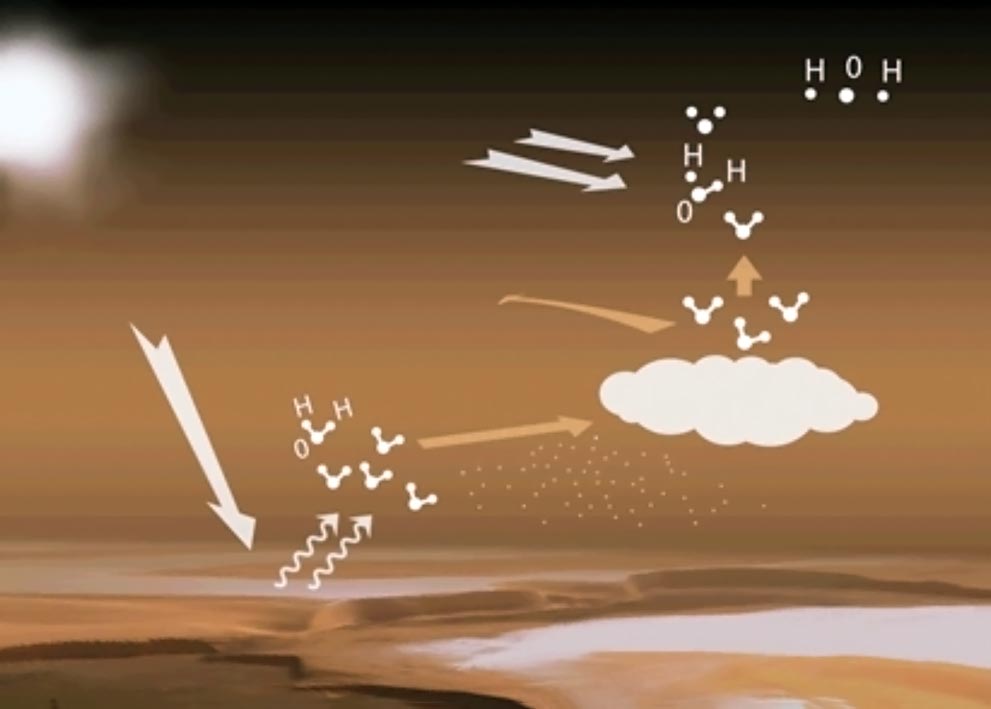
    Water Cycle in Martian Atmosphere
    When the sun lights up the large reservoirs of ice at the poles, water vapor is released into the atmosphere. These water molecules are then transported by winds toward higher and colder altitudes where, in the presence of dust particles, they can condense into clouds and prevent a rapid and mass progression of water toward higher altitudes (as on Earth). On Mars condensation is often hindered. The atmosphere is thus regularly supersaturated in water vapor, which allows even more water to reach the upper atmosphere, where the sun’s UV rays disassociate them into atoms. The discovery of the increased presence of water vapor at very high altitude entails that a greater number of hydrogen and oxygen atoms are able to escape from Mars, amplifying the loss of Martian water over the long term. Credit: ESA

    The small red planet is losing water more quickly than what theory, as well as past observations, would suggest.

    The gradual disappearance of water (H2O) occurs in the upper atmosphere of Mars: sunlight and chemistry disassociate water molecules into hydrogen and oxygen atoms that the weak gravity of Mars cannot prevent from escaping into space.

    An international research team, led partly by CNRS researcher Franck Montmessin, has just revealed that water vapor is accumulating in large quantities and unexpected proportions at an altitude of over 80 km (50 mi) in the Martian atmosphere. Measurements showed that large atmospheric pockets are even in a state of supersaturation, with the atmosphere containing 10 to 100 times more water vapor than its temperature should theoretically allow.

    With the observed supersaturation rates, the capacity of water to escape would greatly increase during certain seasons. These results, which were published in Science on 9 January 2020, were obtained thanks to the Trace Gas Orbiter probe from the ExoMars mission, financed by the European Space Agency and the Russian space agency Roscosmos.

    Reference: “Stormy water on Mars: The distribution and saturation of atmospheric water during the dusty season” by Anna A. Fedorova, Franck Montmessin, Oleg Korablev, Mikhail Luginin, Alexander Trokhimovskiy, Denis A. Belyaev, Nikolay I. Ignatiev, Franck Lefèvre, Juan Alday, Patrick G. J. Irwin, Kevin S. Olsen, Jean-Loup Bertaux, Ehouarn Millour, Anni Määttänen, Alexey Shakun, Alexey V. Grigoriev, Andrey Patrakeev, Svyatoslav Korsa, Nikita Kokonkov, Lucio Baggio, Francois Forget and Colin F. Wilson, 17 January 2020, Science.
    DOI: 10.1126/science.aay9522

    In France this research involved scientists from the Laboratoire atmosphères, milieux, observations spatiales (CNRS/Université de Versailles Saint-Quentin-en-Yvelines/Sorbonne Université) and the Laboratoire de météorologie dynamique (CNRS/École polytechnique/ENS Paris/Sorbonne Université).

    Never miss a breakthrough: Join the SciTechDaily newsletter.
    Follow us on Google and Google News.

    CNRS European Space Agency Mars
    Share. Facebook Twitter Pinterest LinkedIn Email Reddit

    Related Articles

    New Mosaic Shows Off the Red Planet’s North Polar Ice Cap

    Mars Express Image of the Rim of the Schiaparelli Crater

    ESA’s Mars Express Sheds New Light on the Red Planet’s Rare Aurora

    New ESA Image of Craters within the Hellas Basin on Mars

    New Fly-Through Video of the Ancient Flood Plain Kasei Valles

    Mars Express Captures a Radar View of the Southern Highlands of Mars

    ESA’s Mars Express Captures New Images of Sulci Gordii

    Images From ESA’s Mars Express Reveals the Features of Ladon Basin

    ESA’s Mars Express MARSIS Radar Explores Martian Oceans

    Leave A Reply Cancel Reply

    • Facebook
    • Twitter
    • Pinterest
    • YouTube

    Don't Miss a Discovery

    Subscribe for the Latest in Science & Tech!

    Trending News

    Tea or Coffee? Your Daily Choice Could Affect Osteoporosis Risk

    Vitamin C May Fight Cancer in a Surprising Way

    Hidden Earthquake Threat: Oregon’s Fault May Be Closer to the Surface Than Scientists Thought

    Scientists Discover Hidden Sleep Switch That Boosts Brainpower, Builds Muscle, and Burns Fat

    Ancient Mega-Floods Once Ripped Across Mars and Left This Giant Scar

    Scientists Discover Cheap, Natural Remedy for High Blood Pressure

    Earth’s Upper Atmosphere Is Cooling Fast and Scientists Finally Know Why

    32,000 Olympic Pools of Magma Nearly Erupted Beneath Atlantic Island

    Follow SciTechDaily
    • Facebook
    • Twitter
    • YouTube
    • Pinterest
    • Newsletter
    • RSS
    SciTech News
    • Biology News
    • Chemistry News
    • Earth News
    • Health News
    • Physics News
    • Science News
    • Space News
    • Technology News
    Recent Posts
    • Ancient DNA Reveals How Farming Spread and Nearly Broke a Civilization
    • 146,000-Year-Old Discovery Rewrites the Story of Human Creativity
    • The Type of Alcohol You Drink Could Affect How Long You Live
    • 19-Year Study Reveals the Surprising Truth About Sitting and Dementia
    • This Common Vitamin May Help Stop Prediabetes From Turning Into Diabetes
    Copyright © 1998 - 2026 SciTechDaily. All Rights Reserved.
    • Science News
    • About
    • Contact
    • Editorial Board
    • Privacy Policy
    • Terms of Use

    Type above and press Enter to search. Press Esc to cancel.