
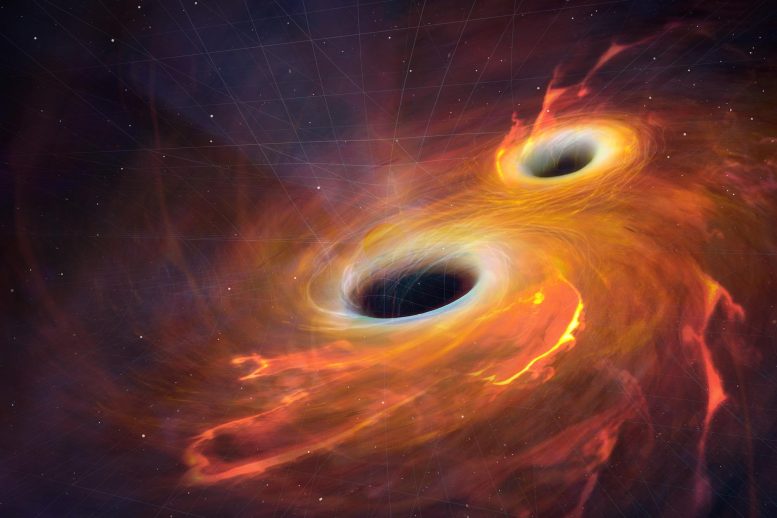
A new study by a group of researchers at the University of Birmingham has found that collisions of supermassive black holes may be simultaneously observable in both gravitational waves and X-rays at the beginning of the next decade.
The European Space Agency (ESA) has recently announced that its two major space observatories of the 2030s will have their launches timed for simultaneous use. These missions, Athena, the next generation X-ray space telescope and LISA, the first space-based gravitational wave observatory, will be coordinated to begin observing within a year of each other and are likely to have at least four years of overlapping science operations.
According to the new study, published this week in Nature Astronomy, ESA’s decision will give astronomers an unprecedented opportunity to produce multi-messenger maps of some of the most violent cosmic events in the Universe, which have not been observed so far and which lie at the heart of long-standing mysteries surrounding the evolution of the Universe.
They include the collision of supermassive black holes in the core of galaxies in the distant universe and the “swallowing up” of stellar compact objects such as neutron stars and black holes by massive black holes harbored in the centers of most galaxies.
The gravitational waves measured by LISA will pinpoint the ripples of space time that the mergers cause while the X-rays observed with Athena reveal the hot and highly energetic physical processes in that environment. Combining these two messengers to observe the same phenomenon in these systems would bring a huge leap in our understanding of how massive black holes and galaxies co-evolve, how massive black holes grow their mass and accrete, and the role of gas around these black holes.
These are some of the big unanswered questions in astrophysics that have puzzled scientists for decades.
Dr. Sean McGee, Lecturer in Astrophysics at the University of Birmingham and a member of both the Athena and LISA consortiums, led the study. He said, “The prospect of simultaneous observations of these events is uncharted territory, and could lead to huge advances. This promises to be a revolution in our understanding of supermassive black holes and how they growth within galaxies.”
Professor Alberto Vecchio, Director of the Institute for Gravitational Wave Astronomy, University of Birmingham, and a co-author on the study, said: “I have worked on LISA for twenty years and the prospect of combining forces with the most powerful X-ray eyes ever designed to look right at the center of galaxies promises to make this long haul even more rewarding. It is difficult to predict exactly what we’re going to discover: we should just buckle up, because it is going to be quite a ride.”
During the life of the missions, there may be as many as 10 mergers of black holes with masses of 100,000 to 10,000,000 times the mass of the sun that have signals strong enough to be observed by both observatories. Although due to our current lack of understanding of the physics occurring during these mergers and how frequently they occur, the observatories could observe many more or many fewer of these events. Indeed, these are questions which will be answered by the observations.
In addition, LISA will detect the early stages of stellar-mass black hole mergers which will conclude with the detection in ground-based gravitational wave observatories. This early detection will allow Athena to be observing the binary location at the precise moment the merger will occur.
Reference: “Linking gravitational waves and X-ray phenomena with joint LISA and Athena observations” by Sean McGee, Alberto Sesana and Alberto Vecchio, 6 January 2020, Nature Astronomy.
DOI: 10.1038/s41550-019-0969-7
Never miss a breakthrough: Join the SciTechDaily newsletter.
Follow us on Google and Google News.
3 Comments
Im on my savage shi
do it😼
why be savage when you can be a cabbage
-trippie redd