
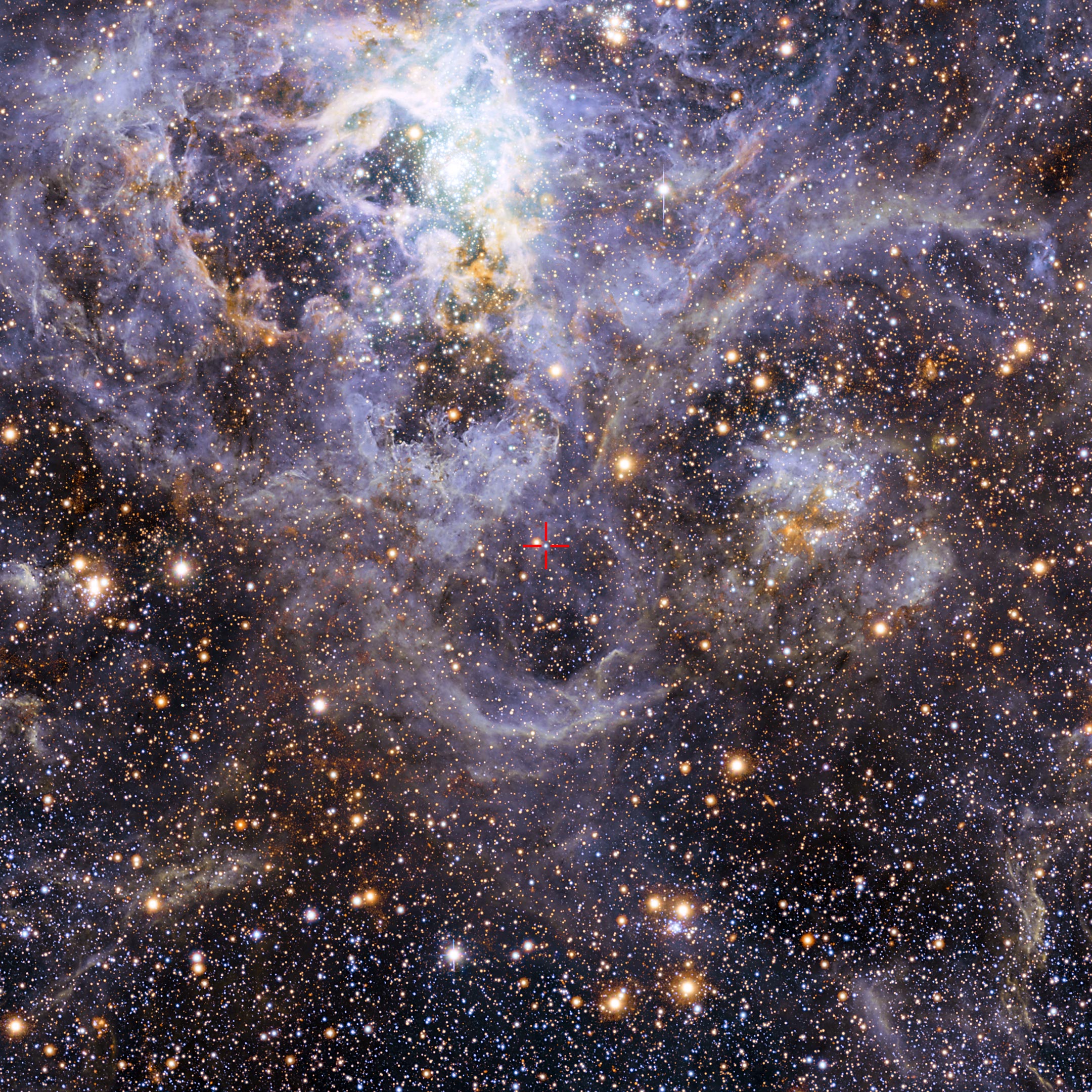
In 2015, the first direct observation of gravitational waves was made by the Advanced Laser Interferometer Gravitational-wave Observatory (aLIGO) (Abbott et al. 2016). The detected signal, known as GW150914, not only provided the most rigorous test of General Relativity—Einstein’s theory of gravity—it was also the first observation of two black holes merging. This confirmed the existence of black holes, binary stellar-mass black hole systems, and proved that they can merge within the current age of the Universe.
Since that first detection, aLIGO has detected many more black hole mergers but scientists are still puzzled: many of the black hole mergers that aLIGO has detected so far, including GW150914, involve systems with the component black holes weighing in at more than 20 solar masses each—some much more. These are massive black holes—heavier than any previously known black holes from X-ray binary observations—which raises the question: how did they form? Our recent study seeks to answer that question.
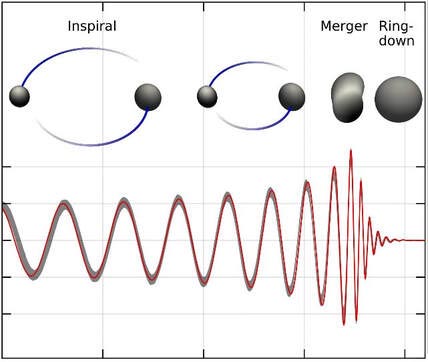
aLIGO records (part of) the inspiral, merger, and ring-down of the orbiting black holes—as shown in Figure 1 (above). aLIGO can only record these events if they occur within its operating lifetime—that means that the progenitor stars must collapse to black holes before they merge, and the subsequent orbiting black holes must spiral in towards each other and merge within the age of the Universe. For that to happen, the black holes must be big and close together; however, progenitor stars big enough and close enough to produce a binary black hole (BBH) system that would spiral in and eventually merge within the age of the universe, and that could generate gravitational waves detectable by aLIGO, would be too big and too close; so these progenitor stars merge first and then collapse into black holes.
Thus, the aLIGO detections raise the intriguing questions: how did the black holes get so massive? and how did they get so close together?
Chemically Homogeneous Evolution (CHE) has been proposed as a possible solution. Rapid spinning stirs a star leading to its interior becoming homogeneous, and possibly fusing entirely rather than just the core. A hot, rapidly spinning, chemically homogeneous star doesn’t expand as it ages in the way a conventionally evolving star does. The chemically homogeneous model begins with a pair of close, massive stars rotating around each other extremely rapidly—so close that they become tidally locked, causing the stars to spin rapidly on their own axes. The component stars of this massive, overcontact binary eventually collapse into massive black holes, which are now close enough to spiral in and merge within the age of the Universe.
For the first time, we simultaneously explore conventional isolated binary star evolution and chemically homogeneous evolution under the same set of assumptions. This approach allows us to constrain population properties and make simultaneous predictions about the gravitational-wave detection rates of BBH mergers for the CHE and conventional formation channels.
This joint model for the classical and CHE isolated binary evolution channels will enable simultaneous inference on binary evolution model parameters and the metallicity-specific star formation history once the full trove of observations from the aLIGO third gravitational-wave observing run is available. Ultimately, the relatively short delay times of CHE BBHs make them ideal probes of high-redshift star formation history; their high masses make them perfect targets for third-generation gravitational-wave detectors with good low-frequency sensitivity, such as the Einstein Telescope or the Cosmic Explorer.
Reference: “Chemically Homogeneous Evolution: A rapid population synthesis approach” by Jeff Riley, Ilya Mandel, Pablo Marchant, Ellen Butler, Kaila Nathaniel, Coenraad Neijssel, Spencer Shortt and Alejandro Vigna-Gomez, 11 May 2021, MNRAS.
DOI: 10.1093/mnras/stab1291
arXiv: 2010.00002
Never miss a breakthrough: Join the SciTechDaily newsletter.
Follow us on Google and Google News.
1 Comment
Very Ineresting.
Some computer modeling and replication of these processes on a massively parrellel Quantum Computer may gave insights not currently available.
Also, doing what-if scenarios and questioning every assumption for e.g. CHE, (Change it to Non-Homogenous Let is call it [NCHE]) , and monitoring the formation of new Black Holes from Infancy Onwards.May yield interesting insights.
Always, wondered if the speed of Dark Energy is determined / determinable, and if it is many times faster than the Speed of Light and can be exceeded by other dark energy and also accelerate as it speeds away from the anti-dark holes we are assuiming exist ! If Black Holes do exist and , ( which they probably do based on current particle-wave dual nature of matter) we can observe, then I suspect anti-balck-holes (white holes ) probably do. If the speed of the Dark Energy is identical to the speed of light , then Symmetry exists and this dark energy which drives our relative perception of the space ship “Earth” rapidly accelerating away from the the center as well as the relative speed of this event can throw further light on the subject matter!
This is what makes me suspect that not only Black Holes and Black Energy exists but also Anti Black-Holes and Light Energy ( which we know exist — or are we delude?) AND Anti-Univesres also exist and maybe this phenomenon of formation of Massive Black Holes being observed and explained may be only part of the answers we are looking for.
Maybe our Universeforms as a reults of the intercation of the Universe and Anti Univeres? Currently none of this is observale by us and we have lumped all of the invisible and unknown together and labelled it a Black Hole. Maybe there are many shades of black including grey — not just fifty shades of Grey! Maybe if we improve our ability to “See” our Univesre , and gather information over many human lifetimes and have sufficient data which are meaningful in terms of the Age of the UNiverse , we may have an ability to predict the future course of the Universe.
opinions expressed are personal