
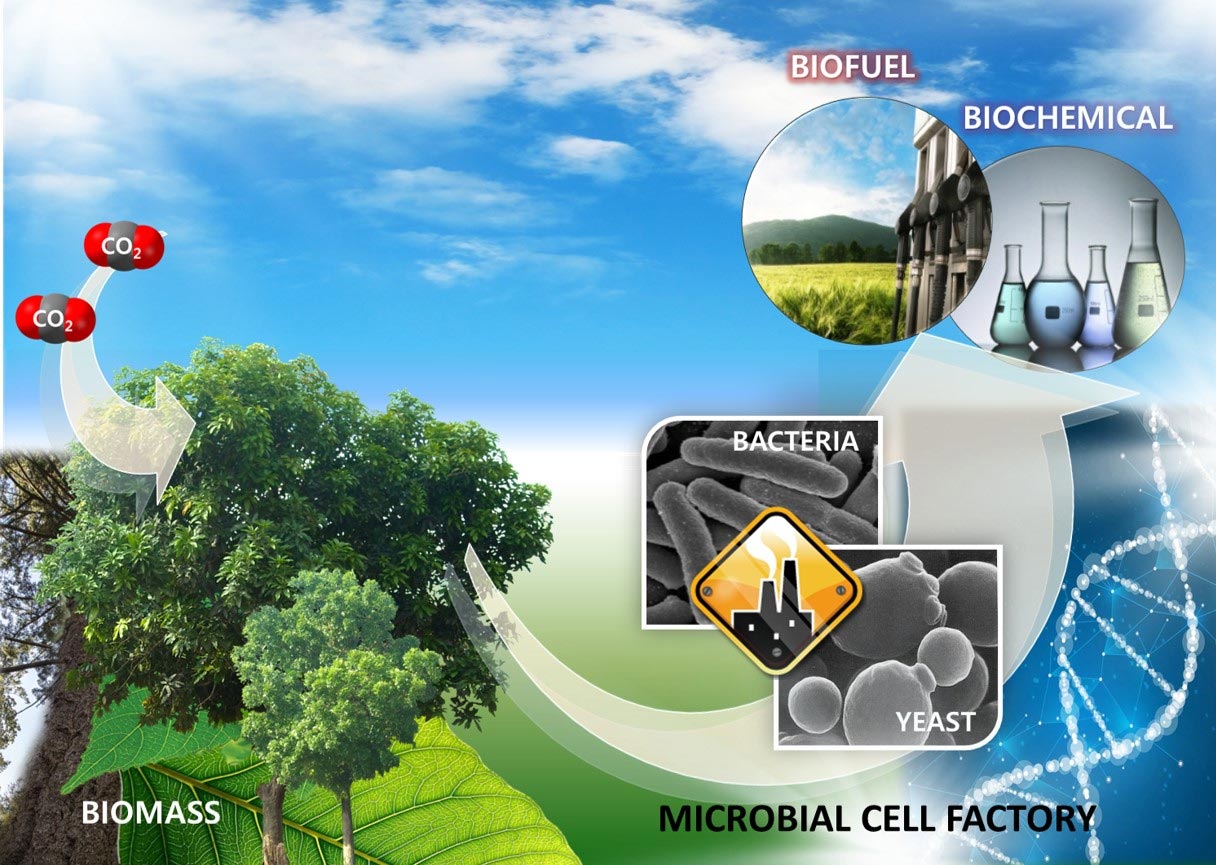
Development of a microorganism that doubles the yield of biodiesel precursor production using genetic scissors and based on the principles of evolution; expected to reduce fine dust release and reduce greenhouse gas emissions.
Automobile exhaust emitted by fossil-fuel-based vehicles, especially those operating on diesel, is known to be a major source of fine dust and greenhouse gases. Using biodiesel instead of diesel is an effective way of coping with climate change caused by greenhouse gases while reducing fine dust emission. However, the current method of producing biodiesel by chemically processing vegetable oil or waste cooking oil, such as palm or soybean oil, is limited. This is due to the unreliable availability of raw materials.
Therefore, there is an active effort to develop biofuels by converting lignocellulosic biomass generated as a by-product of farming or logging, instead of consuming raw materials derived from food crops. Lignocellulosic biomass is an economical and sustainable raw material that can be converted to eco-friendly motor fuel through microbial metabolism.
Dr. Sun-Mi Lee and her team at the Clean Energy Research Center of the Korea Institute of Science and Technology (KIST) have announced that they have developed a novel microorganism capable of producing biodiesel precursors from lignocellulosic biomass such as discarded agricultural by-products, waste paper, and cardboard boxes. This microorganism has achieved the product yield twice what was obtainable from its predecessors.

Credit: Korea Institue of Science and Technology (KIST)
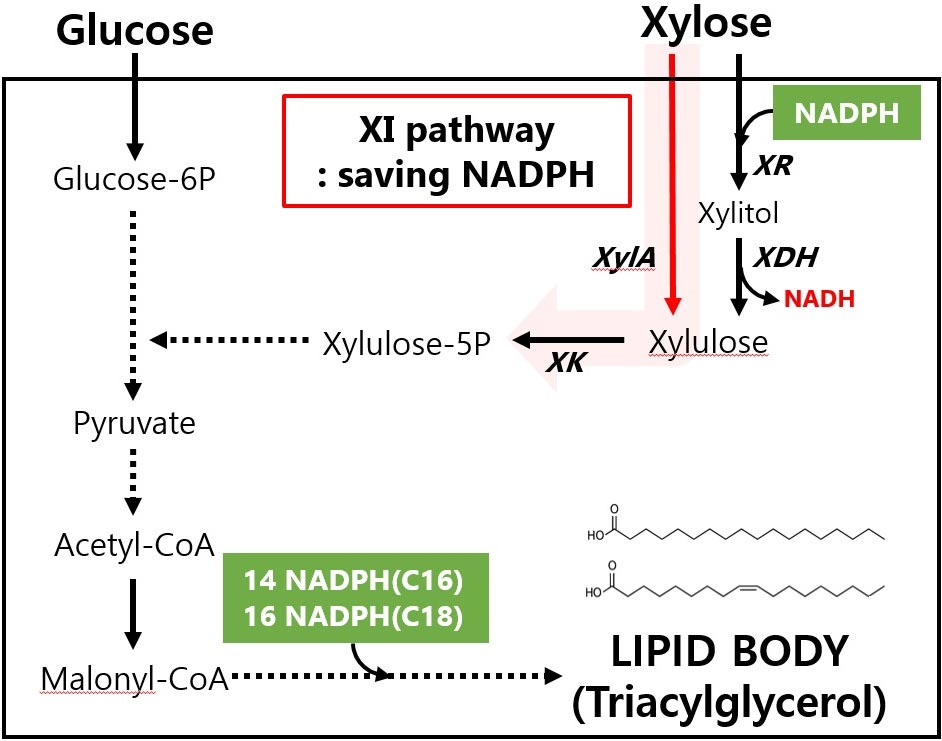
This novel microorganism can produce biodiesel precursors during the process of metabolizing sugars contained in the lignocellulosic biomass that it feeds on. The sugar contained in lignocellulosic biomass is generally composed of 65-70% glucose and 30-35% xylose. While microorganisms that exist in nature are effective in producing diesel precursors by metabolizing glucose, they do not feed on xylose, thus limiting the yield of the raw materials.
To solve this problem, the KIST research team developed a new microorganism that can produce diesel precursors by effectively metabolizing xylose as well as glucose. In particular, the metabolic pathway of the microorganism was redesigned using genetic scissors to prevent interference with the supply of coenzymes essential for producing diesel precursors. The ability to metabolize xylose was improved by effectively controlling the process of evolution in a laboratory, for instance, by selecting and cultivating only those microorganisms that delivered excellent performance.
This confirmed the possibility of producing diesel precursors using all sugar components including xylose from lignocellulosic biomass, and the product yield was almost doubled, compared to that obtained in previous studies which employed metabolic pathways having unresolved coenzyme issues.
“Biodiesel is an effective alternative fuel that can reduce greenhouse gas and fine dust emissions without restricting the operation of existing diesel-fueled vehicles, and we developed a core technology that can improve the economic efficiency of biodiesel production,” said Dr. Sun-Mi Lee of KIST. “At a time like this, when we feel climate change in our bones due to frequent typhoons and severe weather phenomena, expanded supply of biofuels that help us cope with climate change most quickly and effectively will facilitate the expansion of related industries and the development of technology.”
Reference: “High‐yield lipid production from lignocellulosic biomass using engineered xylose‐utilizing Yarrowia lipolytica” by Sang Do Yook, Jiwon Kim, Gyeongtack Gong, Ja Kyong Ko, Youngsoon Um, Sung Ok Han and Sun‐Mi Lee, 19 May 2020, Global Change Biology Bioenergy.
DOI: 10.1111/gcbb.12699
This study was carried out with a grant from the Ministry of Science and ICT (MSIT), as part of the Institutional R&D Program of KIST and the New and Renewable Energy Research Program of the Korea Energy Technology Evaluation and Planning, and it was published in the most recent edition of Global Change Biology Bioenergy (Top 0.55% in the field of JCR).
Never miss a breakthrough: Join the SciTechDaily newsletter.
Follow us on Google and Google News.
1 Comment
Hmmn.
Still in Fossil Fuel burning mode as a source of energy on a mass scale!! Maybe burning coal or burning liquified coal may be interesting scientific experiments.
If I remember my sixth grade Science, Lignite comes from trees and Biomass which have become petrified over time and can be used as a fossil fuel for meeting energy needs.
I guess creating Lipids ( Fats ) from the same Lignite Biomass and burning it would be similar to burning liquified coal? Please do orrect me if I am wrong.
Subjecting lignite to a few chemical transformations and making claims and converting it into Fats/ Lipids and burning it to meet energy requirements , needs to be examined under a microscope.
Please Note, I am not against either “Clean” Coal or ” Clean” Lignite Technologies to meet Humanity’s Growing needs as a temporary stop gap measure, with heavey incentives to move towards Hydrogen and Solar Technologies, whose by products are either water or nothing ( Solar) , though the process for producing the energy may not be Carbon Neutral, Also, increasing disincentives for continuing the Fossil Fuel Fix in a graded fashion regardless of political party in power, needs to become Law. We seem to have become addicted to fossil fuels as a Species! Best of luck to us!
Views expressed are personal and not binding on others.