
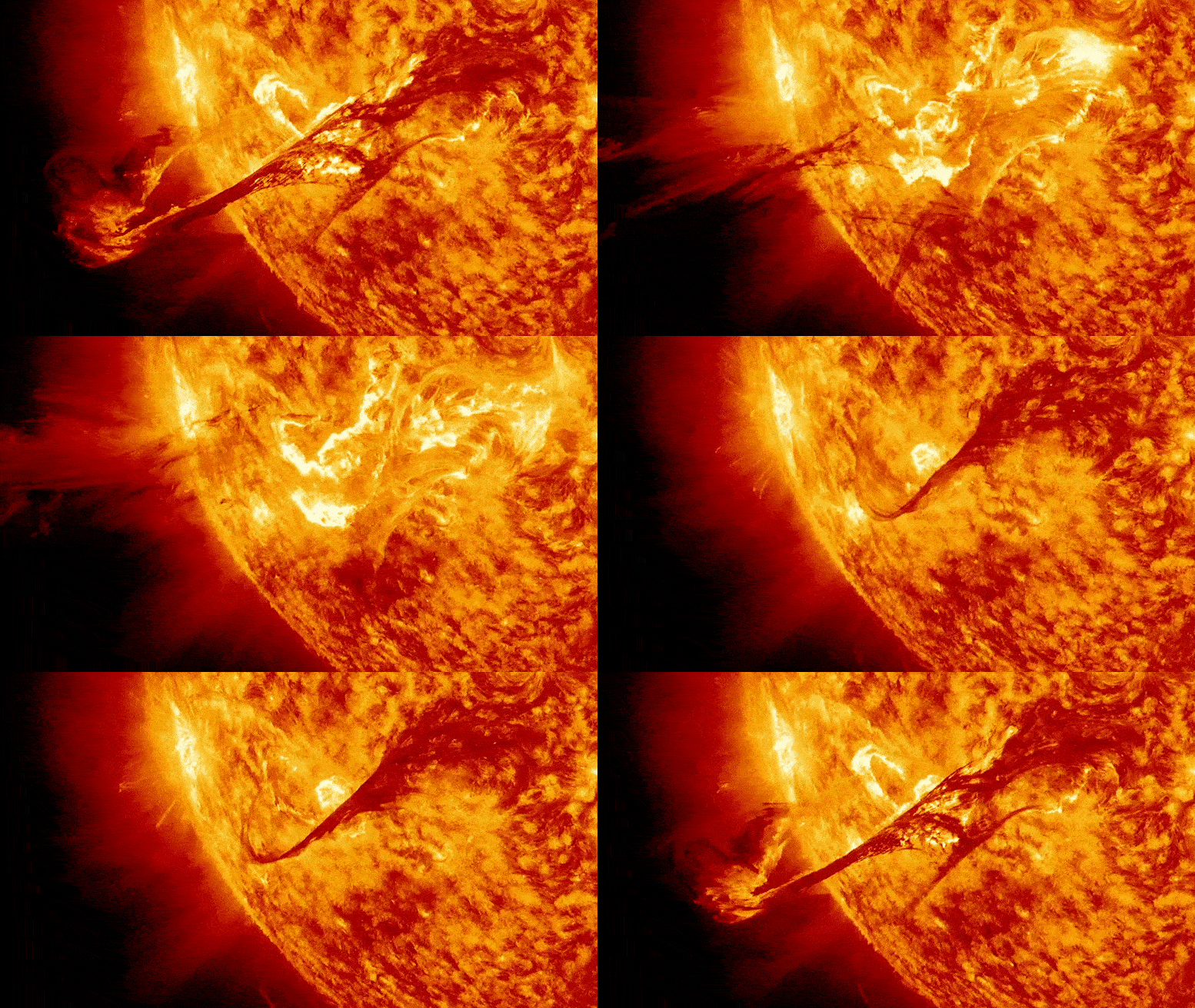
A young star, EK Draconis, unleashed a coronal mass ejection far more powerful than any seen in our solar system.
Astronomers spying on a stellar system located dozens of lightyears from Earth have, for the first time, observed a troubling fireworks show: A star, named EK Draconis, ejected a massive burst of energy and charged particles much more powerful than anything scientists have seen in our own solar system.
The researchers, including astrophysicist Yuta Notsu of the University of Colorado Boulder, will publish their results today (December 9, 2021) in the journal Nature Astronomy.
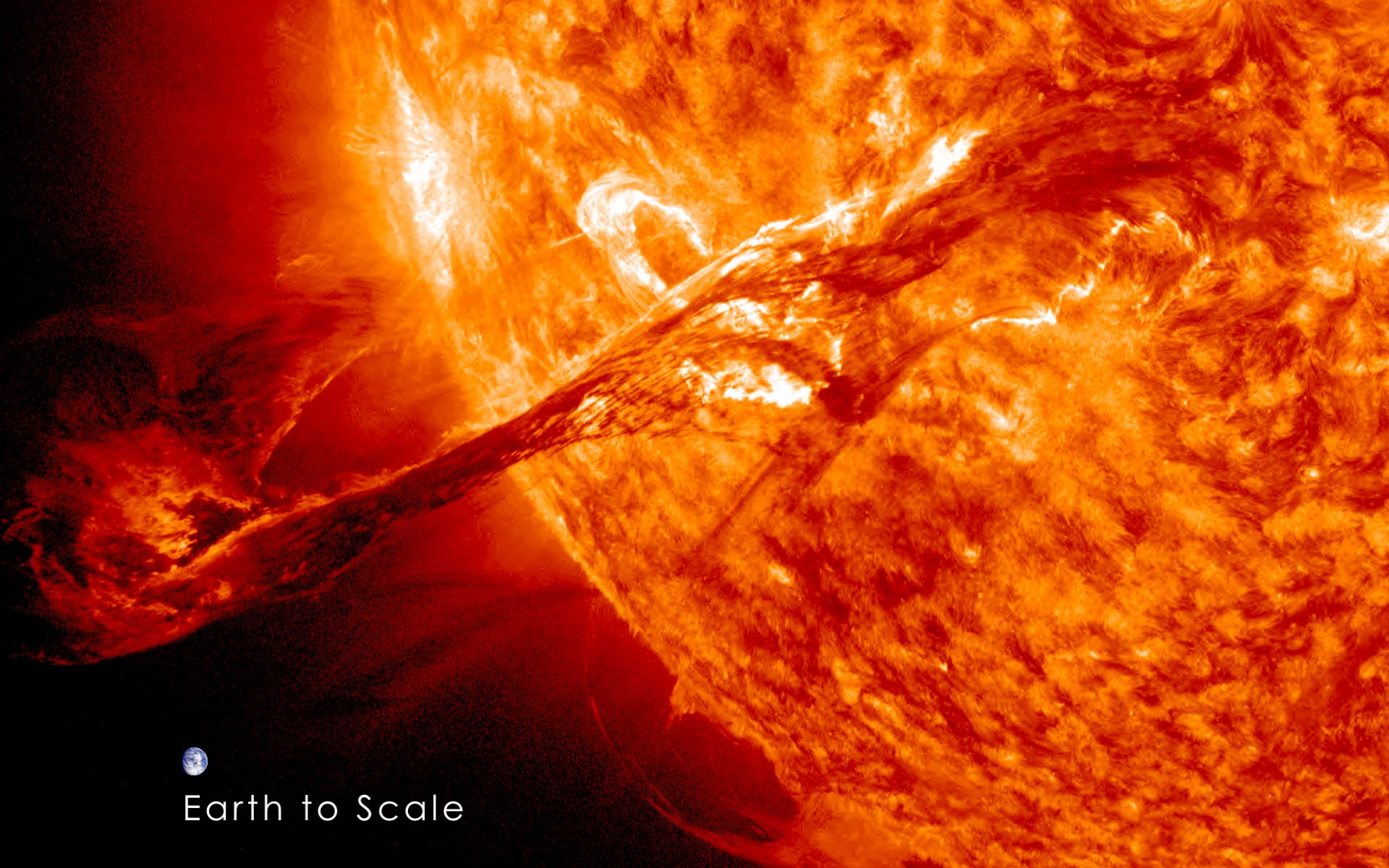
The study explores a stellar phenomenon called a “coronal mass ejection,” sometimes known as a solar storm. Notsu explained that the sun shoots out these sorts of eruptions on a regular basis—they’re made up of clouds of extremely-hot particles, or plasma, that can hurtle through space at speeds of millions of miles per hour. And they’re potentially bad news: If a coronal mass ejection hit Earth dead on, it could fry satellites in orbit and shut down the power grids serving entire cities.
“Coronal mass ejections can have a serious impact on Earth and human society,” said Notsu, a research associate at the Laboratory for Atmospheric and Space Physics (LASP) at CU Boulder and the U.S. National Solar Observatory.
The new study, led by Kosuke Namekata of the National Astronomical Observatory of Japan and formerly a visiting scholar at CU Boulder, also suggests that they can get a lot worse.
In that research, Namekata, Nostu, and their colleagues used telescopes on the ground and in space to peer at EK Draconis, which looks like a young version of the sun. In April 2020, the team observed EK Draconis ejecting a cloud of scorching-hot plasma with a mass in the quadrillions of kilograms—more than 10 times bigger than the most powerful coronal mass ejection ever recorded from a sun-like star.
The event may serve as a warning of just how dangerous the weather in space can be.
“This kind of big mass ejection could, theoretically, also occur on our sun,” Notsu said. “This observation may help us to better understand how similar events may have affected Earth and even Mars over billions of years.”
Superflares Erupt
Notsu explained that coronal mass ejections often come right after a star lets loose a flare, or a sudden and bright burst of radiation that can extend far out into space.
Recent research, however, has suggested that on the sun, this sequence of events may be relatively sedate, at least so far as scientists have observed. In 2019, for example, Notsu and his colleagues published a study that showed that young sun-like stars around the galaxy seem to experience frequent superflares—like our own solar flares but tens or even hundreds of times more powerful.
Such a superflare could, theoretically, also happen on Earth’s sun but not very often, maybe once every several thousand years. Still, it got Notsu’s team curious: Could a superflare also lead to an equally super coronal mass ejection?
“Superflares are much bigger than the flares that we see from the sun,” Notsu said. “So we suspect that they would also produce much bigger mass ejections. But until recently, that was just conjecture.”
Danger From Above
To find out, the researchers set their sights on EK Draconis. The curious star, Notsu explained, is about the same size as our sun, but, at just 100 million years old, it’s a relative youngster in a cosmic sense.
“It’s what our sun looked like 4.5 billion years ago,” Notsu said.
The researchers observed the star for 32 nights in winter and spring 2020 using NASA’s Transiting Exoplanet Survey Satellite (TESS) and Kyoto University’s SEIMEI Telescope. On April 5, Notsu and his colleagues got lucky: The researchers looked on as EK Draconis erupted into a superflare, a really big one. About 30 minutes later, the team observed what appeared to be a coronal mass ejection flying away from the star’s surface. The researchers were only able to catch the first step in that ejection’s life, called the “filament eruption” phase. But even so, it was a monster, moving at a top speed of roughly 1 million miles (1.6 million kilometers) per hour.
It may also not bode well for life on Earth: The team’s findings hint that the sun could also be capable of such violent extremes. But don’t hold your breath—like superflares, super coronal mass ejections are probably rare around our getting-on-in-years sun.
Still, Notsu noted that huge mass ejections may have been much more common in the early years of the solar system. Gigantic coronal mass ejections, in other words, could have helped to shape planets like Earth and Mars into what they look like today.
“The atmosphere of present-day Mars is very thin compared to Earth’s,” Notsu said. “In the past, we think that Mars had a much thicker atmosphere. Coronal mass ejections may help us to understand what happened to the planet over billions of years.”
Reference: “Probable detection of an eruptive filament from a superflare on a solar-type star” by Kosuke Namekata, Hiroyuki Maehara, Satoshi Honda, Yuta Notsu, Soshi Okamoto, Jun Takahashi, Masaki Takayama, Tomohito Ohshima, Tomoki Saito, Noriyuki Katoh, Miyako Tozuka, Katsuhiro L. Murata, Futa Ogawa, Masafumi Niwano, Ryo Adachi, Motoki Oeda, Kazuki Shiraishi, Keisuke Isogai, Daikichi Seki, Takako T. Ishii, Kiyoshi Ichimoto, Daisaku Nogami and Kazunari Shibata, 9 December 2021, Nature Astronomy.
DOI: 10.1038/s41550-021-01532-8
Co-authors on the new study include researchers from the National Astronomical Observatory of Japan, University of Hyogo, Kyoto University, Kobe University, Tokyo Institute of Technology, The University of Tokyo and Doshisha University.
Never miss a breakthrough: Join the SciTechDaily newsletter.
Follow us on Google and Google News.
3 Comments
@Andrea, I saw you on a street in India. We liked you better when you were a beggar rather than a scammer.
Strange that the authors would not mention Carrington events in an article like this. We definitely are going to get another of them here on earth, and we are woefully unprepared. It will be a global catastrophe. MILLIONS, maybe billions will die because we completely ignored what is certainly headed our way. It’s only a matter of WHEN, not if.
even more interesting/distressing is this months Scientific American article that shows evidence of at least 3 events in the past 20,000 years that were 10-100 times more powerful than the Carrington event.