
A Closer Look at Matcha Tea Powder’s Antidepressant-Like Effects
Researchers elucidate how Matcha tea powder improves depression, and what factors control its effect on the mind.
Matcha, a traditional Japanese tea, has been touted for its health benefits—it can boost mood and mental performance in humans and mice alike—but more mechanistic research is required. Hence, researchers from Japan evaluated the anti-depressive effects of Matcha tea powder in mice. The powder activates dopaminergic neural circuits and improves depression in certain mice, depending on the animal’s prior mental state. More studies like this could help develop better antidepressants.
Depression is currently the most prevalent mental disorder in the world and the number of people affected by it continues to grow. Although the onset of depression varies among individuals, it is believed that the disease commonly stems from a reduction in dopamine in the brain. Dopamine, a neurotransmitter and hormone, plays an important role in elevating one’s mood and making a person feel happy, accomplished, and motivated. And while various antidepressants have been developed to counter the effect of low dopamine, these have many side effects.
Moreover, people may develop resistance to antidepressants, requiring higher doses with time, or a frequent change in medication. These problems gave impetus to the search for natural products with anti-depressant effects. One such product, Matcha, has recently gained popularity. Sourced from the leaves of Camellia sinensis—which are rich in mood-boosting compounds—Matcha powder is traditionally used to make tea.
Consumption of this tea has shown to improve anxiety-like behavior in mice by activating dopamine function via dopamine D1 receptor signaling. The resultant dopamine boost could improve the symptoms of depression as well. So, Dr. Yuki Kurauchi of Kumamoto University led a team of researchers to investigate the effects of Matcha tea powder in socially isolated mice. They have detailed their findings in a paper published in Volume 15, Issue 3 of the journal Nutrients on January 22, 2023.
The team used stress-tolerant BALB/c and stress-susceptible C57BL/6J mice subjected to social isolation stress for their experiments. Orally administering a Matcha tea suspension, however, appeared to reduce levels of depression in the stress-susceptible mice. This was indicated by their performance in tail suspension tests (TST), which are commonly used to evaluate depression in mice. Dr. Kurauchi clarifies: “Matcha tea reduced the immobility time only in stress-susceptible mice that experienced greater stress from social isolation, and exhibited higher depression-like behavior, in comparison to the stress-tolerant mice.”
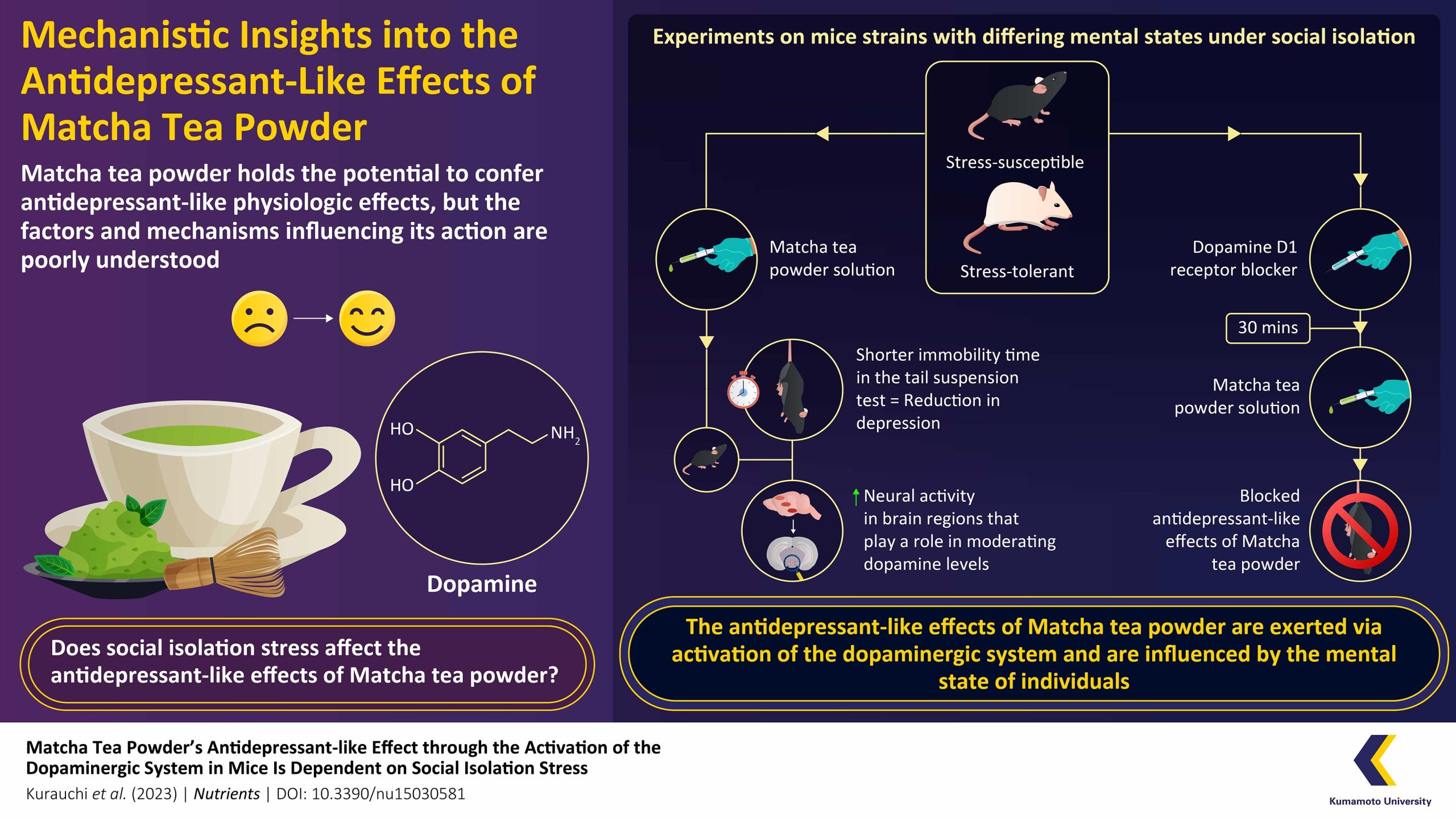
How did this happen? The team dug deeper. An immunohistochemical analysis of the mice brains revealed activation of the prefrontal cortex (PFC) and nucleus accumbens (NAc) in the stress-susceptible mice after they had consumed the Matcha tea suspension. These regions form an important part of the dopaminergic circuit and are crucial for controlling dopamine levels in the brain. Their activation—indicated by an increase in the number of cells expression c-Fos, an important indicator of neural activity—would typically boost dopamine levels, elevating one’s mood. Stress-susceptible mice with a shorter immobility time also had more c-Fos-positive cells in the ventral tegmental area (VTA) of their brains (which initiates dopaminergic activity), as well as in the PFC and NAc, indicating higher neural activity and dopamine production. In contrast, none of these effects were seen in stress-tolerant mice.
This was further cemented by another finding—administering a dopamine D1 receptor blocker to stress-susceptible mice negated the antidepressant-like effects of Matcha tea suspension. Dr. Kurauchi ties it all together. “These results suggest that Matcha tea powder exerts an antidepressant-like effect by activating the dopaminergic system of the brain, and this is influenced by the mental state of the individual.”
Dr. Kurauchi is also optimistic of the future implications of their research. While evaluating antidepressants in individuals, the differences in their mental conditions should be considered as well now, given how stress-susceptible mice were sensitive to the effect of Matcha tea suspension, but stress-tolerant mice were not. “Also, incorporating Matcha into health promotion programs has potential to improve its widespread utility,” he says. Here’s to better mental health with safer food ingredients!
Reference: “Matcha Tea Powder’s Antidepressant-like Effect through the Activation of the Dopaminergic System in Mice Is Dependent on Social Isolation Stress” by Yuki Kurauchi, Yuki Ohta, Keigo Matsuda, Wakana Sanematsu, Hari Prasad Devkota, Takahiro Seki and Hiroshi Katsuki, 22 January 2023, Nutrients.
DOI: 10.3390/nu15030581
About Associate Professor Yuki Kurauchi
Dr. Yuki Kurauchi is an Associate Professor at the Department of Chemico-Pharmacological Sciences at Graduate School of Pharmaceutical Sciences, Kumamoto University, Japan. He holds a Ph.D in Pharmaceutical Sciences and has over 100 research papers to his credit. His work focuses on the use of pharmacological approaches to treat central nervous system disorders. His specific research interests include behavioral analysis of patients with anxiety, the neurochemical basis of social hierarchy-induced stress, and analysis of the pathogenic mechanisms of migraine.
Never miss a breakthrough: Join the SciTechDaily newsletter.
Follow us on Google and Google News.