
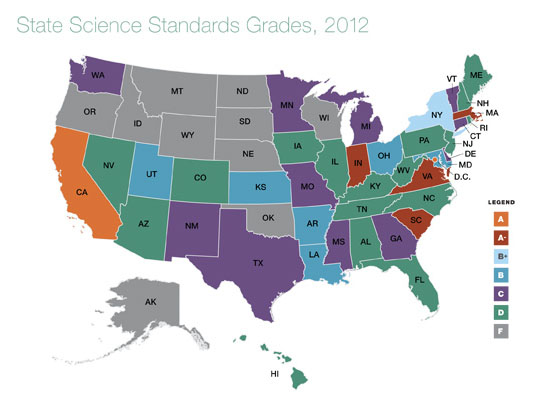
A new report from the Thomas B. Fordham Institute on the United States K-12 state science standards reports that “the majority of the states’ standards remain mediocre to awful.” Several states around the northwest scored F’s, while only seven states scored an A- or higher.
A major Thomas B. Fordham Institute report released today finds that the K-12 science standards of most states remain mediocre to awful, placing America’s national competitiveness, technological prowess, and scientific leadership in grave jeopardy.
Since the Sputnik launch of 1957, Americans have regarded science education as crucial to our national security and economic competitiveness. Just recently, a National Science Board report found that the U.S. could soon be overtaken as the global leader in supporting science and technology, and advocates educational improvement as crucial to America maintaining its role as the world’s engine of scientific innovation. But The State of State Science Standards, which reviews and analyzes the guidelines that inform K-12 science curriculum and instruction in every state and the District of Columbia, concludes that what states presently expect of their schools in this critical subject is woefully inadequate.
In this comprehensive appraisal, more than 75 percent of states received grades of C or lower, and a majority received D’s or F’s. California and the District of Columbia earned the only straight As—while Indiana, Massachusetts, South Carolina, and Virginia received A-‘s for their excellent state science standards. But most states lack rigorous, content-rich standards. Seven of them received B-level grades; 11 states received Cs; 17 states received Ds; and 10 states received failing F grades. (COMPLETE STATE RANKINGS CAN BE VIEWED BELOW)
“If America is to remain a prosperous, scientifically-advanced and economically competitive nation, then we must ensure that every school is teaching science to a very high standard,” said Chester E. Finn, Jr., Fordham’s president. “In this subject as in others reviewed by Fordham experts, the states set the bar, prescribing what schools should teach and students need to learn. They then develop assessments keyed to those standards. If our expectations are low and unclear, we’re guaranteeing the failure of our students and the weakening of our nation.”
Leading science education experts authored this analysis, evaluating state science standards for their clarity, content completeness, and scientific correctness. Science standards are the foundation upon which a state’s system of assessment, instruction, and accountability rests. Therefore, this review analyzes the standards themselves to ensure that they’re clear, thorough, and academically demanding. It does not investigate whether science standards are being properly assessed with state tests, effectively implemented in the schools, or whether they are driving improvements in student achievement.
Shortcomings were many and diverse but there turned out to be four areas, in particular, where state science standards were flawed.
- While many states are handling evolution better today than during the last Fordham review in 2005, antievolutionary pressures continue to threaten and weaken science standards in many jurisdictions.
- A great many standards are so vague for educators as to be completely meaningless. Only 7 states earned full-credit scores for clarity and specificity while 29 earned a one or zero out of three.
- Science educators, curriculum developers, and standards writers have focused excessive attention on “inquiry based learning”—attempting to help students learn through “discovery” instead of direct instruction of specific content. In too many states, these inquiry standards are vague to the point of uselessness—depriving students of an education based on substantive scientific content.
- Mathematics is essential to science, yet few states make this link between math and science clear—and many seem to go to great lengths to avoid mathematical formulae and equations altogether. Students cannot adequately learn physics and chemistry without understanding mathematical concepts and mastering quantitative operations.
“The brave souls, expert scientists, and veteran educators currently struggling to develop a draft of ‘common’ science standards under the aegis of Achieve, Inc., have a weighty burden,” Finn remarked. “Can they develop a K-12 product that is suitably content-rich, rigorous, clear and usable across America? Will such a product replace the mediocre standards that most states have in place today? But the authors don’t have to start from scratch. Besides a commendable science-education “framework” from the National Research Council, they can look to the excellent standards already in use in several states as models. It’s no secret what good science standards look like. It’s a blight upon the United States, however, that such standards are guiding the schools and teachers in so few places today.”
| Jurisdiction | Grade | Total Score | Content and Rigor Score (out of 7) | Clarity and Specificity Score (out of 3) |
| California | A | 10 | 7 | 3 |
| District of Columbia | A | 10 | 7 | 3 |
| Indiana | A- | 9 | 6 | 3 |
| Massachusetts | A- | 9 | 6 | 3 |
| NAEP framework | A- | 9 | 7 | 2 |
| South Carolina | A- | 9 | 6 | 3 |
| Virginia | A- | 9 | 6 | 3 |
| New York | B+ | 8 | 6 | 2 |
| Arkansas | B | 7 | 5 | 2 |
| Kansas | B | 7 | 5 | 2 |
| Louisiana | B | 7 | 5 | 2 |
| Maryland | B | 7 | 5 | 2 |
| Ohio | B | 7 | 5 | 2 |
| Utah | B | 7 | 5 | 2 |
| Connecticut | C | 6 | 4 | 2 |
| Georgia | C | 6 | 4 | 2 |
| Michigan | C | 6 | 4 | 2 |
| Missouri | C | 6 | 4 | 2 |
| New Mexico | C | 6 | 4 | 2 |
| Texas | C | 6 | 5 | 1 |
| Washington | C | 6 | 3 | 3 |
| Delaware | C | 5 | 3 | 2 |
| Minnesota | C | 5 | 4 | 1 |
| Mississippi | C | 5 | 4 | 1 |
| Vermont | C | 5 | 3 | 2 |
| Alabama | D | 4 | 3 | 1 |
| Arizona | D | 4 | 3 | 1 |
| Florida | D | 4 | 3 | 1 |
| Hawaii | D | 4 | 3 | 1 |
| Illinois | D | 4 | 3 | 1 |
| Maine | D | 4 | 3 | 1 |
| New Hampshire | D | 4 | 3 | 1 |
| North Carolina | D | 4 | 3 | 1 |
| Rhode Island | D | 4 | 2 | 2 |
| Tennessee | D | 4 | 3 | 1 |
| West Virginia | D | 4 | 3 | 1 |
| Colorado | D | 3 | 2 | 1 |
| Iowa | D | 3 | 2 | 1 |
| Kentucky | D | 3 | 2 | 1 |
| Nevada | D | 3 | 2 | 1 |
| New Jersey | D | 3 | 2 | 1 |
| Pennsylvania | D | 3 | 2 | 1 |
| Alaska | F | 2 | 1 | 1 |
| Idaho | F | 2 | 2 | 0 |
| Nebraska | F | 2 | 1 | 1 |
| Oklahoma | F | 2 | 1 | 1 |
| Oregon | F | 2 | 1 | 1 |
| South Dakota | F | 2 | 1 | 1 |
| Wyoming | F | 2 | 2 | 0 |
| Montana | F | 1 | 1 | 0 |
| North Dakota | F | 1 | 1 | 0 |
| Wisconsin | F | 0 | 0 | 0 |
Never miss a breakthrough: Join the SciTechDaily newsletter.
Follow us on Google and Google News.
2 Comments
Well, it’s nice to know California does something right, given all the breast-beating that goes on out here about our schools. I’d like to point out that the Social Studies standards adopted years ago are top-flight, too.
Wait, so the majority of the country is science illiterate and the main concern about that is international competitiveness?? Good grief. I have SO many other concerns related to people simply being dumb and ignorant and unable to think logically and scientifically.