
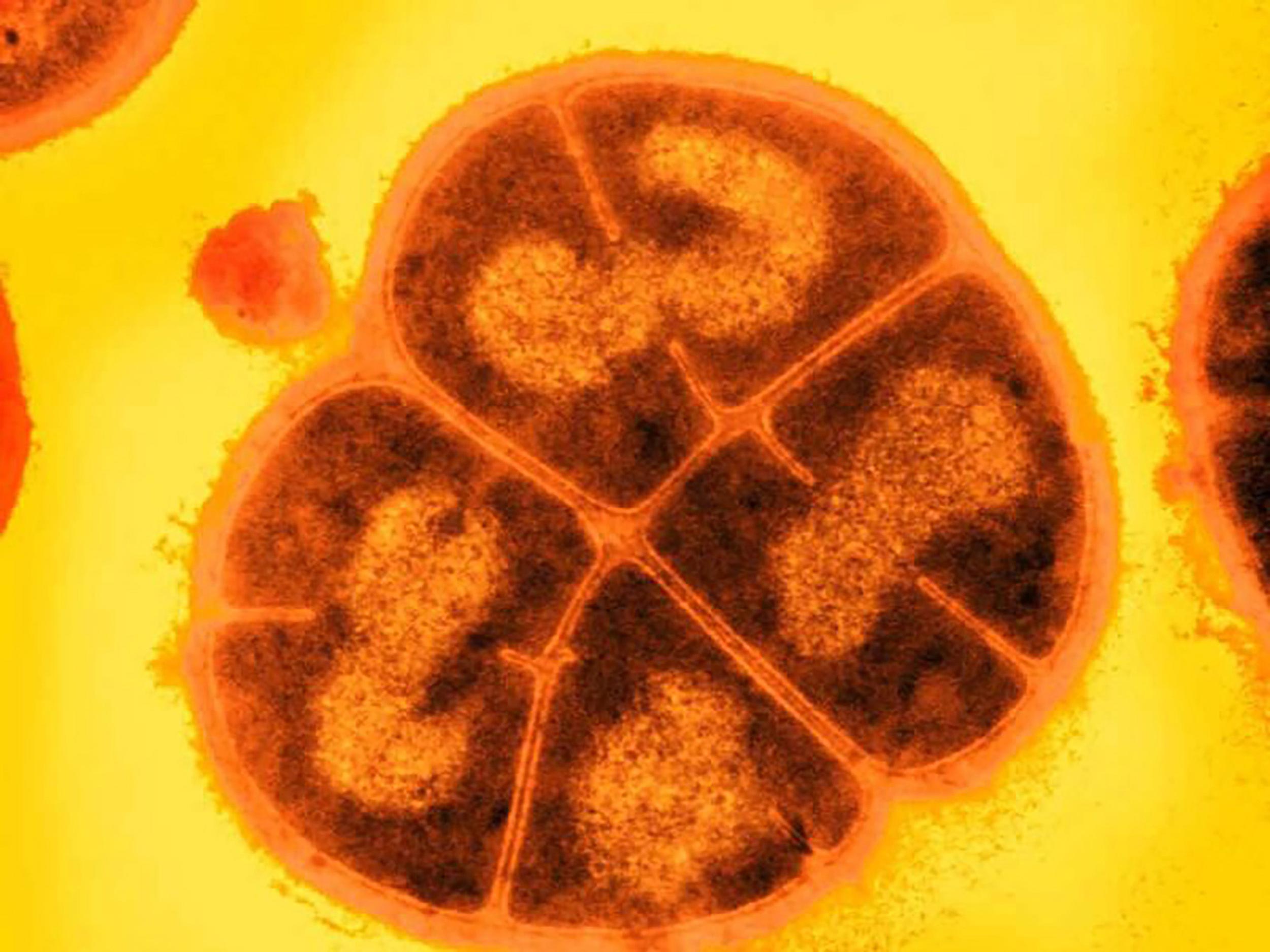
Deinococcus radiodurans, also known as “Conan the Bacterium,” is one of nature’s toughest life forms, capable of surviving radiation levels thousands of times higher than what would kill a human.
Scientists have finally uncovered the molecular secret behind its resilience: a unique antioxidant complex formed by manganese and specific metabolites. This discovery could pave the way for life-saving technologies, from space exploration to medical treatments.
“Conan the Bacterium”
Nicknamed “Conan the Bacterium” for its incredible resilience, Deinococcus radiodurans can survive radiation doses thousands of times stronger than what would be fatal to humans — or any other known organism.
This extraordinary resistance comes from a set of simple metabolites that combine with manganese to create a powerful antioxidant. Researchers at Northwestern University and the Uniformed Services University (USU) have now uncovered how this natural defense mechanism works.
Synthetic Antioxidant Inspired by Microbial Resilience
In a new study, the researchers characterized a synthetic designer antioxidant, called MDP, which was inspired by Deinococcus radiodurans’ resilience. They found MDP’s components — manganese ions, phosphate and a small peptide — form a ternary complex that is a much more powerful protectant from radiation damage than manganese combined with either of the other individual components alone.
This discovery could eventually lead to new synthetic antioxidants specifically tailored to human needs. Applications include protecting astronauts from intense cosmic radiation during deep-space missions, preparing for radiation emergencies, and producing radiation-inactivated vaccines.
The study was published on December 12 in the Proceedings of the National Academy of Sciences.
The Breakthrough in Antioxidant Research
“It is this ternary complex that is MDP’s superb shield against the effects of radiation,” said Northwestern’s Brian Hoffman, who conducted the study with USU’s Michael Daly. “We’ve long known that manganese ions and phosphate together make a strong antioxidant, but discovering and understanding the ‘magic’ potency provided by the addition of the third component is a breakthrough. This study has provided the key to understanding why this combination is such a powerful — and promising — radioprotectant.”
Hoffman is the Charles E. and Emma H. Morrison Professor of Chemistry and professor of molecular biosciences at Northwestern’s Weinberg College of Arts and Sciences. He also is a member of the Chemistry of Life Processes Institute. An expert on Deinococcus radiodurans, Daly is a professor of pathology at USU and a member of the National Academies’ Committee on Planetary Protection.
Incredible Hulk of the Microbial World
The new study builds on previous research from Hoffman’s and Daly’s collaboration, during which they sought to better understand Deinococcus radiodurans’ predicted ability to withstand radiation on Mars. In that research, Hoffman’s team at Northwestern used an advanced spectroscopy technique to measure the accumulation of manganese antioxidants in the microbes’ cells.
According to Hoffman and Daly, the size of the radiation dose that a microorganism or its spores can survive directly correlates with the amount of manganese antioxidants it contains. In other words, more manganese antioxidants mean more resistance to intense radiation.
In earlier studies, other researchers discovered Deinococcus radiodurans can survive 25,000 grays (or units of x- and gamma-rays). But, in their 2022 study, Hoffman and Daly found that the bacterium — when dried and frozen — could weather 140,000 grays of radiation, a dose 28,000 times greater than what would kill a human. So, if there are any slumbering, frozen microbes buried on Mars, they possibly could have survived the onslaught of galactic cosmic radiation and solar protons to this day.
Unique Radiation Shielding Properties
Building on their efforts to understand the microbe’s radiation resistance, Hoffman and Daly’s team investigated a designer decapeptide called DP1. When combined with phosphate and manganese, DP1 forms the free-radical-scavenging agent MDP, which successfully protects cells and proteins against radiation damage. In another recent study, Daly and his collaborators found MDP is effective in the preparation of irradiated polyvalent vaccines.
Using advanced paramagnetic resonance spectroscopy, the team revealed that the active ingredient of MDP is a ternary complex — a precise assembly of phosphate and peptide bound to manganese.
“This new understanding of MDP could lead to the development of even more potent manganese-based antioxidants for applications in health care, industry, defense and space exploration,” Daly said.
Reference: “The ternary complex of Mn2+, synthetic decapeptide DP1 (DEHGTAVMLK) and orthophosphate is a superb antioxidant” by Hao Yang, Ajay Sharma, Michael J. Daly and Brian M. Hoffman, 12 December 2024, Proceedings of the National Academy of Sciences.
DOI: 10.1073/pnas.2417389121
The study was supported by the National Institutes of Health (grant number GM111097), the National Science Foundation (grant number CHE-2333907) and the Defense Threat Reduction Agency (grant number HDTRA1620354).
Never miss a breakthrough: Join the SciTechDaily newsletter.
Follow us on Google and Google News.