
Close Menu
    Facebook X (Twitter) Instagram
    SciTechDaily
    • Biology
    • Chemistry
    • Earth
    • Health
    • Physics
    • Science
    • Space
    • Technology
    Facebook X (Twitter) Pinterest YouTube RSS
    SciTechDaily
    Home»Space»Meteorite Chunk Contains Unexpected Evidence of Solid Interstellar Material Formed Before the Sun Was Born
    Space

    Meteorite Chunk Contains Unexpected Evidence of Solid Interstellar Material Formed Before the Sun Was Born

    By Washington University in St. LouisApril 5, 2020No Comments4 Mins Read
    Facebook Twitter Pinterest Telegram LinkedIn WhatsApp Email Reddit
    Share
    Facebook Twitter LinkedIn Pinterest Telegram Email Reddit
    Allende Meteorite Fragment
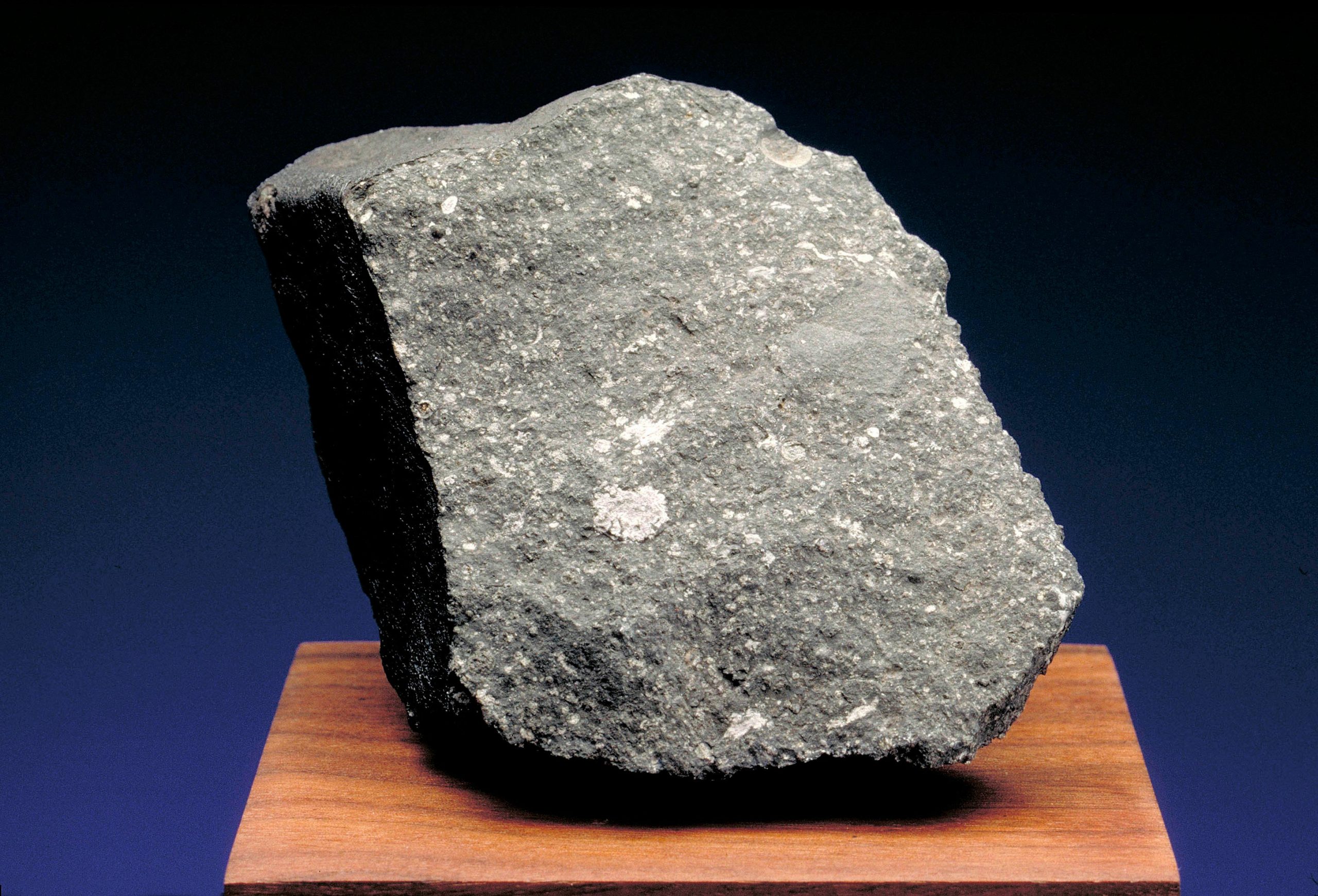
    Curious Marie comes from the Allende meteorite, which fell in northern Mexico in February 1969. The white, fuzzy-looking features in this fragment of Allende are calcium-aluminum-rich inclusions — some of the first solids to condense in the solar system. Credit: Chip Clark, Smithsonian Institution

    ‘Curious and Curiouser!’ – Meteorite Chunk Contains Unexpected Evidence of Presolar Grains

    An unusual chunk in a meteorite may contain a surprising bit of space history, based on research from Washington University in St. Louis.

    Presolar grains — tiny bits of solid interstellar material formed before the sun was born — are sometimes found in primitive meteorites. But a new analysis reveals evidence of presolar grains in part of a meteorite where they are not expected to be found.

    “What is surprising is the fact that presolar grains are present,” said Olga Pravdivtseva, research associate professor of physics in Arts & Sciences and lead author of a paper published in Nature Astronomy. “Following our current understanding of solar system formation, presolar grains could not survive in the environment where these inclusions are formed.”

    Curious Marie is a notable example of an “inclusion,” or a chunk within a meteorite, called a calcium-aluminum-rich inclusion (CAI). These objects, some of the first to have condensed in the solar nebula, help cosmochemists define the age of the solar system. This particular chunk of meteorite —  from the collection of the Robert A. Pritzker Center for Meteoritics and Polar Studies at the Chicago Field Museum — was in the news once before, when scientists from the University of Chicago gave it its name to honor chemist Marie Curie.

    Olga Pravdivtseva
    Olga Pravdivtseva, research associate professor of physics in Arts & Sciences at Washington University in St. Louis, uses noble gas isotopes to study the formation and evolution of the early solar system. Pravdivtseva, a member of the McDonnell Center for the Space Sciences, is pictured in her laboratory in Compton Hall. Credit: Whitney Curtis/Washington University

    For the new work, Pravdivtseva and her co-authors, including Sachiko Amari, research professor of physics at Washington University, used noble gas isotopic signatures to show that presolar silicon carbide (SiC) grains are present in Curious Marie.

    That’s important because presolar grains are generally thought to be too fragile to have endured the high-temperature conditions that existed near the birth of our sun.

    But not all CAIs were formed in quite the same way.

    “The fact that SiC is present in refractory inclusions tells us about the environment in the solar nebula at the condensation of the first solid materials,” said Pravdivtseva, who is part of Washington University’s McDonnell Center for the Space Sciences. “The fact that SiC was not completely destroyed in Curious Marie can help us to understand this environment a little bit better.

    “Many refractory inclusions were melted and lost all textural evidence of their condensation. But not all.”

    Like solving a mystery

    Pravdivtseva and her collaborators used two mass spectrometers built in-house at Washington University to make their observations. The university has a long history of using noble gas isotopes as tracers of various nuclear processes and is home to one of the best-equipped noble gas laboratories in the world. Still, this work was uniquely challenging.

    The researchers had 20 mg of Curious Marie to work with, which is a relatively large sample from a cosmochemistry perspective. They heated it up incrementally, increasing the temperature and measuring the composition of four different noble gases released at each of the 17 temperature steps.

    “Experimentally, it is an elegant work,” Pravdivtseva said. “And then we had a puzzle of noble gas isotopic signatures to untangle. For me, it is like solving a mystery.”

    Others have looked for evidence of SiC in such calcium-aluminum-rich inclusions in meteorites using noble gases before, but Pravdivtseva’s team is the first to find it.

    “It was beautiful when all noble gases pointed to the same source of the anomalies — SiC,” she said.

    “Not only do we see SiC in the fine-grained CAIs, we see a population of small grains that formed at special conditions,” Pravdivtseva said. “This finding forces us to revise how we see the conditions in the early solar nebula.”

    Reference: “Evidence of presolar SiC in the Allende Curious Marie calcium–aluminium-rich inclusion” by O. Pravdivtseva, F. L. H. Tissot, N. Dauphas and S. Amari, 27 January 2020, Nature Astronomy.
    DOI: 10.1038/s41550-019-1000-z

    Never miss a breakthrough: Join the SciTechDaily newsletter.
    Follow us on Google and Google News.

    Astronomy Meteorites Popular Washington University in St. Louis
    Share. Facebook Twitter Pinterest LinkedIn Email Reddit

    Related Articles

    Physics Beyond Known Laws: Neutron Star Collisions Shed Light on Dark Matter Mysteries

    Polarized X-Rays Reveal Stunning New Details About Extremely Hot Matter Surrounding Black Hole

    Ancient Space Dust Analysis Could Solve Mystery of Origins of Earth’s Water

    Analyzing Meteorites To Track Down the Forces That Shaped Our Solar System’s Evolution

    We Asked a NASA Expert: When Was the Last Time an Asteroid Hit Earth? [Video]

    Tread Lightly: Strange “Eggshell Planets” Possible Around Other Stars

    Stellar Fossils in Pristine Meteorites Point to Ancient Stars That Died Before the Sun Formed

    Sculpted by Starlight: An Unusual Meteorite Witness to the Solar System’s Birth

    Investigating Baked Meteorites Yields Clues to Planetary Atmospheres

    Leave A Reply Cancel Reply

    • Facebook
    • Twitter
    • Pinterest
    • YouTube

    Don't Miss a Discovery

    Subscribe for the Latest in Science & Tech!

    Trending News

    Largest-Ever Study Finds Medicinal Cannabis Ineffective for Anxiety, Depression, PTSD

    250-Million-Year-Old Egg Solves One of Evolution’s Biggest Mysteries

    Living With Roommates Might Be Changing Your Gut Microbiome Without You Knowing

    Century-Old Cleaning Chemical Linked to 500% Increased Risk of Parkinson’s Disease

    What if Your Memories Never Happened? Physicists Take a New Look at the Boltzmann Brain Paradox

    One of the Universe’s Largest Stars May Be Getting Ready To Explode

    Scientists Discover Enzyme That Could Supercharge Ozempic-Like Weight Loss Drugs

    Popular Sweetener Linked to DNA Damage – “It’s Something You Should Not Be Eating”

    Follow SciTechDaily
    • Facebook
    • Twitter
    • YouTube
    • Pinterest
    • Newsletter
    • RSS
    SciTech News
    • Biology News
    • Chemistry News
    • Earth News
    • Health News
    • Physics News
    • Science News
    • Space News
    • Technology News
    Recent Posts
    • Scientists Uncover Hidden Genetic Cause of Diabetes in Babies
    • Amazonian Chocolate Could Become the Next Superfood, Scientists Say
    • Challenging the Narrative: New Study Shows U.S. Life Expectancy Is Rising Across All States
    • Mystery Illness Kills 5 in Burundi As Doctors Scramble for Answers
    • Bone-Strengthening Discovery Could Reverse Osteoporosis
    Copyright © 1998 - 2026 SciTechDaily. All Rights Reserved.
    • Science News
    • About
    • Contact
    • Editorial Board
    • Privacy Policy
    • Terms of Use

    Type above and press Enter to search. Press Esc to cancel.