
Close Menu
    Facebook X (Twitter) Instagram
    SciTechDaily
    • Biology
    • Chemistry
    • Earth
    • Health
    • Physics
    • Science
    • Space
    • Technology
    Facebook X (Twitter) Pinterest YouTube RSS
    SciTechDaily
    Home»Space»Micrometeoroid Bombardment and Magnetic Fields: Decoding the Effects of Interplanetary Space on Asteroid Ryugu
    Space

    Micrometeoroid Bombardment and Magnetic Fields: Decoding the Effects of Interplanetary Space on Asteroid Ryugu

    By Hokkaido UniversityApril 29, 2024No Comments4 Mins Read
    Facebook Twitter Pinterest Telegram LinkedIn WhatsApp Email Reddit
    Share
    Facebook Twitter LinkedIn Pinterest Telegram Email Reddit
    Effects of Interplanetary Space on Asteroid Ryugu
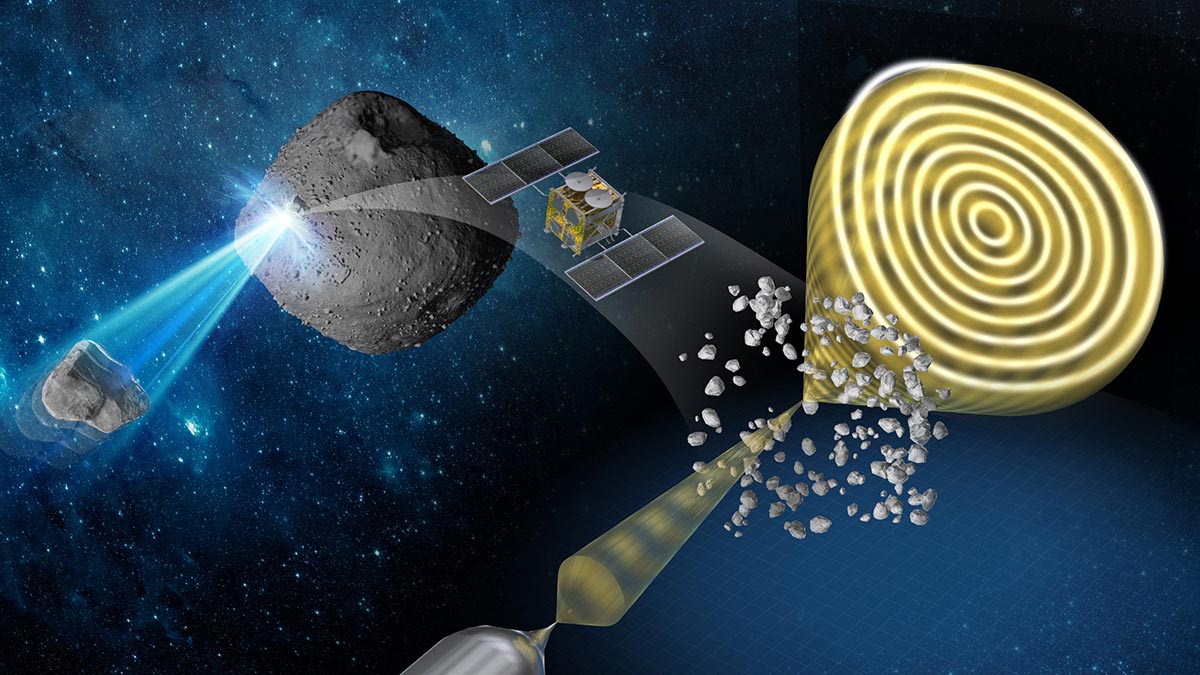
    Researchers analyzed samples from asteroid Ryugu, collected by the Hayabusa2 spacecraft, revealing new insights into space weathering and magnetic properties. (Conceptual illustration of the study.) Credit: Yuki Kimura

    Samples reveal evidence of changes experienced by the surface of asteroid Ryugu, some probably due to micrometeoroid bombardment.

    Analyzing samples retrieved from the asteroid Ryugu by the Japanese Space Agency’s Hayabusa2 spacecraft has revealed new insights into the magnetic and physical bombardment environment of interplanetary space. The results of the study, carried out by Professor Yuki Kimura at Hokkaido University and co-workers at 13 other institutions in Japan, are published today (April 29) in the journal Nature Communications.

    The investigations used electron waves penetrating the samples to reveal details of their structure and magnetic and electric properties, a technique called electron holography.

    Hayabusa2 Mission

    Hayabusa2 reached asteroid Ryugu on June 27, 2018, collected samples during two delicate touchdowns, and then returned the jettisoned samples to Earth in December 2020. The spacecraft is now continuing its journey through space, with plans for it to observe two other asteroids in 2029 and 2031.
    Magnetite Particles Cut From Ryugu Sample
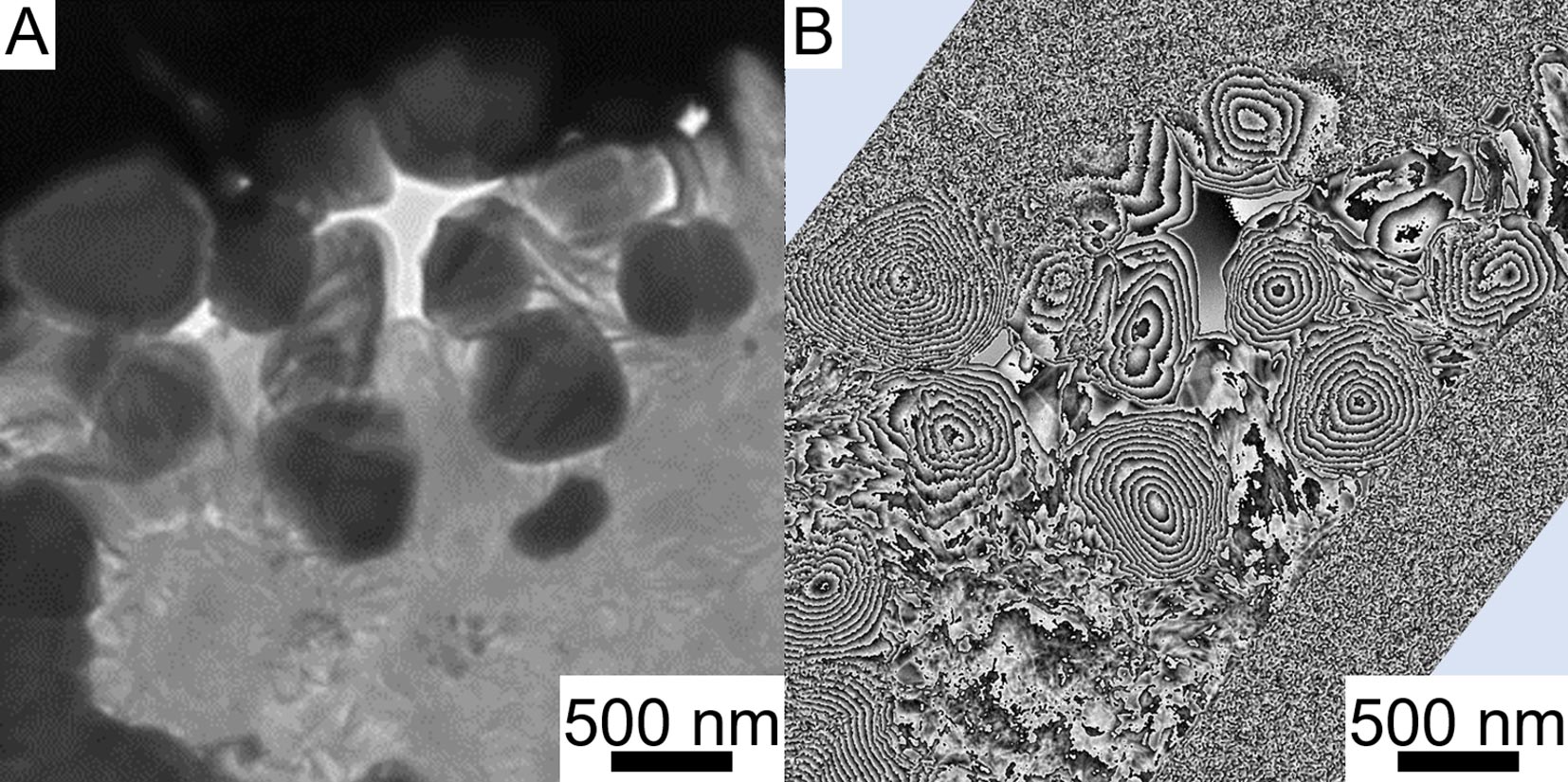
    Magnetite (round particles) particles cut from a Ryugu sample. (A) Bright field transmission electron microscopy image. (B) Magnetic flux distribution image obtained by electron holography. The concentric circular stripes seen inside the particles correspond to magnetic lines of force. They are called vortex magnetic domain structures and are more stable than ordinary hard disks, which can record magnetic fields for more than 4.6 billion years. Credit: Yuki Kimura, et al. Nature Communications. April 29, 2024

    One advantage of collecting samples directly from an asteroid is that it allows researchers to examine the long-term effects of its exposure to the environment of space. The ‘solar wind’ of high energy particles from the sun and bombardment by micrometeoroids cause changes known as space-weathering. It is impossible to study these changes precisely using most of the meteorite samples that land naturally on Earth, partly due to their origin from the internal parts of an asteroid, and also due to the effects of their fiery descent through the atmosphere.

    Insights Into Space Weathering

    “The signatures of space weathering we have detected directly will give us a better understanding of some of the phenomena occurring in the Solar System,” says Kimura. He explains that the strength of the magnetic field in the early solar system decreased as planets formed, and measuring the remnant magnetization on asteroids can reveal information about the magnetic field in the very early stages of the solar system.
    Iron Nanoparticles Distributed Around Pseudo-Magnetite
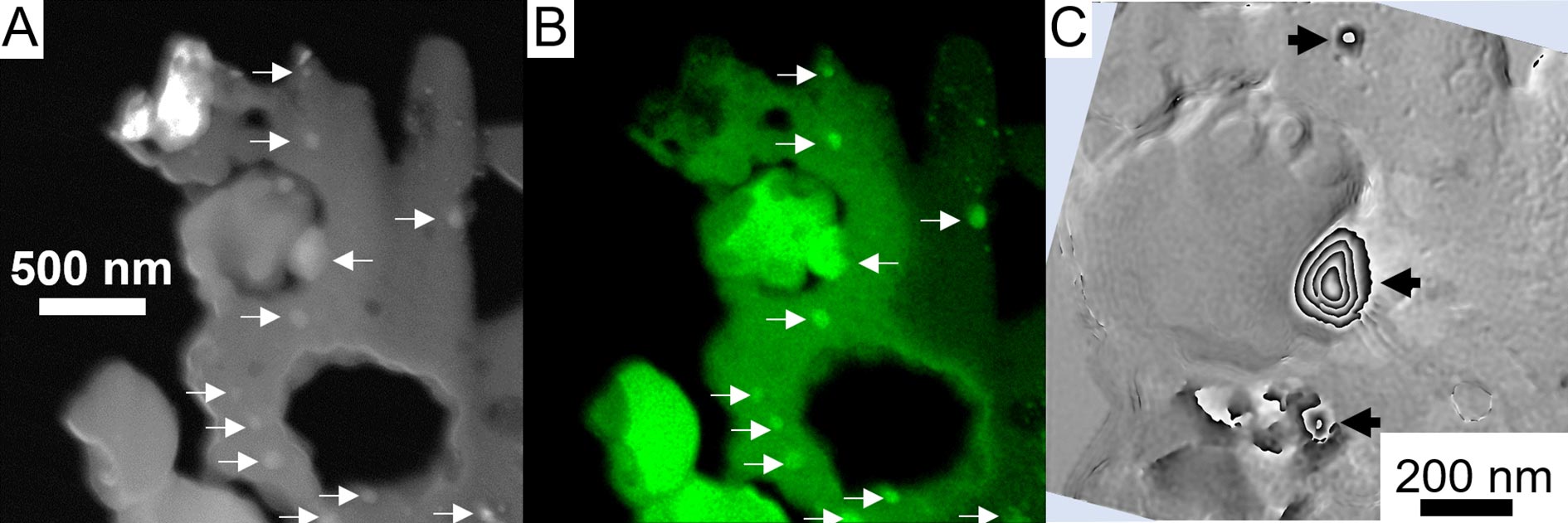
    Iron nanoparticles distributed around pseudo-magnetite. (A) Dark-field image taken with a scanning transmission electron microscope. (B) Corresponding iron distribution image. White arrows indicate iron nanoparticles. (C) Magnetic flux distribution image of the central region of A and B. No magnetic field lines can be seen in the pseudo-magnetite, whereas concentric vortex-like magnetic domain structures can be seen inside the iron particles as shown by black arrows. Credit: Yuki Kimura, et al. Nature Communications. April 29, 2024

    Kimura adds, “In future work, our results could also help to reveal the relative ages of surfaces on airless bodies and assist in the accurate interpretation of remote sensing data obtained from these bodies.”

    One particularly interesting finding was that small mineral grains called framboids, composed of magnetite, a form of iron oxide, had completely lost their normal magnetic properties. The researchers suggest this was due to collision with high-velocity micrometeoroids between 2 and 20 micrometers in diameter. The framboids were surrounded by thousands of metallic iron nanoparticles. Future studies of these nanoparticles will hopefully reveal insights into the magnetic field that the asteroid has experienced over long periods of time.

    Implications for Space Exploration

    “Although our study is primarily for fundamental scientific interest and understanding, it could also help estimate the degree of degradation likely to be caused by space dust impacting robotic or manned spacecraft at high velocity,” Kimura concludes.

    Reference: “Nonmagnetic framboid and associated iron nanoparticles with a space-weathered feature from asteroid Ryugu” by Yuki Kimura, Takeharu Kato, Satoshi Anada, Ryuji Yoshida, Kazuo Yamamoto, Toshiaki Tanigaki, Tetsuya Akashi, Hiroto Kasai, Kosuke Kurosawa, Tomoki Nakamura, Takaaki Noguchi, Masahiko Sato, Toru Matsumoto, Tomoyo Morita, Mizuha Kikuiri, Kana Amano, Eiichi Kagawa, Toru Yada, Masahiro Nishimura, Aiko Nakato, Akiko Miyazaki, Kasumi Yogata, Masanao Abe, Tatsuaki Okada, Tomohiro Usui, Makoto Yoshikawa, Takanao Saiki, Satoshi Tanaka, Fuyuto Terui, Satoru Nakazawa, Hisayoshi Yurimoto, Ryuji Okazaki, Hikaru Yabuta, Hiroshi Naraoka, Kanako Sakamoto, Sei-ichiro Watanabe, Yuichi Tsuda and Shogo Tachibana, 29 April 2024, Nature Communications.
    DOI: 10.1038/s41467-024-47798-0

    Never miss a breakthrough: Join the SciTechDaily newsletter.
    Follow us on Google and Google News.

    Asteroid Hayabusa2 Mission Hokkaido University JAXA
    Share. Facebook Twitter Pinterest LinkedIn Email Reddit

    Related Articles

    Rethinking Cosmic Origins: The Ryugu Asteroid Samples’ Revelatory Findings

    Component of RNA Found in Asteroid Ryugu Samples

    Samples From Asteroid Ryugu Shed New Light on Solar System History

    Next Target Asteroid for Hayabusa2 Photographed by Subaru Telescope

    World’s First Gas Sample From Deep Space Returned With Asteroid Ryugu Material From Hayabusa2

    Asteroid Ryugu Sample Collected in Space and Delivered to Earth – Now NASA Astrobiologists Prepare to Probe It

    Hera Team Congratulates Japan Aerospace Exploration Agency on Hayabusa2’s Asteroid Sample Return

    Australia-Bound Asteroid Sample From Japan’s Hayabusa2 Mission May Reveal Life’s Origins

    Space Agencies Across the Globe Prepare to Explore Comets and Asteroids

    Leave A Reply Cancel Reply

    • Facebook
    • Twitter
    • Pinterest
    • YouTube

    Don't Miss a Discovery

    Subscribe for the Latest in Science & Tech!

    Trending News

    Researchers Have Found a Dietary Compound That Increases Longevity

    Scientists Baffled by Bizarre “Living Fossil” From 275 Million Years Ago

    Your IQ at 23 Could Predict Your Wealth at 27, Study Finds

    320 Light-Years Away, a Planet Confirms a Fundamental Cosmic Assumption

    The Crown Jewel of Dentistry? Breakthrough Tech Could Transform Tooth Repair

    Python Blood Could Hold the Secret to Weight Loss Without Side Effects

    Naturally Occurring Bacteria Completely Eradicate Tumors in Mice With a Single Dose

    New “Nanozyme Hypothesis” Could Rewrite the Story of Life’s Origins

    Follow SciTechDaily
    • Facebook
    • Twitter
    • YouTube
    • Pinterest
    • Newsletter
    • RSS
    SciTech News
    • Biology News
    • Chemistry News
    • Earth News
    • Health News
    • Physics News
    • Science News
    • Space News
    • Technology News
    Recent Posts
    • Scientists May Have Found the Key to Jupiter and Saturn’s Moon Mystery
    • Scientists Uncover Hidden Clues to the Origin of the Genetic Code
    • Scientists Discover Unexpected Role of Alzheimer’s Protein in Cell Division
    • Scientists Uncover Brain Changes That Link Pain to Depression
    • A New Chapter in Chemistry? Scientists Uncover New Way Metals Bind Oxygen
    Copyright © 1998 - 2026 SciTechDaily. All Rights Reserved.
    • Science News
    • About
    • Contact
    • Editorial Board
    • Privacy Policy
    • Terms of Use

    Type above and press Enter to search. Press Esc to cancel.