

Columbia and Northwestern engineers use electric fields to induce oscillations in tiny particles; this motion could be used by researchers to develop microrobots.
A challenging frontier in science and engineering is controlling matter outside of thermodynamic equilibrium to build material systems with capabilities that rival those of living organisms. Research on active colloids aims to create micro- and nanoscale “particles” that swim through viscous fluids like primitive microorganisms. When these self-propelled particles come together, they can organize and move like schools of fish to perform robotic functions, such as navigating complex environments and delivering “cargo” to targeted locations.
A Columbia Engineering team led by Kyle Bishop, professor of chemical engineering, is at the forefront of studying and designing the dynamics of active colloids powered by chemical reactions or by external magnetic, electric, or acoustic fields. The group is developing colloidal robots, in which active components interact and assemble to perform dynamic functions inspired by living cells.
Microscale Oscillators Using Electric Fields
In a new study published today by Physical Review Letters, Bishop’s group, working with collaborators at Northwestern University’s Center for Bio-Inspired Energy Science (CBES), report that they have demonstrated the use of DC electric fields to drive back-and-forth rotation of micro-particles in electric boundary layers. These particle oscillators could be useful as clocks that coordinate the organization of active matter and even, perhaps, orchestrate the functions of micron-scale robots.
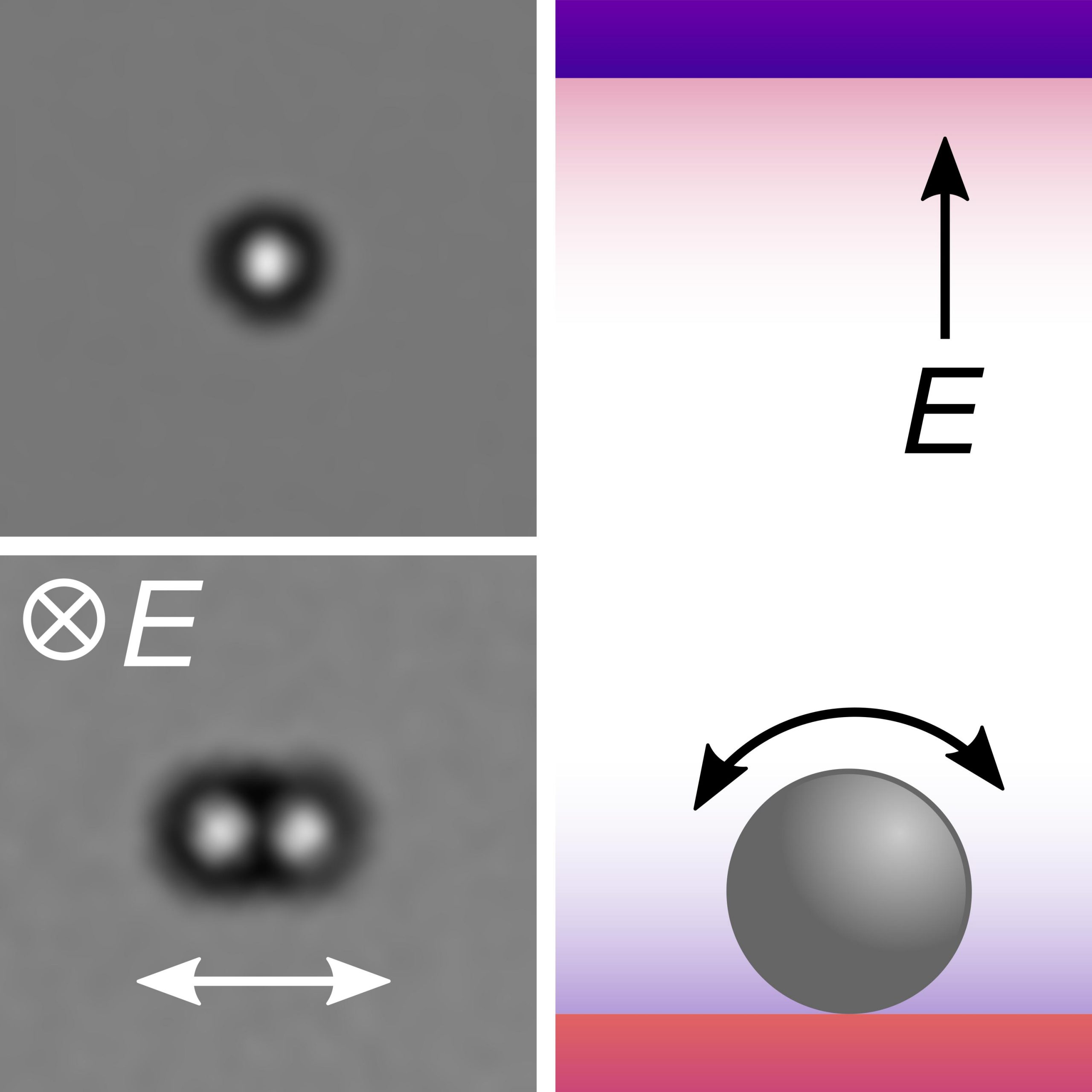
“Tiny particle oscillators could enable new types of active matter that combine the swarming behaviors of self-propelled colloids and the synchronizing behaviors of coupled oscillators,” says Bishop. “We expect interactions among the particles to depend on their respective positions and phases, thus enabling richer collective behaviors–behaviors that can be designed and exploited for applications in swarm robotics.”
Making a reliable clock at the micron-scale is not as simple as it may sound. As one can imagine, pendulum clocks don’t work well when immersed in honey. Their periodic motion–like that of all inertial oscillators–drags to a halt under sufficient resistance from friction. Without the help of inertia, it is similarly challenging to drive the oscillatory motion of micron-scale particles in viscous fluids.
Solving the Mystery of Particle Oscillations
“Our recent observation of colloidal spheres oscillating back and forth in a DC electric field presented a bit of mystery, one we wanted to solve,” observes the paper’s lead author, Zhengyan Zhang, a PhD student in Bishop’s lab who discovered this effect. “By varying the particle size, field strength, and fluid conductivity, we identified experimental conditions needed for oscillations and uncovered the mechanism underlying the particles’ rhythmic dynamics.”
Earlier work has demonstrated how similar particles can rotate steadily by a process known as Quincke rotation. Like a water wheel filled from above, the Quincke instability is driven by the accumulation of electric charge on the particle surface and its mechanical rotation in the electric field. However, existing models of Quincke rotation–and of overdamped water wheels–do not predict oscillatory dynamics.
This new study characterizes and explains the “mysterious” oscillations by reference to a boundary layer in the nonpolar electrolyte. Within this layer, often ignored by researchers, charge carriers are generated and then migrate away under the influence of the electric field. These processes introduce spatial asymmetries in the rates of charge accumulation at the particle surface. Like a water wheel whose buckets leak faster at the top than at the bottom, asymmetric charging can lead to back-and-forth rotation at high field strengths.
Asymmetric Charging as a Driving Force
“The limited generation rate of charges in these weak electrolytes creates a boundary layer comparable to the size of particle under a strong electric field, as found numerically by my PhD student Hang Yuan, a co-author of the work. As a result, the ‘conductivity’ of ions around particles that are within the large boundary layer is not constant, leading to the observed oscillations at strong electric fields,” says Monica Olvera de la Cruz, Lawyer Taylor Professor of Materials Science and Engineering, Chemistry and (by courtesy) Chemical and Biological Engineering, Physics and Astronomy at Northwestern Engineering.
“This work shows a way to generate oscillators, which could lead to the emergence of cooperative phenomena in fluids,” she adds.
The team experimented with different shapes of particles and found they could generate oscillations with any particles, provided that their size was comparable to that of the boundary layer.
“By tuning the field strength and/or the electrolyte, we can predictably control the frequency of these `Quincke clocks,'” Bishop adds. “Our paper enables the design of new forms of active matter based on collections of mobile oscillators.”
The team is currently studying the collective behaviors that emerge when many Quincke oscillators move and interact with one another.
Reference: “Quincke oscillations of colloids at planar electrodes” by Zhengyan Zhang, Hang Yuan, Yong Dou, Monica Olvera de la Cruz, and Kyle J. M. Bishop, 23 June 2021, Physical Review Letters.
DOI: 10.1103/PhysRevLett.126.258001
Funding: Center for Bio-Inspired Energy Science, an Energy Frontier Research Center funded by the U.S. Department of Energy, Office of Science, Basic Energy Sciences Award
Never miss a breakthrough: Join the SciTechDaily newsletter.
Follow us on Google and Google News.
1 Comment
Thanks!