
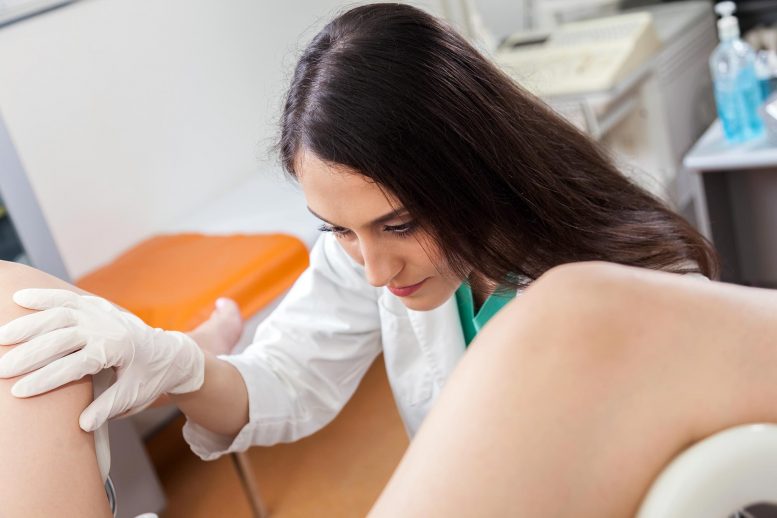
UC San Francisco and CDC study finds millions of ‘outdated’ tests being performed on healthy females 15 to 20 years old.
Pelvic examinations and cervical cancer screenings are no longer recommended for most females under age 21 during routine health visits, but a new study has found that millions of young women are unnecessarily undergoing the tests, which can lead to false-positive testing, over-treatment, anxiety, and needless cost.
Researchers at University of California San Francisco and the Centers for Disease Control and Prevention (CDC) estimated that 1.4 million pelvic examinations and 1.6 million Pap tests performed on U.S. females 15 to 20 years old in a single year may have been medically unnecessary.
“Parents of adolescents and young women should be aware that cervical cancer screening is not recommended routinely in this age group.” — George F. Sawaya, MD
The findings suggest that despite professional guidelines and recommendations against routine pelvic examinations and Pap tests in this age group, there’s a critical lag in clinical practice. The estimated cost of these unnecessary exams was approximately $123 million a year.
The study was published on January 6, 2020 in JAMA Internal Medicine.
“Recent media reports have called attention to inappropriate gynecologic examinations in young women,” said senior author George F. Sawaya, MD, professor of Obstetrics, Gynecology and Reproductive Sciences at UCSF and director of the UCSF Center for Healthcare Value.
“Parents of adolescents and young women should be aware that cervical cancer screening is not recommended routinely in this age group. Pelvic exams are not necessary prior to getting most contraceptives and are often not needed to screen for sexually transmissible infections,” Sawaya said.
Cervical cancer screening is not recommended for individuals under age 21, according to the U.S. Preventive Services Task Force, the American College of Obstetricians and Gynecologists, and the American Cancer Society. Additionally, leading professional organizations recommend against performing pelvic examinations in asymptomatic women who are not pregnant.
The new analysis was intended to estimate how often pelvic examinations and Pap tests occurred among young women in the U.S., as well as the proportion that were potentially unnecessary. The population-based study used data from 2011 to 2017.
Researchers classified the pelvic examination into two types: medically indicated or potentially unnecessary. Pelvic examinations were considered medically indicated if performed during pregnancy or in association with use of an intrauterine device, or in the context of treatment for a sexually transmitted disease.
The investigators estimated that of approximately 2.6 million young women who received a pelvic exam during the previous year, more than half (54.4 percent) were potentially unnecessary, representing an estimated 1.4 million young women.
Additionally, the researchers found that nearly a fifth of females younger than the recommended age had a Pap test within the past year. Because 72 percent were performed as “part of a routine exam,” they were potentially unnecessary, representing an estimated 1.6 million young women. Almost all of the pelvic examinations were performed at the same time as the Pap test.
Young women who had been screened for a sexually transmitted infection were 3.8 times more likely to receive a Pap test and 60 percent more likely to receive a pelvic examination, compared with those who had not been screened.
Similarly, young women who used a hormonal contraception other than IUD were 75 percent more likely to receive a Pap test and 31 percent more likely to receive a pelvic examination, compared with those who did not use those contraception methods.
“This study suggests that healthcare providers and young women need to communicate clearly and often about the best time for these tests,” said first author Jin Qin, ScD, an epidemiologist with the Division of Cancer Prevention and Control at the Centers for Disease Control and Prevention. “We want to ensure that guidelines are followed, and lives are saved.”
Reference: “Prevalence of Potentially Unnecessary Bimanual Pelvic Examinations and Papanicolaou Tests Among Adolescent Girls and Young Women Aged 15-20 Years in the United States” by Jin Qin, ScD; Mona Saraiya, MD, MPH; Gladys Martinez, Ph.D. and George F. Sawaya, MD, 6 January 2020, JAMA Internal Medicine.
DOI: 10.1001/jamainternmed.2019.5727
Authors: Co-authors are Mona Saraiya, MD, and Gladys Martinez, PhD, who are with the Centers for Disease Control and Prevention. No disclosures were reported.
Never miss a breakthrough: Join the SciTechDaily newsletter.
Follow us on Google and Google News.
1 Comment
The Un-necesary GYN tests/exams help the clinician/s improve their skills
In the photo – the examiner is using a “sterile” glove – yet in contact with patient’s thigh skin that reduces the sterility value…