
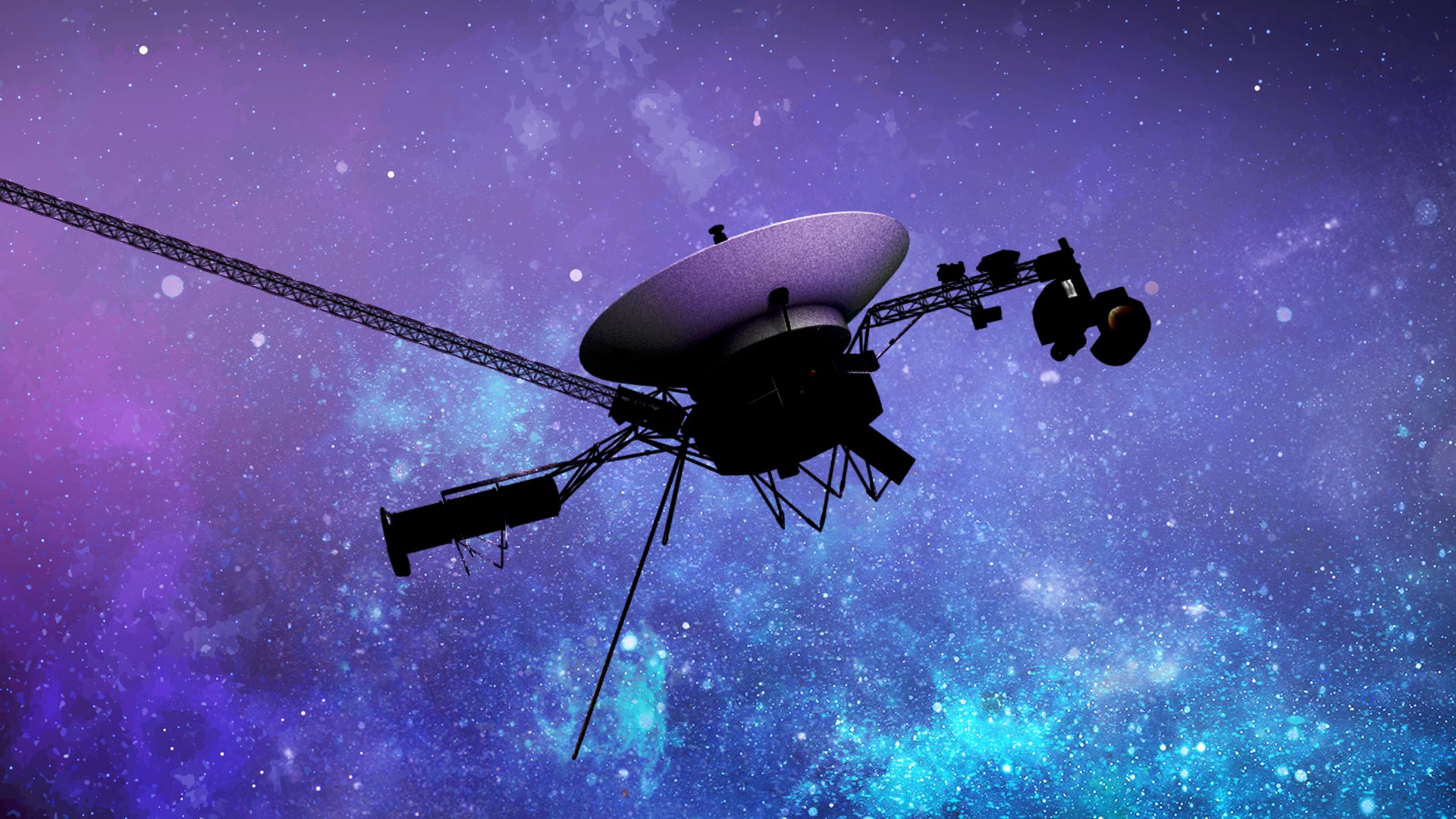
Voyager 1 is losing power, and NASA just shut down a decades-old instrument to keep it going. The sacrifice could help the spacecraft continue exploring interstellar space a little longer.
On April 17, engineers at NASA’s Jet Propulsion Laboratory (JPL) in Southern California transmitted commands to switch off an instrument on Voyager 1 known as the Low-energy Charged Particles experiment, or LECP. The spacecraft, which runs on nuclear power, is steadily losing energy, and shutting down this instrument is the most effective way to extend the mission of the first human-made object to reach interstellar space.
A 49-Year-Old Instrument Falls Silent
The LECP has operated with very few interruptions since Voyager 1 launched in 1977 — nearly 49 years ago. It measures low-energy charged particles such as ions, electrons, and cosmic rays from both our solar system and the broader galaxy. Over time, it has provided essential data about the interstellar medium, including identifying pressure waves and variations in particle density beyond the heliosphere. Voyager 1 and Voyager 2 are the only spacecraft far enough away to gather this type of information.
Power Loss After Decades in Deep Space
Like its twin, Voyager 2, Voyager 1 depends on a radioisotope thermoelectric generator, which converts heat from decaying plutonium into electricity. Each spacecraft loses about 4 watts of power every year. After almost five decades in space, available energy has become extremely limited. Engineers must carefully reduce power use by shutting off heaters and instruments while ensuring the spacecraft stays warm enough to prevent its fuel lines from freezing.
During a planned roll maneuver on February 27, Voyager 1 experienced an unexpected drop in power. Engineers recognized that any further decline could activate the spacecraft’s undervoltage fault protection system. This safety system would automatically shut down components to protect the probe, requiring a complex recovery effort that carries additional risk.
The team chose to act before that scenario could occur.
“While shutting down a science instrument is not anybody’s preference, it is the best option available,” said Kareem Badaruddin, Voyager mission manager at JPL. “Voyager 1 still has two remaining operating science instruments — one that listens to plasma waves and one that measures magnetic fields. They are still working great, sending back data from a region of space no other human-made craft has ever explored. The team remains focused on keeping both Voyagers going for as long as possible.”
Long-Term Plan for Instrument Shutdowns
The decision to turn off the LECP followed a plan created years ago. Scientists and engineers worked together to determine the order in which systems would be powered down, with the goal of preserving as much scientific capability as possible. Each Voyager spacecraft originally carried 10 sets of instruments, and seven have already been shut off. For Voyager 1, the LECP was next in line. The same instrument was turned off on Voyager 2 in March 2025.
Because Voyager 1 is now more than 15 billion miles (25 billion kilometers) from Earth, communication takes significant time. Commands require about 23 hours to reach the spacecraft, and once received, the shutdown process takes around three hours and 15 minutes.
A small portion of the LECP will remain active. A motor that rotates the sensor to scan in all directions will continue operating because it consumes very little power (0.5 watts). Keeping this component running preserves the possibility of reactivating the instrument in the future if additional power becomes available.
Future Plans to Extend the Voyager Mission
Engineers estimate that turning off the LECP will provide Voyager 1 with roughly one more year of operation. During that time, they are preparing a more advanced power-saving approach known as “the Big Bang.” This strategy involves replacing several power-hungry components at once with lower-energy alternatives to maintain enough heat and functionality for continued data collection.
The Big Bang will be tested first on Voyager 2, which has slightly more available power and is closer to Earth, making it a safer candidate. Testing is scheduled for May and June 2026. If successful, the same approach will be attempted on Voyager 1 no earlier than July.
If the plan works, there is even a possibility that Voyager 1’s LECP instrument could be restarted in the future.
Never miss a breakthrough: Join the SciTechDaily newsletter.
Follow us on Google and Google News.
4 Comments
Great efforts by smart people.
Please yhank them for their efforts!
We have a great opportunity to send a very complex facility to probe space and we are going to waste it! The international Space Station could be set up to send out to deep space! Why waste all that technology by burning it up down to the the earth. What a project that could be! Have Lockheed Martin set it up? Or Elon Musk put it in orbit around Mars?
I think that’s a very clever idea recycle reuse, imagine what we may be able to see!!!!
Bhai is me ander me hota