
Close Menu
    Facebook X (Twitter) Instagram
    SciTechDaily
    • Biology
    • Chemistry
    • Earth
    • Health
    • Physics
    • Science
    • Space
    • Technology
    Facebook X (Twitter) Pinterest YouTube RSS
    SciTechDaily
    Home»Space»Fly Along With the Voyager Spacecraft As They Head Towards Interstellar Space
    Space

    Fly Along With the Voyager Spacecraft As They Head Towards Interstellar Space

    By Jia-Rui C. Cook, Jet Propulsion Laboratory; NASAApril 25, 20132 Comments3 Mins Read
    Facebook Twitter Pinterest Telegram LinkedIn WhatsApp Email Reddit
    Share
    Facebook Twitter LinkedIn Pinterest Telegram Email Reddit
    Fly Along with NASAs Voyager Spacecraft
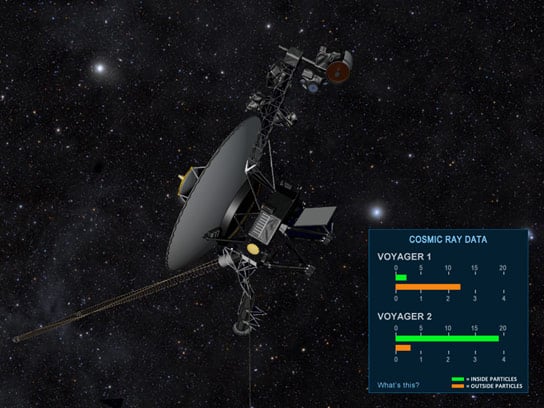
    The public will be able to fly along with NASA’s Voyager spacecraft as the twin probes head towards interstellar space, which is the space between stars. As indicated in this artist’s concept, a regularly updated gauge using data from the two spacecraft will indicate the levels of particles that originate from far outside our solar system and those that originate from inside our solar bubble. Those are two of the three signs scientists expect to see in interstellar space. The other sign is a change in the direction of the magnetic field. Credit: NASA/JPL-Caltech

    Follow NASA’s Voyager spacecraft as they head towards interstellar space with NASA’s Eyes on the Solar System program.

    A gauge on the Voyager home page tracks levels of two of the three key signs scientists believe will appear when the spacecraft leaves our solar neighborhood and enter interstellar space.

    When the three signs are verified, scientists will know that one of the Voyagers has hurtled beyond the magnetic bubble the sun blows around itself, which is known as the heliosphere.

    The gauge indicates the level of fast-moving charged particles, mainly protons, originating from far outside the heliosphere, and the level of slower-moving charged particles, also mainly protons, from inside the heliosphere. If the level of outside particles jumps dramatically and the level of inside particles drops precipitously, and these two levels hold steady, that means one of the spacecraft is closing in on the edge of interstellar space. These data are updated every six hours.

    Scientists then need only see a change in the direction of the magnetic field to confirm that the spacecraft has sailed beyond the breath of the solar wind and finally arrived into the vast cosmic ocean between stars. The direction of the magnetic field, however, requires periodic instrument calibrations and complicated analyses. These analyses typically take a few months to return after the charged particle data are received on Earth.

    Voyager 1, the most distant human-made spacecraft, appears to have reached this last region before interstellar space, which scientists have called “the magnetic highway.” Inside particles are zooming out and outside particles are zooming in. However, Voyager 1 has not yet seen a change in the direction of the magnetic field, so the consensus among the Voyager team is that it has not yet left the heliosphere.

    Voyager 2, the longest-operating spacecraft, but not as distant as Voyager 1, does not yet appear to have reached the magnetic highway, though it has recently seen some modest drops of the inside particle level.

    NASA’s Eyes on the Solar System program, a Web-based, video-game-like tool to journey with NASA’s spacecraft through the solar system, has added a Voyager module that takes viewers along for a ride with Voyager 1 as it explores the outer limits of the heliosphere. Time has been sped up to show one day per second. Rolls and other maneuvers are incorporated into the program, based on actual spacecraft navigation data. The charged particle data are also shown.

    The Voyager spacecraft were built and continue to be operated by NASA’s Jet Propulsion Laboratory, Pasadena, California. Caltech manages JPL for NASA. The Voyager missions are a part of NASA’s Heliophysics System Observatory, sponsored by the Heliophysics Division of the Science Mission Directorate at NASA Headquarters in Washington.

    Never miss a breakthrough: Join the SciTechDaily newsletter.
    Follow us on Google and Google News.

    Astronomy Astrophysics Heliophysics NASA Voyager
    Share. Facebook Twitter Pinterest LinkedIn Email Reddit

    Related Articles

    NASA’s Interstellar Boundary Explorer Provides New Details on Solar System Boundary

    20 Years of Science Discoveries From NASA’s Wind Spacecraft

    IBEX Explores the Magnetic System Beyond the Solar Wind

    Voyager 1 Presents the “Sounds” of Interstellar Space

    It’s Official – Voyager 1 Has Entered Interstellar Space

    Study Shows Interstellar Wind Has Changed Direction

    NASA’s Voyager 1 Explores the Outer Limits of Our Heliosphere

    Voyager Spacecraft Poised to Make New Discoveries

    Voyager 1 Reports a Rapid Increase in High-Energy Cosmic Ray Particles

    2 Comments

    1. Ross Parkinson on April 25, 2013 7:57 am

      What about Pioneers 10 & 11? They were launched in the early 70’s. They should be out of the solar system by now-shouldn’t they?

      Reply
    2. Ralph Asplen on April 25, 2013 9:59 am

      That information is avaialble on NASA’s wesite. Taken from http://www.nasa.gov/centers/ames/missions/archive/pioneer.html:
      On 17 February 1998, Voyager 1’s heliocentric radial distance equaled Pioneer 10 at 69.4 AU and thereafter exceeded Pioneer 10 at the rate of 1.02 AU per year.

      Reply
    Leave A Reply Cancel Reply

    • Facebook
    • Twitter
    • Pinterest
    • YouTube

    Don't Miss a Discovery

    Subscribe for the Latest in Science & Tech!

    Trending News

    Don’t Miss: A Brilliant Venus and Glowing Harvest Moon Light Up the Sky

    New Twist on the Einstein Problem Reveals Unexpected Physics

    JWST Captures Stunning Evidence of How Supermassive Black Holes Feed

    Early Exercise May Permanently Change How Much Energy the Body Uses To Move

    New Molecule Wipes Out Aggressive Lymphoma Tumors in Mice in Just 11 Days

    The Human Family Tree May Need a Major Rewrite

    Scientists Find a Surprising Cancer-Fighting Effect in Dark Sweet Cherries

    New AI Detects Hidden Warning Signs of Solar Eruptions Hours Before They Emerge

    Follow SciTechDaily
    • Facebook
    • Twitter
    • YouTube
    • Pinterest
    • Newsletter
    • RSS
    SciTech News
    • Biology News
    • Chemistry News
    • Earth News
    • Health News
    • Physics News
    • Science News
    • Space News
    • Technology News
    Recent Posts
    • Africa’s Giant Herbivores Were Disappearing Millions of Years Before Humans Could Hunt Them
    • This Utah Mountain Is Hiding Enough Ice To Fill 600 Olympic Pools
    • Vagus Nerve Stimulation Could Unlock the Brain’s Hidden Learning Potential
    • Your Mother’s Age May Leave a Biological Mark That Lasts for Generations
    • Women Who Ate More Antioxidants Had Strikingly Lower Rates of Cervical Cancer
    Copyright © 1998 - 2026 SciTechDaily. All Rights Reserved.
    • Science News
    • About
    • Contact
    • Editorial Board
    • Privacy Policy
    • Terms of Use

    Type above and press Enter to search. Press Esc to cancel.