
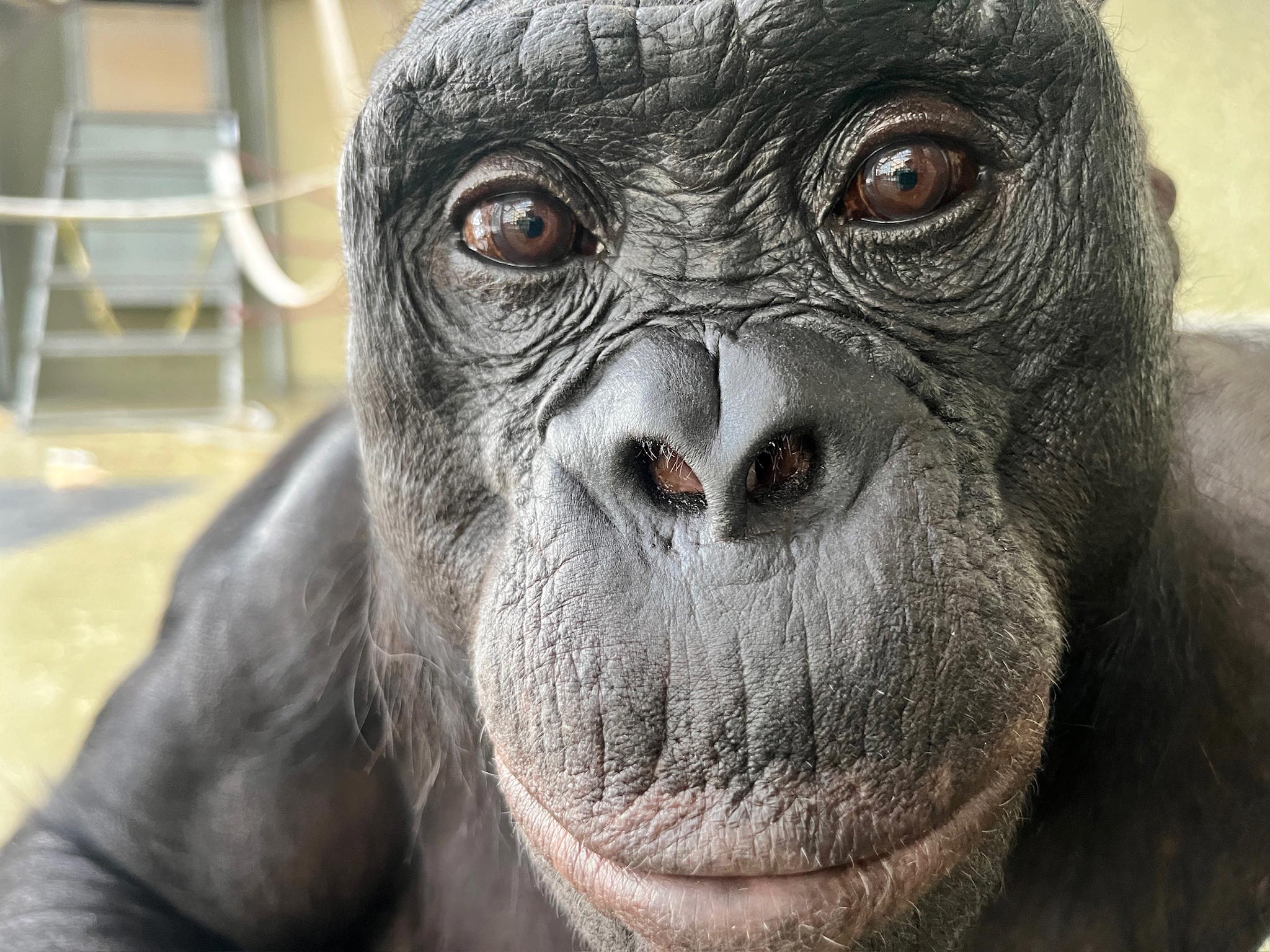
Apes don’t just act on instinct—they recognize when someone lacks information and actively help them out!
In a controlled study, bonobos pointed out hidden treats to unaware humans, demonstrating a level of social intelligence that challenges the belief that “theory of mind” is uniquely human.
Groundbreaking Study on Ape Cognition
Apes eagerly pointed out hidden treats to humans who didn’t know where to find them, revealing a surprising ability to communicate missing information for the sake of teamwork. This seemingly simple experiment is the first to show that apes will actively share knowledge to help others. The study also offers the strongest evidence yet that apes can recognize when someone lacks information — an ability once believed to be uniquely human.
The research, conducted by scientists from Johns Hopkins University’s Social and Cognitive Origins Group, was published today (February 3) in the Proceedings of the National Academy of Sciences.

Understanding Others’ Knowledge Gaps
“The ability to sense gaps in one another’s knowledge is at the heart of our most sophisticated social behaviors, central to the ways we cooperate, communicate, and work together strategically,” said co-author Chris Krupenye a Johns Hopkins assistant professor of psychological and brain sciences who studies how animals think. “Because this so-called theory of mind supports many of the capacities that make humans unique, like teaching and language, many believe it is absent from animals. But this work demonstrates the rich mental foundations that humans and other apes share—and suggests that these abilities evolved millions of years ago in our common ancestors.”
Apes eagerly pointed out the location of treats to humans who didn’t know where they were. Credit: Johns Hopkins University
Meet the Clever Bonobos
Krupenye and co-author Luke Townrow, a Johns Hopkins PhD student, worked with three male bonobos, Nyota, 25; Kanzi, 43; and Teco, 13, all living at Ape Initiative, a research and education nonprofit. During the experiment one of the bonobos would sit with Townrow, facing each other across a table. The bonobo would watch as a second person placed a treat, a grape or a Cheerio, under one of three cups. Sometimes Townrow could see where the treat was going, sometimes he couldn’t. The bonobo could have the treat if Townrow could find it.
During the experiments, apes eagerly pointed out treats to humans who didn’t know where they were, but when humans had watched the treats being placed the apes did not point. Credit: Johns Hopkins University
Ape Communication in Action
Whether or not Townrow saw where the treat was hidden, he’d say, “Where’s the grape?” and then wait 10 seconds. If he’d seen the treat being hidden, during the 10 seconds the ape would usually sit still and wait for the treat. But when Townrow hadn’t seen where the treat was hidden, the ape would quickly point to the right cup—sometimes quite demonstratively.
“Their fingers would point right through the mesh—it was clear what they were trying to communicate,” Krupenye said. “One, Kanzi, who was very food motivated, would point repeatedly in certain phases of the experiment—he’d tap several times to get our attention and was quite insistent about it.”
The work is the first to replicate in a controlled setting similar findings from the wild that suggest chimpanzees will vocalize to warn groupmates ignorant to potential threats, such as a snake.
Apes Can Hold Conflicting Perspectives
“We predicted that if apes are really tracking ignorance, when their partners lacked knowledge they would be pointing more often and more quickly and that’s exactly what they did,” Krupenye said. “The results also suggest apes can simultaneously hold two conflicting world views in their mind. They know exactly where the food is, and at the same time, they know that their partner’s view of the same situation is missing that information.”
The team was thrilled to further confirm apes’ mental sophistication.
“There are debates in the field about the capabilities of primates and for us it was exciting to confirm that they really do have these rich capacities that some people have denied them,” Krupenye said.
What’s Next? More Mind-Reading Experiments
Next the team will work to more deeply explore the apes’ motivations and how they think about other individuals’ minds.
“What we’ve shown here is that apes will communicate with a partner to change their behavior,” said Townrow, “but a key open question for further research is whether apes are also pointing to change their partner’s mental state or their beliefs.”
Reference: 3 February 2025, Proceedings of the National Academy of Sciences.
Never miss a breakthrough: Join the SciTechDaily newsletter.
Follow us on Google and Google News.
1 Comment
I saved a wild bunnie when her mate died of injuries sustained from a cat. Wild bunnies have bigger, more developed brains than domestic bunnies. I had been leaving food out for several years. I went on full alert to keep her alive, manning the monitors all night and intervening when a predator would come into view. With my instant appearance, she realized I was observing through the cameras.
After she was trapped and I made an enclosure around her, she moves into the camera blind spots so I can’t see her.
But here’s the brain stumper: When I think to check on her, and look through one of the cameras to see where she might be, she pops up scolding with dislike at my intrusion; – further she knows, every time, from which of the five cameras I have chosen to look. Put that in your nap-sack.