
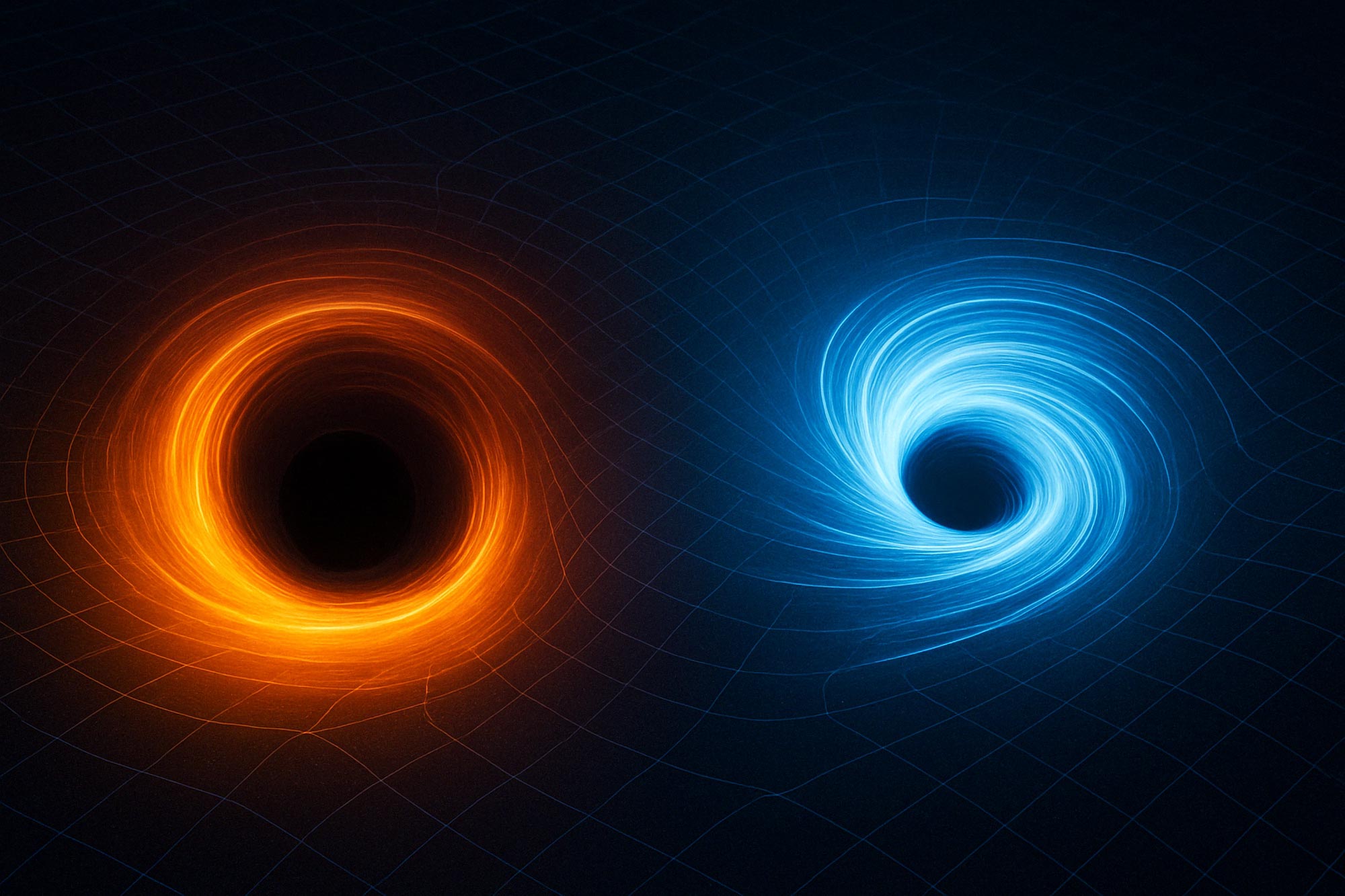
A team of researchers has engineered a groundbreaking optical device that mimics the physics of black holes and their mysterious counterparts, white holes.
These “optical analogs” use a principle called coherent perfect absorption to either absorb or reflect light depending on its polarization, much like how black holes trap matter and white holes hypothetically expel it. Their success opens new doors not only for studying far-off cosmic phenomena in a lab setting but also for developing advanced technologies like energy conversion systems and stealth materials.
From Cosmic Phenomena to Lab Devices
In Einstein’s theory of general relativity, black holes are known for their ability to trap both light and matter by warping spacetime – creating a boundary known as the point of no return. While black holes have long captured the imagination of scientists and the public, their hypothetical opposites, called white holes, remain mostly theoretical. A white hole is thought to do the reverse: instead of pulling matter in, it would push light and matter out.
Now, researchers have developed a novel optical device that behaves in a surprisingly similar way to these cosmic phenomena.
Creating an Optical Black and White Hole
Described in Advanced Photonics, the device can act like an optical black hole or white hole depending on the polarization of incoming light. It’s based on a principle called “coherent perfect absorption,” where light waves interact in just the right way to either be completely absorbed or entirely reflected.
By forming a standing wave and directing it toward an ultrathin absorbing material, the device can absorb nearly all the light or let it pass through – mimicking the way black holes absorb light or how white holes would theoretically emit it. In essence, it’s a lab-made system that can either trap light or push it away, depending on how that light is polarized.
Bridging Physics Across Scales
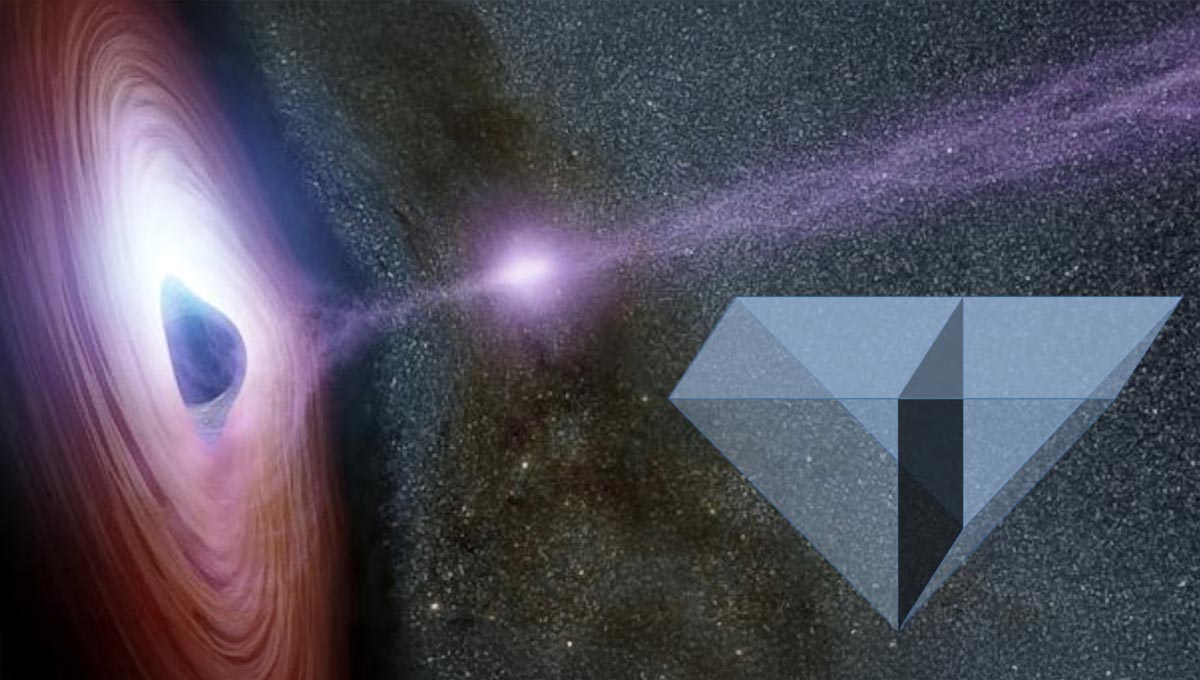
Senior corresponding author Nina Vaidya, professor at the University of Southampton (UK), remarks, “Celestial phenomena, especially black holes, have fascinated the imagination and exploratory intrigue of humans for generations. Analogs are ways of accessing physics, especially for far away objects like the black holes, as the mathematical frameworks and aspects of the physical principles repeat themselves in surprising ways in several systems – celestial phenomena to nano- and pico-scale devices.
“We introduce the concept of optical black and white holes that deterministically absorb almost all light of one polarization while rejecting light of the orthogonal polarization. It relies on our experimental demonstration of broadband coherent perfect absorption in compact devices, enabled by spatial coherence and interference, while polarization sensitivity is acquired from the geometrical phase of the interfering beams.”
Proof-of-Concept Demonstrates Cosmic Mimicry
The team’s proof-of-concept experiments demonstrate that this optical device manipulates electromagnetic waves in a way that mirrors the behavior of gravitational black and white holes. Simulations illustrate the absence of reflection from the device for the black hole analog and the formation of a standing wave due to interference of incident and reflected light for the white hole.
New Frontiers in Light Contro
The results illuminate fascinating insights and possibilities of manipulating light–matter interactions and may enable wide-ranging practical applications. Vaidya notes, “Our optical device can be employed as an analog to study and explore the physics of these far away celestial phenomena; or indeed to provide a practical framework for several potential applications of tailoring of electromagnetic waves and enhanced light–matter interactions, such as detection, energy conversion, multispectral camouflage, stealth technologies, and more.”
Reference: “Optical analog of black and white gravitational holes” by Eric Plum, Anton N. Vetlugin, Baurzhan Salimzhanov, Nikolay I. Zheludev and Nina Vaidya, 27 February 2025, Advanced Photonics.
DOI: 10.1117/1.AP.7.2.025001
Never miss a breakthrough: Join the SciTechDaily newsletter.
Follow us on Google and Google News.
1 Comment
nice topic