
A “miracle cure” meets real science — and the results are alarming.
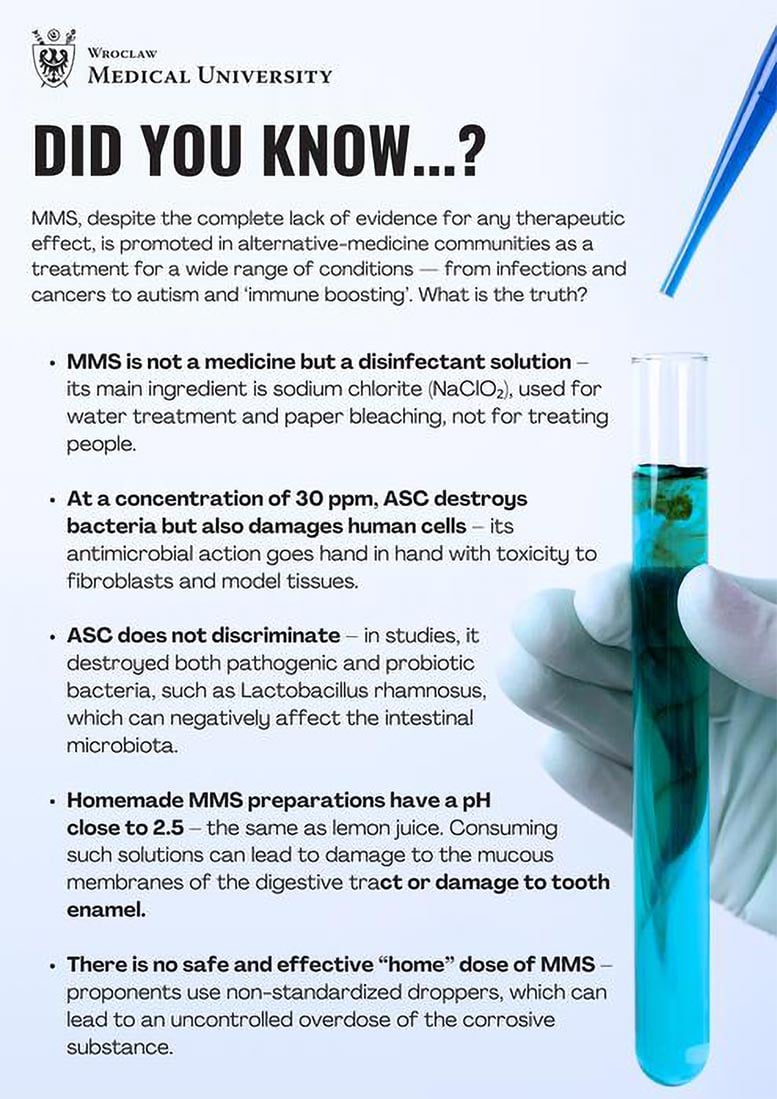
Miracle Mineral Solution, or MMS, has long been promoted as a supposed cure for a wide range of illnesses, from cancer and autism to COVID-19. The product is essentially sodium chlorite (NaClO2), a strong disinfectant commonly used in water treatment. When sodium chlorite is mixed with an acid, it produces chlorine dioxide (ClO2), a compound that can be dangerous when ingested.
Scientists at Wroclaw Medical University set out to examine these claims. Their study, published in Scientific Reports, evaluated the effects of acidified sodium chlorite (ASC), the substance that generates ClO2. The researchers tested two formulations, ASC1 (acidified with hydrochloric acid) and ASC2 (acidified with gluconic acid), on several bacterial strains. These included harmful bacteria such as Staphylococcus aureus and E. coli, as well as beneficial probiotic strains like Lactobacillus rhamnosus.
The results confirmed that chlorine dioxide can kill bacteria. However, the researchers stressed that it only works at levels that are also harmful to human cells. At 30 ppm (0.003 percent), the concentration needed to destroy bacteria, they observed clear damage to skin cells and a high death rate in the in vivo model. The team also examined how ASC affects bacterial biofilms, the protective layers that help bacteria survive. Although ASC could break down these biofilms, it did so while causing significant tissue injury.
Why toxicity creates a major safety concern
“The results of the study indicate that effective concentrations of ASC against biofilms are also toxic to eukaryotic cells, but it cannot be ruled out that a formulation for external use will be developed that ensures the safety of use with high anti-biofilm efficacy,” explains Dr. Ruth Dudek-Wicher from the Department of Pharmaceutical Microbiology and Parasitology, Faculty of Pharmacy, Wroclaw Medical University.
At the same time, she points out the significant differences between industrially purified ClO2 solutions (used, for example, in dentistry) and those produced in the home kitchens of MMS enthusiasts. The study also tested the effect of ASC on probiotic bacteria. The biofilm of Lactobacillus bacteria was extremely sensitive to the preparation, which may pose a risk to the intestinal microflora.
“At the moment, we are not planning such studies, but we do not rule them out in the future. If a safe oral form of ASC is developed, an analysis of its impact on the microbiome will be necessary,” says Dr. Ruth Dudek-Wicher.
Misinformation, unethical promotion, and public health risks
The researchers make no secret of the fact that the study was not only about microbiology but also about combating misinformation.
“The most harmful mistake is to believe in the effectiveness of MMS without hard scientific evidence,” emphasizes Dr. Dudek-Wicher. “In pharmacy and medicine, the benefit-risk ratio is considered. In the case of MMS, the benefit is zero, and the risk is high, especially since the dosage is often administered using non-standardized droppers, which can achieve 1 ml by applying 15 or 30 drops. Such fluctuations in the oral dosage of a corrosive substance are extremely irresponsible,” she adds.
Moreover, MMS is sometimes recommended for children and pregnant women. “I was particularly shocked by the recommendations for combating obesity, which did not mention the effect of MMS on adipose tissue but only affirmed self-acceptance combined with stigmatization of obesity,” says the scientist. In her opinion, the problem lies not only in the preparation itself but also in the way it is promoted – unethically, based on emotional manipulation rather than facts.
The need for better science communication and future research
Can anything be done about it? “Yes, but it requires an integrated, interdisciplinary approach and empathy. Currently, the fight against myths is too often marked by a lack of respect and compassion. People turn to MMS because they are concerned about their health – and education must take this into account, with communication based on respect.
It is also essential to fund research that debunks myths. Science should protect citizens from misinformation, says Dr. Dudek-Wicher. That is why I am thrilled that the topic of the grant awarded to me by our University, related to MMS, has gained the recognition of reviewers and that the results of the research have been published in such a prestigious journal as Scientific Reports.
“At the Faculty of Pharmacy, we are not afraid of difficult topics. The safety of patients who have lost their way in search of treatment is of utmost importance to us. And the interest in the results encourages us to continue our work. We are planning a series of analyses and publications on other miracle preparations – DMSO, adaptogens, ‘detoxification’ protocols – all in the spirit of scientific myth-busting,” summarize the authors of the article, Dr. Dudek-Wicher, and Prof Adam Junka from the Department of Pharmaceutical Microbiology and Parasitology at Wroclaw Medical University.
Reference: “Antimicrobial properties and toxicity challenges of chlorine dioxide used in alternative medicine” by Ruth Dudek-Wicher, Malwina Brożyna, Justyna Paleczny, Beata Mączyńska, Bartłomiej Dudek, Paweł Migdał, Arleta Dołowacka-Jóźwiak, Jędrzej Fischer and Adam Junka, 25 May 2025, Scientific Reports.
DOI: 10.1038/s41598-025-01852-z
Never miss a breakthrough: Join the SciTechDaily newsletter.
Follow us on Google and Google News.
5 Comments
So much for open mindedness and approaching a topic with an open scientific mind. Instead of stating that you plan to investigate some of the reported claims surrounding the use of DMSO, adaptive a, etc., you show a clear bias by stating “We are planning a series of analyses and publications on other miracle preparations – DMSO, adaptogens, ‘detoxification’ protocols – all in the spirit of scientific MYTH-BUSTING.” You could have stated instead that you intend to use the scientific method to research these formulas/protocols objectively. Instead you’re clearly approaching these investigations with a bias and poor faith.
It should be noted that many theories were aggressively ridiculed by the scientific community when they were first proposed; H. pylori and ulcers, Leaky Gut (aka intestinal hyperpermeability), and many others. It wasn’t until members of the scientific community approached these areas with an open mind and apply unbiased research principles that these ideas were accepted. I hope you do the same when researching other “myths.”
Yes, when someone announces that their intent is to find evidence to prove that their assumptions or beliefs are correct, the model of the “disinterested observer” objectively looking for the ‘Truth’ is violated. They will almost certainly find the evidence they are looking for. However, will they also report on everything they find that doesn’t support their position?
“The need for better science communication and future research”
I couldn’t agree more. The large number of published studies that are not replicable, or retracted for other errors, particularly in the medical field, and poorly designed climatology studies that are easily criticized, points to the magnitude of the problem. Only Materials Science seems to me to be making rapid advancements, which is probably because their experiments have clearly defined goals and it is immediately apparent whether or not those goals are achieved — one doesn’t have to wait 30 years for a claim of it ‘could’ happen, to be certain of the results. Political agendas have no influence if a new superconductor doesn’t conduct.
The sciences have become populated with technicians with PhDs who are little better than hacks following ‘cookbook recipes’ without a comprehensive understanding of the ‘big picture.’ Even 50-years ago the remark that a PhD was 1% inspiration and 99% perspiration was well known. I’m afraid that things have gotten even worse.
I wish I could find researchers who have noticed that folks proclaiming the benefits of chlorine dioxide finally are acknowledging MMS is not safe. Instead, the new formulation that is being promoted is called Chlorine Dioxide Solution (CDS). In other words, no one around here uses MMS. It’s all CDS all the time for everything. Seems like all my dear friends will try anything and everything that comes by way of any body who claims that it works simply because other people said it works.
Chlorine Dioxide Solution:
Will a chemist, biologist, and/or physiologist please produce clear research that tells us what the usual dosing of CDS within the “CDS community” actually does when it lands in the stomach or is administered topically with DMSO?
The only thing I can find is that CDS releases pure chlorine upon mixing with HCL (stomach acid). Pure chlorine as I understand it is a very strong oxidant that not only kills bad bacteria and viruses but also the good bacteria in our gut. Not only that, but it damages eukaryotic cells in the human body, oxidizing normal and good cells throughout.
Is there someone, please, who might be able to do actual research, get to the bottom of this, and let the people know, definitively, what happens when they consume or topically apply Chlorine Dioxide Solution?
Thank you.
I KNOW I WANT TO “TRUST THE SCIENCE” AFTER THE COVID FIASCO.