

MIT scientists have snapped the first-ever images of individual atoms interacting freely in space, making visible the elusive quantum effects that govern their behavior.
Using a unique technique that briefly traps atoms in place with a lattice of light, the researchers captured never-before-seen interactions between bosons and fermions. These snapshots confirm decades of theoretical predictions, showing bosons clustering into wave-like formations and fermions forming pairs — mechanisms tied to superconductivity.
Capturing Atoms in the Act
MIT physicists have captured the first direct images of individual atoms interacting freely in space. These images reveal subtle quantum correlations among these “free-range” particles — behaviors that, until now, had only been predicted by theory. The findings, published in Physical Review Letters, provide a powerful new way to observe elusive quantum phenomena in real space.
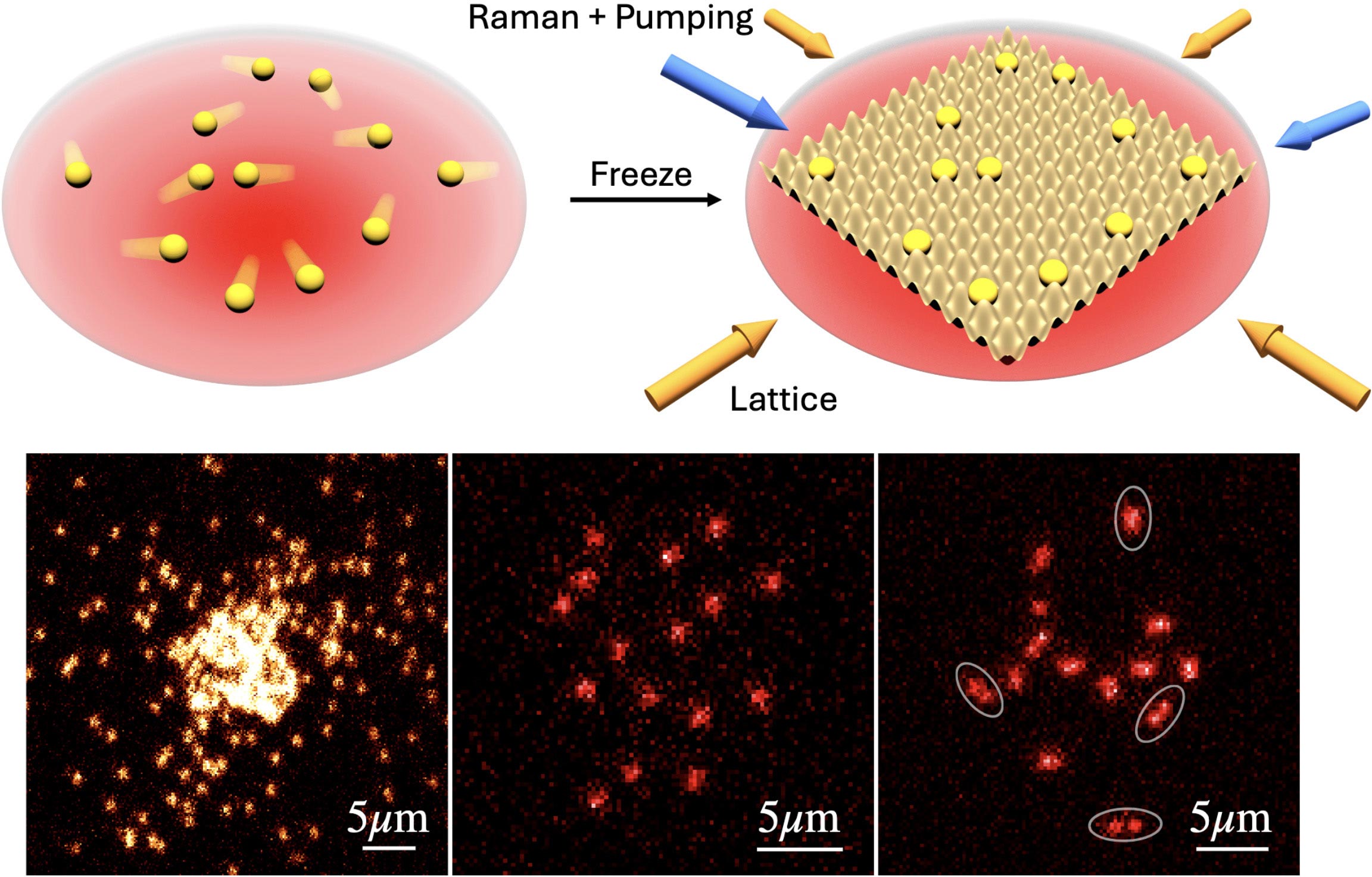
To create these images, the researchers developed a method that first lets a cloud of atoms move and interact naturally. They then switch on a lattice of light, essentially a grid of laser beams, that momentarily freezes the atoms in place. Using finely tuned lasers, they quickly illuminate the atoms while they’re suspended, capturing their precise positions before the cloud disperses.
Visualizing Quantum Behavior
Using this technique, the team was able to photograph clouds of different kinds of atoms and achieve several imaging firsts. They captured images of “bosons,” which bunched up in a quantum phenomenon to form a wave. They also observed “fermions” pairing up in free space, a key process involved in superconductivity.
“We are able to see single atoms in these interesting clouds of atoms and what they are doing in relation to each other, which is beautiful,” says Martin Zwierlein, the Thomas A. Frank Professor of Physics at MIT.
In the same issue of the journal, two additional research teams reported similar breakthroughs using related techniques. One was led by Nobel laureate Wolfgang Ketterle, the John D. MacArthur Professor of Physics at MIT, who imaged enhanced pair correlations among bosons. The other team, based at École Normale Supérieure in Paris and led by Tarik Yefsah, visualized a cloud of noninteracting fermions.
The study by Zwierlein and his colleagues is co-authored by MIT graduate students Ruixiao Yao, Sungjae Chi, and Mingxuan Wang, and MIT assistant professor of physics Richard Fletcher.
Peering Into the Quantum Cloud
A single atom is about one-tenth of a nanometer in diameter, which is one-millionth of the thickness of a strand of human hair. Unlike hair, atoms behave and interact according to the rules of quantum mechanics; it is their quantum nature that makes atoms difficult to understand. For example, we cannot simultaneously know precisely where an atom is and how fast it is moving.
Scientists can apply various methods to image individual atoms, including absorption imaging, where laser light shines onto the atom cloud and casts its shadow onto a camera screen.
“These techniques allow you to see the overall shape and structure of a cloud of atoms, but not the individual atoms themselves,” Zwierlein notes. “It’s like seeing a cloud in the sky, but not the individual water molecules that make up the cloud.”
A Radical New Technique
He and his colleagues took a very different approach in order to directly image atoms interacting in free space. Their technique, called “atom-resolved microscopy,” involves first corralling a cloud of atoms in a loose trap formed by a laser beam. This trap contains the atoms in one place where they can freely interact. The researchers then flash on a lattice of light, which freezes the atoms in their positions. Then, a second laser illuminates the suspended atoms, whose fluorescence reveals their individual positions.
“The hardest part was to gather the light from the atoms without boiling them out of the optical lattice,” Zwierlein says. “You can imagine if you took a flamethrower to these atoms, they would not like that. So, we’ve learned some tricks through the years on how to do this. And it’s the first time we do it in-situ, where we can suddenly freeze the motion of the atoms when they’re strongly interacting, and see them, one after the other. That’s what makes this technique more powerful than what was done before.”
Bosons vs. Fermions in Action
The team applied the imaging technique to directly observe interactions among both bosons and fermions. Photons are an example of a boson, while electrons are a type of fermion. Atoms can be bosons or fermions, depending on their total spin, which is determined by whether the total number of their protons, neutrons, and electrons is even or odd. In general, bosons attract, whereas fermions repel.
Zwierlein and his colleagues first imaged a cloud of bosons made up of sodium atoms. At low temperatures, a cloud of bosons forms what’s known as a Bose-Einstein condensate — a state of matter where all bosons share one and the same quantum state. MIT’s Ketterle was one of the first to produce a Bose-Einstein condensate, of sodium atoms, for which he shared the 2001 Nobel Prize in Physics.
Zwierlein’s group now is able to image the individual sodium atoms within the cloud, to observe their quantum interactions. It has long been predicted that bosons should “bunch” together, having an increased probability to be near each other. This bunching is a direct consequence of their ability to share one and the same quantum mechanical wave. This wave-like character was first predicted by physicist Louis de Broglie. It is the “de Broglie wave” hypothesis that in part sparked the beginning of modern quantum mechanics.
Visualizing the de Broglie Wave
“We understand so much more about the world from this wave-like nature,” Zwierlein says. “But it’s really tough to observe these quantum, wave-like effects. However, in our new microscope, we can visualize this wave directly.”
In their imaging experiments, the MIT team were able to see, for the first time in situ, bosons bunch together as they shared one quantum, correlated de Broglie wave. The team also imaged a cloud of two types of lithium atoms. Each type of atom is a fermion, that naturally repels its own kind, but that can strongly interact with other particular fermion types. As they imaged the cloud, the researchers observed that indeed, the opposite fermion types did interact, and formed fermion pairs — a coupling that they could directly see for the first time.
“This kind of pairing is the basis of a mathematical construction people came up with to explain experiments. But when you see pictures like these, it’s showing in a photograph, an object that was discovered in the mathematical world,” says study co-author Richard Fletcher. “So it’s a very nice reminder that physics is about physical things. It’s real.”
Peeking Into the Quantum Hall Future
Going forward, the team will apply their imaging technique to visualize more exotic and less understood phenomena, such as “quantum Hall physics” — situations when interacting electrons display novel correlated behaviors in the presence of a magnetic field.
“That’s where theory gets really hairy — where people start drawing pictures instead of being able to write down a full-fledged theory because they can’t fully solve it,” Zwierlein says. “Now we can verify whether these cartoons of quantum Hall states are actually real. Because they are pretty bizarre states.”
Reference: “Measuring Pair Correlations in Bose and Fermi Gases via Atom-Resolved Microscopy” by Ruixiao Yao, Sungjae Chi, Mingxuan Wang, Richard J. Fletcher and Martin Zwierlein, 5 May 2025, Physical Review Letters.
DOI: 10.1103/PhysRevLett.134.183402
This work was supported, in part, by National Science Foundation through the MIT-Harvard Center for Ultracold Atoms, as well as by the Air Force Office of Scientific Research, the Army Research Office, the Department of Energy, the Defense Advanced Projects Research Agency, a Vannevar Bush Faculty Fellowship, and the David and Lucile Packard Foundation.
Never miss a breakthrough: Join the SciTechDaily newsletter.
Follow us on Google and Google News.
7 Comments
I’m sorry to point out that the article states “ Their technique, called “atom-resolved microscopy,” involves first corralling a cloud of atoms in a loose trap formed by a laser beam. This trap contains the atoms in one place where they can freely interact. The researchers then flash on a lattice of light, which freezes the atoms in their positions. Then, a second laser illuminates the suspended atoms, whose fluorescence reveals their individual positions.”. So in fact, the atoms are not interacting but had just previously interacted. Still it’s an impressive feat.
The atoms are interacting all the time, the optical traps have a trapping and photonic interaction frequency that needs to be minimized.
“Atom pairs at short distance may end up in the same lattice well, and their density information is lost due to photoassociation. Techniques to protect pairs against such parity-projecting loss have been developed, e.g. via bilayer imaging [17]. To obtain a faithful measurement of atom positions, largely unaffected by the finite resolution offered by the pinning lattice spacing, we work with dilute gases with typical interparticle spacings of n^−(1/2) > 3 µm.”
That’s where theory gets really hairy — where people start drawing pictures instead of being able to write down a full-fledged theory because they can’t fully solve it.
GOOD!
The so-called peer-reviewed publications in physics today (including Physical Review Letters, Nature, Science, etc.) stubbornly believe that two sets of cobalt-60 rotating in opposite directions are two mirror images of each other, creating a more shameless pseudoscientific theoretical system in the history of science than the “geocentric model”. The author sincerely hopes that every researcher will not be misled by them and go astray.
The essence of quantum materials is topological materials. Topological materials are a cutting-edge topic in condensed matter physics and materials science. Symmetry dominates natural laws, the innovation and development of topology theory based on symmetry provide a foundation for further in-depth research on topological materials. If anyone is truly interested in topological materials, please browse https://zhuanlan.zhihu.com/p/1900140514277320438.
The science process works well as the paper that the article discuss show, and your pseudoscience side discussion – notably without peer review published references – is irrelevant.
VERY GOOD!
Thank you for browsing and commenting. Your comments are the greatest contribution of so-called peer-reviewed publications to science and society.
The so-called peer-reviewed publications in physics today stubbornly believe that two sets of cobalt-60 rotating in opposite directions are two mirror images of each other, creating a more shameless pseudoscientific theoretical system in the history of science than the “geocentric model”. The author sincerely hopes that every researcher will not be misled by them and go astray.
thank you for this
This is so cool to see! The Fermi spin pairing condensates that go from Bose-Einstein condensates to more distant Cooper pairs are more complicated to grok (e.g.”Fermi hole”), since there are many-particle correlations coming into play.