
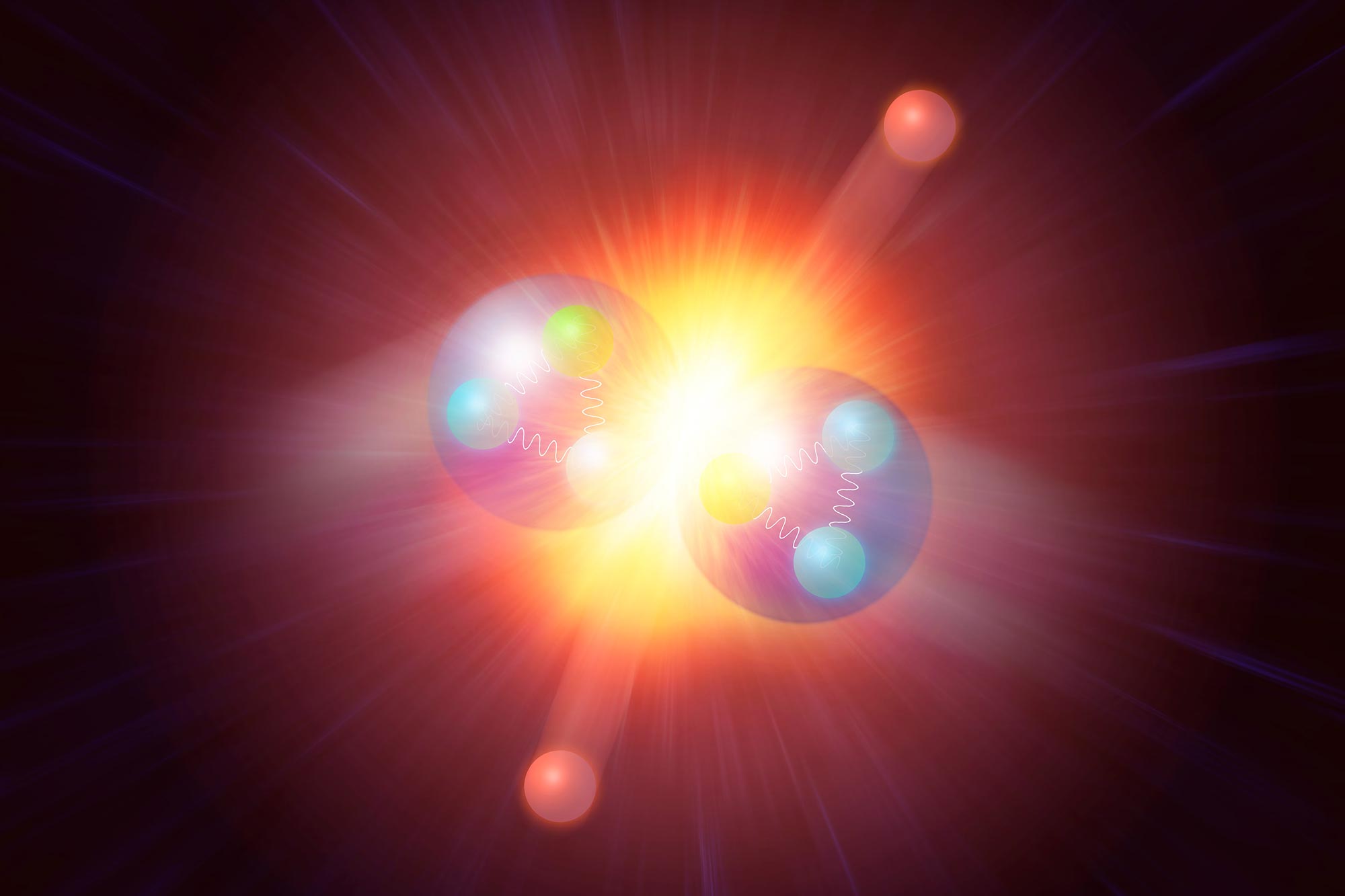
This leads to unique phenomena like Bose-Einstein condensates and superfluidity.
Bosons have integer spins and can occupy the same space, making them key players in force-carrying particles like photons and gluons. Fermions, with half-integer spins, follow the Pauli Exclusion Principle, meaning no two fermions can share the same quantum state.
Understanding Particle Spin and Classification
All the fundamental particles in nature can be divided into two categories—bosons and fermions—depending on how they “spin” in quantum mechanical terms. The fundamental particles can all be distinguished by their spin. This spin is a quantum mechanical property that has characteristics of angular momentum.
Quantum Exclusion and Composite Particles
What distinguishes bosons and fermions? Bosons are the fundamental particles that have spin in integer values (0, 1, 2, etc.). Fermions, on the other hand, have spin in odd half integer values (1/2, 3/2, and 5/2, but not 2/2 or 6/2). Spin can also have a direction, similar to how bigger particles can spin clockwise or counterclockwise. Bosons include photons (light), gluons (particles that act as force carriers in the nucleus), the Higgs boson, and the W and Z bosons. Fermions include protons, neutrons, electrons, neutrinos, and quarks.
Particle Interactions and Quantum Properties
In the world of particle physics, particles can combine to create new particles. For example, two neutrons (each with spin 1/2) and two protons (each with spin 1/2) can combine to create a helium nucleus, or an alpha particle. In this case, the spins combine (either through addition or subtraction) to create the total spin of the composite particle. Spin can add or subtract because it is a vector—it has both direction and magnitude. In our normal world, things can spin clockwise or counterclockwise. In the quantum world, scientists refer to “up” and “down” spin. In the case of a helium nucleus, the total spin is 0, making it a boson!
Quantum Exclusion and Composite Particles
A consequence of quantum mechanics called the Pauli Exclusion Principle dictates that no two fermions can occupy the same quantum state. In other words, identical fermions such as two electrons cannot occupy the same location in space with the same quantum number. They cannot both spin in the same direction, but they can spin in opposite directions. Bosons, on the other hand, are exempt from this principle. This means two bosons may occupy the same location in space with the same spin. This is true even for composite bosons, such as helium. Several bosons in the same quantum state can collect into what is known as a “Bose-Einstein Condensate.” These Bose-Einstein condensates can be found in superfluid helium and scientists believe they also exist in neutron stars.
Boson and Fermion Facts
- A class of bosons known as gauge bosons act as “force carriers” between particles. These include the photon (which carries the electromagnetic force), gluon (which carries the strong nuclear force), and W and Z bosons (which carry the weak nuclear force). The hypothetical graviton, which carries gravity, has not been found.
- Quarks are fermions that combine to form the composite fermions, protons, and neutrons.
- Condensates of bosons can have superfluid properties, meaning they have zero viscosity and flow freely with no loss of energy. Neutron stars may have superfluid cores of boson condensates.
- Some quarks and gluons may have a preferred spin, thanks to the strong nuclear force. Learn more in this article.
DOE Office of Science Contributions to Boson and Fermion Research
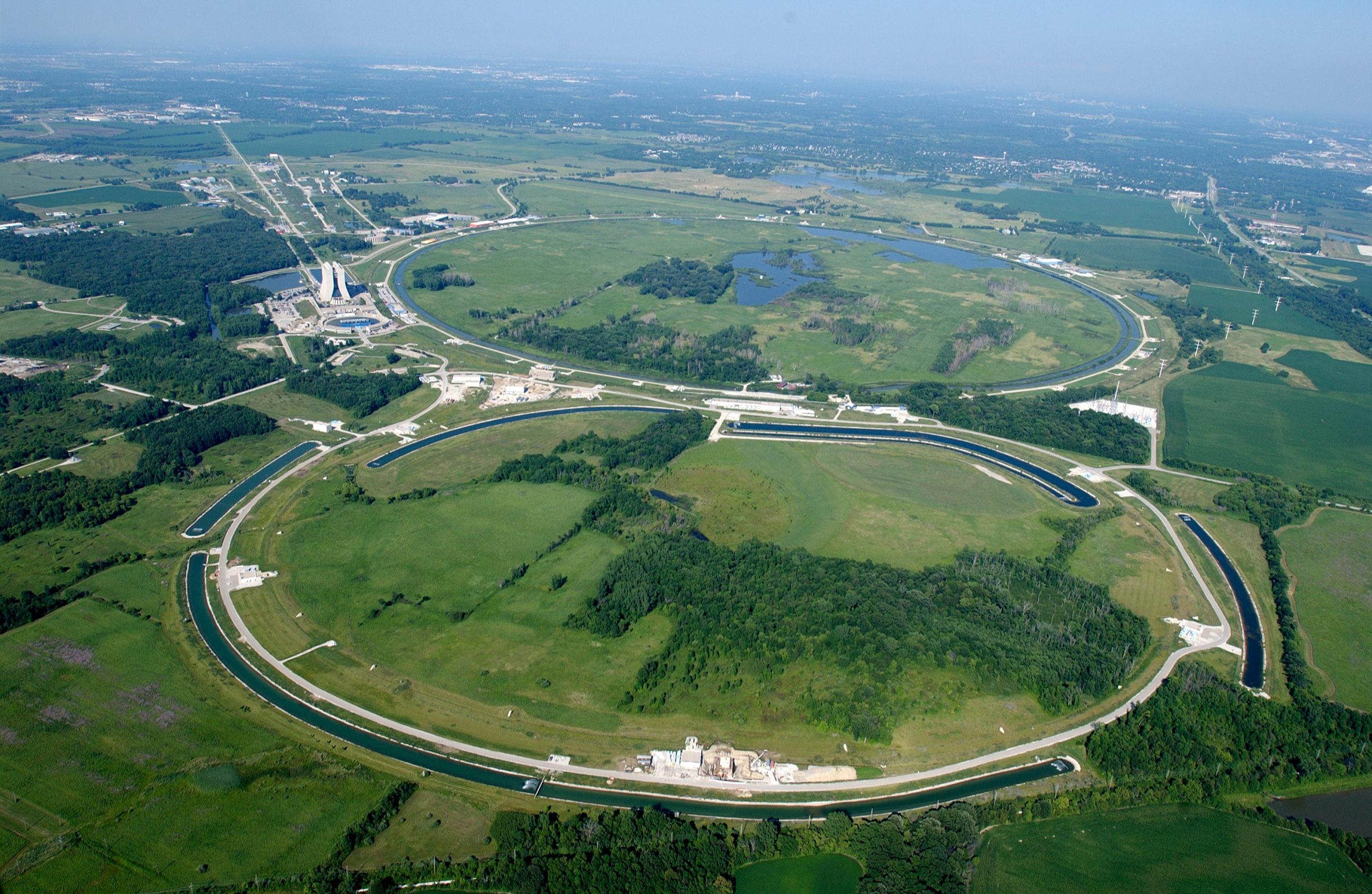
Nearly every aspect of Office of Science research relies on the properties of bosons and fermions. The properties of atomic nuclei, quark-gluon plasmas, laser studies, fusion, and a host of other studies implicitly rely on the fact that fundamental particles are either bosons or fermions. Particle accelerators at facilities such as the ATLAS and the Facility for Rare Isotope Beams study atomic nuclei, which may be composite bosons or fermions. Scientists use the Relativistic Heavy Ion Collider (RHIC) at Brookhaven National Laboratory and the Continuous Electron Beam Accelerator Facility (CEBAF) at Thomas Jefferson National Accelerator Facility to study the bosons known as gluons within protons and neutrons as well as the fermions known as quarks. Researchers use the Long Baseline Neutrino Facility
(LBNF) at Fermilab to study the peculiar properties of the fermions known as neutrinos.
Never miss a breakthrough: Join the SciTechDaily newsletter.
Follow us on Google and Google News.
1 Comment
Bosons and fermions are fundamental particles, distinguished by their quantum spin.
VERY GOOD.
Please ask researchers to think deeply:
1. What is the theoretical basis for Bosons and Fermions?
2. Where does the power of Bosons and Fermions spin come from?
3. Why do Bosons and Fermions spin?
and so on.
Scientific research guided by correct theories can help people avoid detours, failures, and exaggeration. The physical phenomena observed by researchers in experiments are always appearances, never the natural essence of things. The natural essence of things needs to be extracted and sublimated based on mathematical theories via appearances , rather than being imagined arbitrarily.
Everytime scientific revolution, the scientific research space brought by the new paradigm expands exponentially. Physics should not ignore the analyzable physical properties of topological vortices.
(1) Traditional physics: based on mathematical formalism, experimental verification and arbitrary imagination.
(2) Topological Vortex Theory: Although also based on mathematics (such as topology), it focuses more on non intuitive geometry and topological structures, challenging traditional physical intuition.
Extension of the Standard Model: Topological Vortex Theory points out the limitations of the Standard Model in describing the large-scale structure of the universe, proposes the need to consider non-standard model components such as dark matter and dark energy, and suggests that topological vortex fields may be key to understanding these phenomena.
Topological vortex theory heralds innovative technologies such as topological electronics, topological smart batteries, topological quantum computing, etc., which may bring low-energy electronic components, almost inexhaustible currents, and revolutionary computing platforms, etc.
Topology tells us that topological vortices and antivortices can form new spacetime structures via the synchronous effect of superposition, deflection, or twisting of them. In fact, mathematics does not tell us that there must be God particles, ghost particles, fermions, or bosons present. When physics and mathematics diverge, arbitrary imagination will make physics no different from theology.
Today, so-called official (such as PRL, Nature, Science, PNAS, etc.) in physics stubbornly believes that two sets of cobalt-60 rotating in opposite directions can become two sets of objects that mirror each other, is a typical case that pseudoscience is rampant and domineering. Please witness the exemplary collaboration between theoretical physicists and experimentalists (https://scitechdaily.com/microscope-spacecrafts-most-precise-test-of-key-component-of-the-theory-of-general-relativity/#comment-854286).
Let us continue to witness together the dirtiest and ugliest era in the scientific and humanistic history of human society. The laws of nature will not change due to misleading of so-called academic publications.