
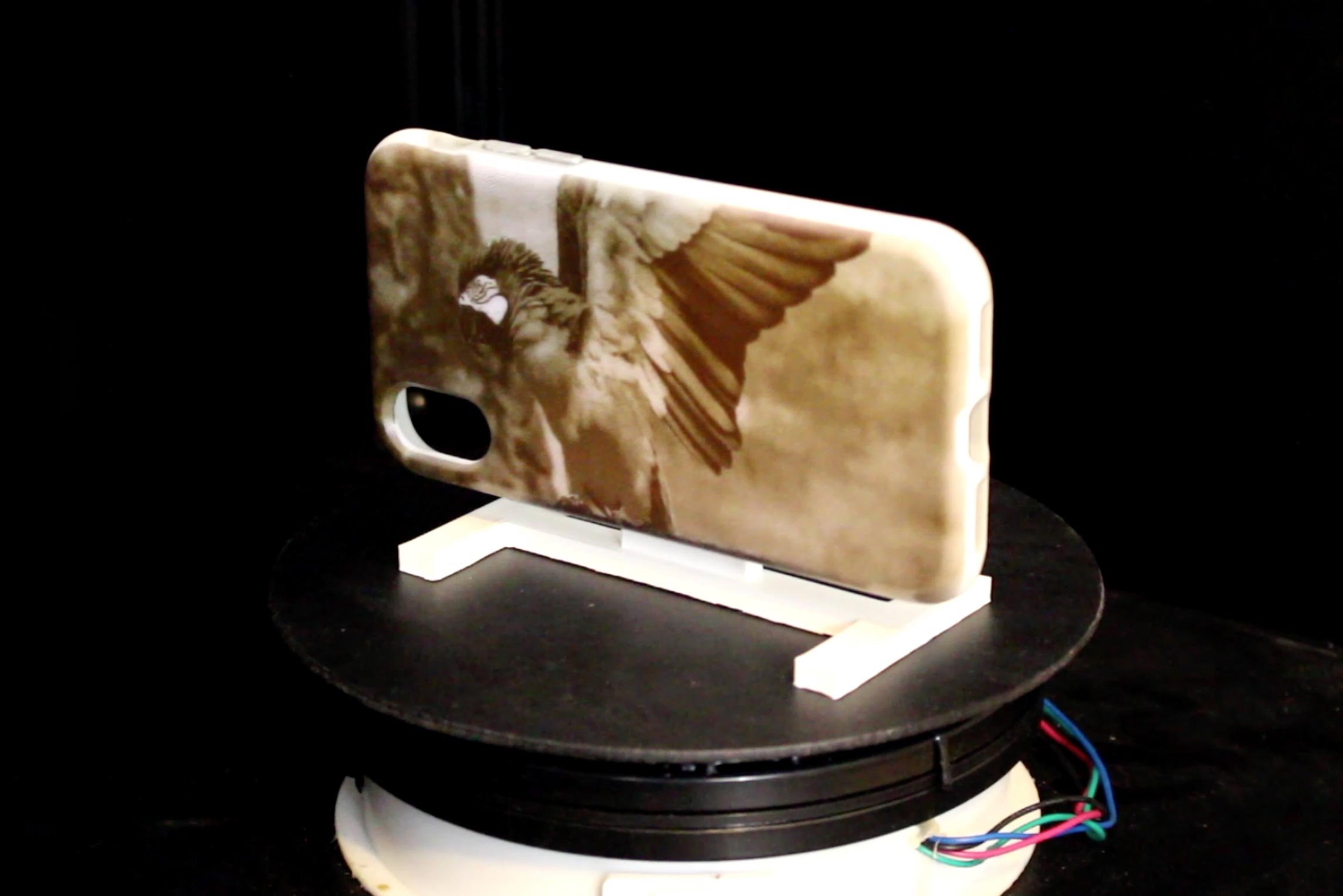
“Programmable matter” technique could enable product designers to churn out prototypes with ease.
When was the last time you repainted your car? Redesigned your coffee mug collection? Gave your shoes a colorful facelift?
You likely answered: never, never, and never. You might consider these arduous tasks not worth the effort. But a new color-shifting “programmable matter” system could change that with a zap of light.
MIT researchers have developed a way to rapidly update imagery on object surfaces. The system, dubbed “ChromoUpdate” pairs an ultraviolet (UV) light projector with items coated in light-activated dye. The projected light alters the reflective properties of the dye, creating colorful new images in just a few minutes. The advance could accelerate product development, enabling product designers to churn through prototypes without getting bogged down with painting or printing.
From PhotoChromeleon to ChromoUpdate
ChromoUpdate “takes advantage of fast programming cycles — things that wouldn’t have been possible before,” says Michael Wessley, the study’s lead author and a postdoc in MIT’s Computer Science and Artificial Intelligence Laboratory.
The research will be presented at the ACM Conference on Human Factors in Computing Systems this month. Wessely’s co-authors include his advisor, Professor Stefanie Mueller, as well as postdoc Yuhua Jin, recent graduate Cattalyya Nuengsigkapian ’19, MNG ’20, visiting master’s student Aleksei Kashapov, postdoc Isabel Qamar, and Professor Dzmitry Tsetserukou of the Skolkovo Institute of Science and Technology.
ChromoUpdate builds on the researchers’ previous programmable matter system, called PhotoChromeleon. That method was “the first to show that we can have high-resolution, multicolor textures that we can just reprogram over and over again,” says Wessely. PhotoChromeleon used a lacquer-like ink comprising cyan, magenta, and yellow dyes. The user covered an object with a layer of the ink, which could then be reprogrammed using light. First, UV light from an LED was shone on the ink, fully saturating the dyes. Next, the dyes were selectively desaturated with a visible light projector, bringing each pixel to its desired color and leaving behind the final image. PhotoChromeleon was innovative, but it was sluggish. It took about 20 minutes to update an image. “We can accelerate the process,” says Wessely.
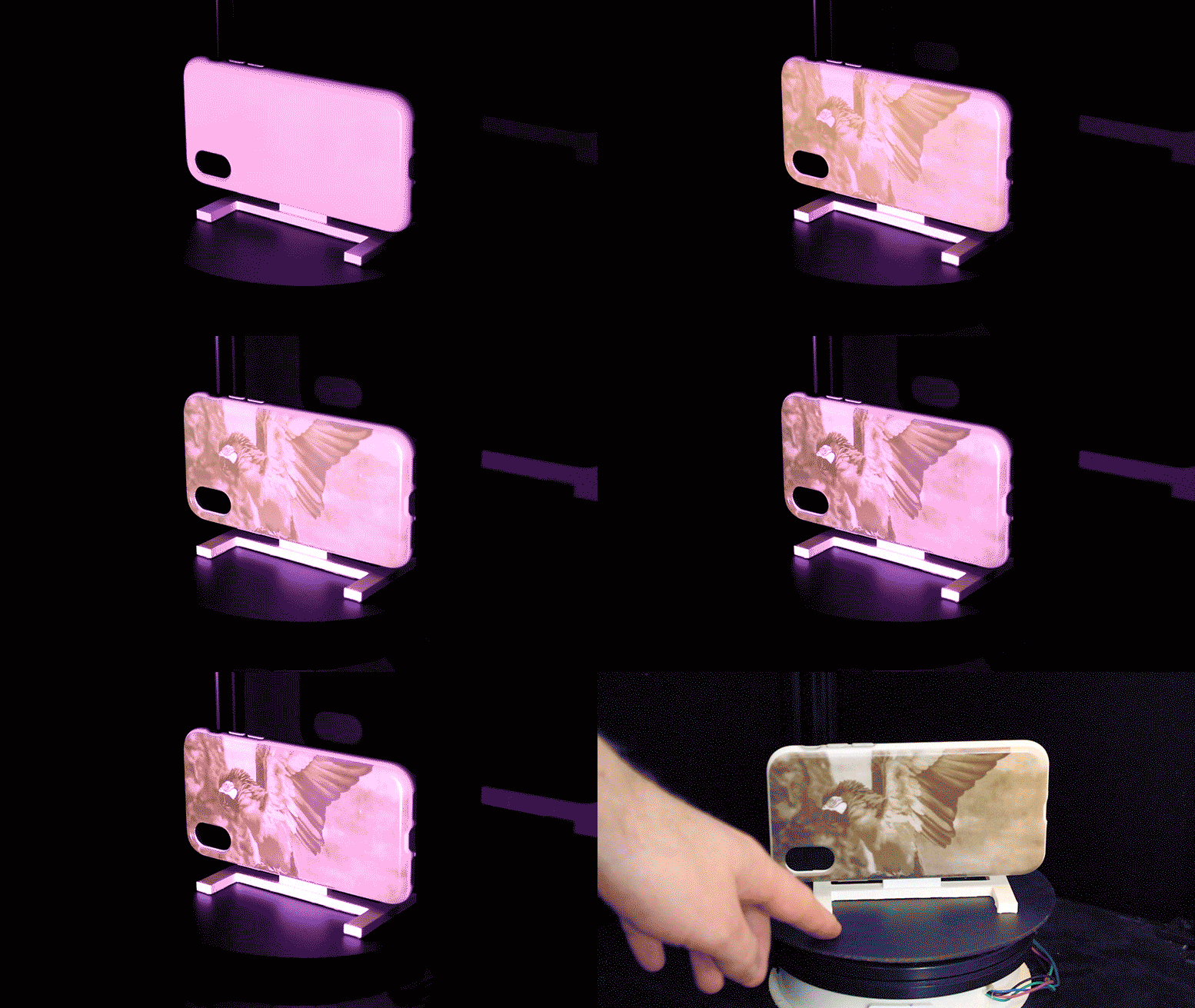
They achieved that with ChromoUpdate, by fine-tuning the UV saturation process. Rather than using an LED, which uniformly blasts the entire surface, ChromoUpdate uses a UV projector that can vary light levels across the surface. So, the operator has pixel-level control over saturation levels. “We can saturate the material locally in the exact pattern we want,” says Wessely. That saves time — someone designing a car’s exterior might simply want to add racing stripes to an otherwise completed design. ChromoUpdate lets them do just that, without erasing and reprojecting the entire exterior.
Rapid Prototyping and Real-World Testing
This selective saturation procedure allows designers to create a black-and-white preview of a design in seconds, or a full-color prototype in minutes. That means they could try out dozens of designs in a single work session, a previously unattainable feat. “You can actually have a physical prototype to see if your design really works,” says Wessely. “You can see how it looks when sunlight shines on it or when shadows are cast. It’s not enough just to do this on a computer.”
That speed also means ChromoUpdate could be used for providing real-time notifications without relying on screens. “One example is your coffee mug,” says Wessely. “You put your mug in our projector system and program it to show your daily schedule. And it updates itself directly when a new meeting comes in for that day, or it shows you the weather forecast.”
Wessely hopes to keep improving the technology. At present, the light-activated ink is specialized for smooth, rigid surfaces like mugs, phone cases, or cars. But the researchers are working toward flexible, programmable textiles. “We’re looking at methods to dye fabrics and potentially use light-emitting fibers,” says Wessely. “So, we could have clothing — t-shirts and shoes and all that stuff — that can reprogram itself.”
The researchers have partnered with a group of textile makers in Paris to see how ChomoUpdate can be incorporated into the design process.
Reference: “ChromoUpdate: Fast Design Iteration of Photochromic Color Textures Using Grayscale Previews and Local Color Updates” by Michael Wessely, Yuhua Jin, Cattalyya Nuengsigkapian, Aleksei Kashapov, Isabel P.S. Qamar, Dzmitry Tsetserukou and Stefanie Mueller.
PDF
This research was funded, in part, by Ford.
Never miss a breakthrough: Join the SciTechDaily newsletter.
Follow us on Google and Google News.