

Close Menu
    Facebook X (Twitter) Instagram
    SciTechDaily
    • Biology
    • Chemistry
    • Earth
    • Health
    • Physics
    • Science
    • Space
    • Technology
    Facebook X (Twitter) Pinterest YouTube RSS
    SciTechDaily
    Home»Biology»New Study Deconstructs Dunbar’s Number: Yes, You Can Have More Than 150 Friends
    Biology

    New Study Deconstructs Dunbar’s Number: Yes, You Can Have More Than 150 Friends

    By Stockholm UniversityMay 4, 2021No Comments4 Mins Read
    Facebook Twitter Pinterest Telegram LinkedIn WhatsApp Email Reddit
    Share
    Facebook Twitter LinkedIn Pinterest Telegram Email Reddit
    Group of Friends
    Dunbar’s number posits a cognitive limit of around 150 for stable social relationships, but a recent study challenges this idea, suggesting group size limits are not solely derived from cognitive factors.

    New research debunks Dunbar’s number, showing human social capacity isn’t fixed at 150 but varies widely and is shaped more by culture than biology.

    An individual human can maintain stable social relationships with about 150 people. This is the proposition known as ‘Dunbar’s number’ – that the architecture of the human brain sets an upper limit on our social lives. A new study from Stockholm University indicates that a cognitive limit on human group sizes cannot be derived in this manner.

    Dunbar’s number is named after the British anthropologist Robin Dunbar, who proposed the theory in the 1990s. The number 150 is based on an extrapolation of the correlation between the relative size of the neocortex and group sizes in non-human primates. Some empirical studies have found support for this number, while other have reported other group sizes.

    “The theoretical foundation of Dunbar’s number is shaky. Other primates’ brains do not handle information exactly as human brains do, and primate sociality is primarily explained by other factors than the brain, such as what they eat and who their predators are. Furthermore, humans have a large variation in the size of their social networks,” says Patrik Lindenfors, Associate Professor of Zoological Ecology at Stockholm University and the Institute for Futures Studies, and one of the authors of the study.
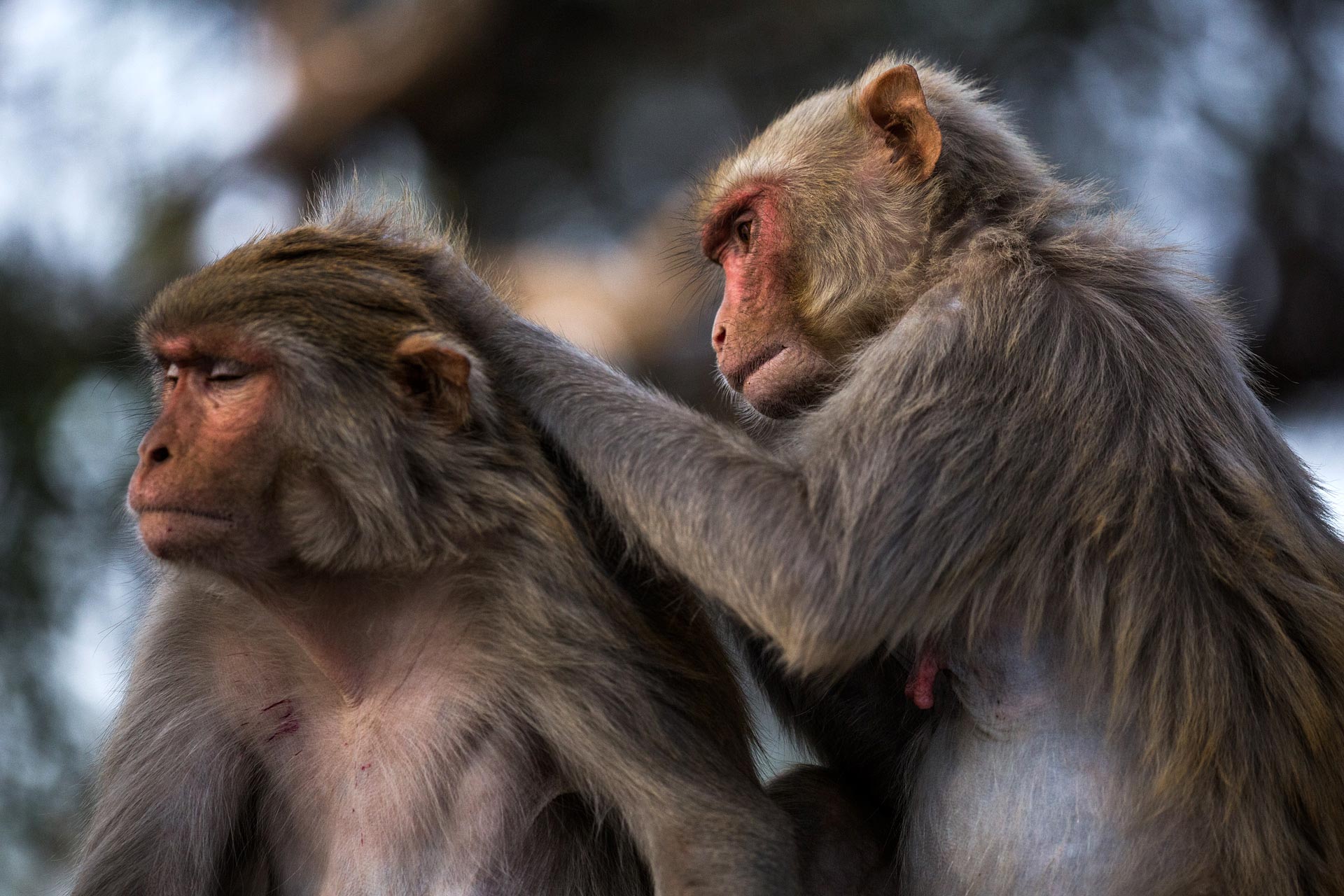
    Rhesus Macaque Monkeys
    Does the brain limit our social capacity, in monkeys as well as humans? Credit: Johan Lind/N

    When the Swedish researchers repeated Dunbar’s analyses using modern statistical methods and updated data on primate brains, the results were simultaneously much larger and far lower than 150.

    Confidence Intervals Undermine Precision

    The average maximum group size often turned out to be lower than 150 persons. But the main problem was that the 95% confidence intervals for these estimates were between 2 and 520 people.

    “It is not possible to make an estimate for humans with any precision using available methods and data,” says Andreas Wartel, co-author of the study.

    Dunbar’s number’ is often cited and has had a great impact in popular culture, not the least after featuring prominently in Malcolm Gladwell’s book “The Tipping Point”. In 2007, Swedish media reported that the Swedish Tax Authority reorganized their offices to stay within the 150-person limit.

    “This reorganization would then be based on the implicit but hopefully unintended assumption that their employees have neither family nor friends outside of work,” says Patrik Lindenfors and adds, “I think Dunbar’s number is widely spread, also among researchers, since it’s so easy to understand. Our claim that it is not possible to calculate a number is not quite as entertaining.”

    The Role of Culture in Social Capacity

    Ideas such as Dunbar’s number highlight questions about the long reach of the gene.

    “Are human social interactions genetically limited via the genes’ influence on the brain’s architecture? New research on cultural evolution has revealed the importance of cultural inheritance for what humans do and how we think. Culture affects everything from size of social networks to whether we can play chess or if we like hiking. Just like someone can learn to remember an enormous number of decimals in the number pi, our brain can be trained in having more social contacts” says Johan Lind, deputy director of the Centre for Cultural Evolution at Stockholm University and co-author of the study.

    Reference: “‘Dunbar’s number’ deconstructed” by Patrik Lindenfors, Andreas Wartel and Johan Lind, 5 May 2021, Biology Letters.
    DOI: 10.1098/rsbl.2021.0158

    Never miss a breakthrough: Join the SciTechDaily newsletter.
    Follow us on Google and Google News.

    Anthropology Behavioral Science Evolution Stockholm University
    Share. Facebook Twitter Pinterest LinkedIn Email Reddit

    Related Articles

    A Sense of Order – The Unique Trait That Sets Us Apart From Other Animals

    Testosterone Drives the Dark Side of Success: Meerkat Societies Fall Apart When Aggression Is Taken Away

    Study Finds Western Gorillas Are Territorial and Their Behavior Is Very Similar to Our Own

    Meerkat Mobs Do Frightening ‘War Dance’ to Protect Territory [Video]

    Attractive Bonobo Females Are More Likely to Win Conflicts Against Males

    New Study Links Expanding Human Population to Threats of Animal Extinction

    Study Provides Picture of Human Expansion From Africa

    Research Shows That American Heads Are Getting Larger

    Iceman Ötzi’s DNA Reveals Health Risks and Relations

    Leave A Reply Cancel Reply

    • Facebook
    • Twitter
    • Pinterest
    • YouTube

    Don't Miss a Discovery

    Subscribe for the Latest in Science & Tech!

    Trending News

    AI Could Detect Early Signs of Alzheimer’s in Under a Minute – Far Before Traditional Tests

    What if Dark Matter Has Two Forms? Bold New Hypothesis Could Explain a Cosmic Mystery

    This Metal Melts in Your Hand – and Scientists Just Discovered Something Strange

    Beef vs. Chicken: Surprising Results From New Prediabetes Study

    Alzheimer’s Breakthrough: Scientists Discover Key Protein May Prevent Toxic Protein Clumps in the Brain

    Quantum Reality Gets Stranger: Physicists Put a Lump of Metal in Two Places at Once

    Scientists May Have Found the Key to Jupiter and Saturn’s Moon Mystery

    Scientists Uncover Brain Changes That Link Pain to Depression

    Follow SciTechDaily
    • Facebook
    • Twitter
    • YouTube
    • Pinterest
    • Newsletter
    • RSS
    SciTech News
    • Biology News
    • Chemistry News
    • Earth News
    • Health News
    • Physics News
    • Science News
    • Space News
    • Technology News
    Recent Posts
    • Ancient “Rock” Microbes May Reveal How Complex Life Began
    • Hidden “Trade Winds” Inside Cells Could Explain Cancer Spread
    • Humans Owe Their Eyes to a Tiny One-Eyed “Cyclops”
    • Researchers Capture Quantum Interference in One of Nature’s Rarest Atoms
    • Ancient DNA Reveals Irish Goats Have a 3,000-Year-Old Lineage Still Alive Today
    Copyright © 1998 - 2026 SciTechDaily. All Rights Reserved.
    • Science News
    • About
    • Contact
    • Editorial Board
    • Privacy Policy
    • Terms of Use

    Type above and press Enter to search. Press Esc to cancel.