
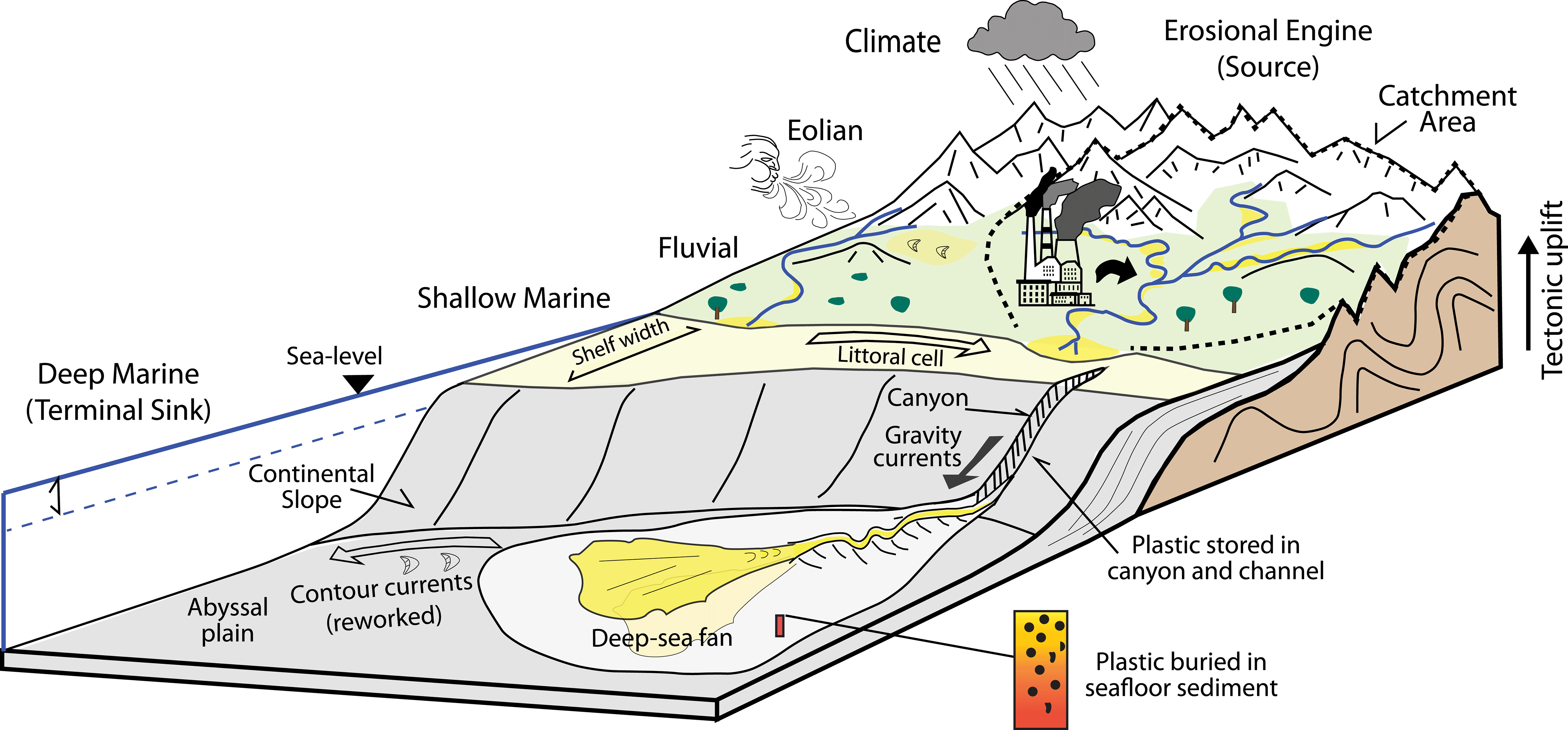
A new focus article in the May issue of Geology summarizes research on plastic waste in marine and sedimentary environments. Authors I.A. Kane of the Univ. of Manchester and A. Fildani of the Deep Time Institute write that “Environmental pollution caused by uncontrolled human activity is occurring on a vast and unprecedented scale around the globe. Of the diverse forms of anthropogenic pollution, the release of plastic into nature, and particularly the oceans, is one of the most recent and visible effects.”
The authors cite multiple studies, including one in the May issue by Guangfa Zhong and Xiaotong Peng, discussed in a previous GSA news release when it was published online ahead of print (January 26, 2021). Zhong and Peng were surprised to find plastic waste in a deep-sea submarine canyon located in the northwestern South China Sea.
The Threat of Microplastics and Nanoplastics
“Plastic is generally considered to be the dominant component of marine litter, due to its durability and the large volume produced,” write Kane and Fildani. “Nano- and microplastics are a particularly insidious form of anthropogenic pollutant: tiny fragments and fibers may be invisible to the naked eye, but they are ingested with the food and water we consume and absorbed into the flesh of organisms.”
One of their vital questions is, “If some plastics can survive for >1000 years in terrestrial environments, how long do they last in ocean trenches that are kilometers deep, dark, cold, and at high pressure? How long does it take plastic to break down into microplastics and nanoplastics in the deep sea?”
“While it is incumbent on policymakers to take action now to protect the oceans from further harm, we recognize the roles that geoscientists can play,” write Kane and Fildani. That includes using their deep-time perspective to address the societal challenges, their understanding of the present-day distribution on the seafloor and in the sedimentary record, using geoscience techniques to record the downstream effects of mitigation efforts, and to predict the future of seafloor plastics.
In summary, they write, “We understand … the transient nature of the stratigraphic record and its surprising preservation, and the unique geochemical environments found in deep-sea sediments. Our source-to-sink approach to elucidate land-to-sea linkages can identify the sources and pathways that plastics take while traversing natural habitats and identify the context in which they are ultimately sequestered, and the ecosystems they affect. This will happen by working closely with oceanographers, biologists, chemists, and others tackling the global pollution problem.”
Reference: “Anthropogenic pollution in deep-marine sedimentary systems—A geological perspective on the plastic problem” by I.A. Kane and A. Fildani, 1 May 2021, Geology.
DOI: 10.1130/focus052021.1
Never miss a breakthrough: Join the SciTechDaily newsletter.
Follow us on Google and Google News.
1 Comment
Gee… I must be getting old… I seem to remember this “problem” being @ issue nearly 30 years ago. The MID-PACIFIC GYRE; a swirling mass of non-biodegradable plastics, North and South of the Equator, several thousand kilometers in diameter and one-hundred or more meters deep. It was NEWS for a bit, then it went away. PROBLEM SOLVED, I guess. Here it is: déja vû all over again. The more things change, the more they stay the same. Reminds me of Herman Melville’s MOBY DICK: First Mate, Starbuck’s caution: Uh… Shouldn’t we about-turn and run the other way?; AHAB’S obsession: Avast! there mateys! Don’t mind him or that White Monster heading straight for us! FULL SPEED AHEAD! Well… It’s off to Starbuck$$, for a caramel latté, in a marginally bio-degradable, plastic-lined cup. Toss it overboard, let it swirl in our wake. It’ll break down, EVENTUALLY. Eco-friendly plastic Bottle of Evian (naïve spelled backwards) with your ‘nosh, sir? On a parallel “tack”: it’s kinda like a drowning sailor stopping to consider the condition of his manicure before grabbing the LIFE RING.
WORRY NOT! LANDLUBBER! SCIENCE will save us! Is that the SAME “commercially VIABLE” Science what dug this trench over the past 200 years? Still can’t see over the gunwales, rooting around the decks for stray silver.
Oh well… Ship to starboard. On second-second thought, make mine a Caramel Macchiato. Skip the danish. I’m watching my cholesterol… 😑 Have a day!