

NASA’s Magnetospheric Multiscale Mission is poised to give astronomers a unique look at magnetic reconnection.
On July 9, 2015 the four spacecraft of NASA’s Magnetospheric Multiscale, or MMS, mission began flying in a pyramid shape for the first time. The four-sided pyramid shape—called a tetrahedron—means that scientists’ observations will be spread out over three dimensions.
MMS will be gathering data to study a phenomenon called magnetic reconnection, which—along with many other places in the universe—happens when the magnetic field surrounding Earth connects and disconnects from the magnetic field carried by solar wind, realigning the very shape of Earth’s magnetic bubble and sending particles flying off at incredible speeds.
This tetrahedral formation is the result of years of discussion between scientists and orbital engineers to fashion feasible orbits that will yield the best possible observations. Such a pyramid is crucial to provide three-dimensional information about Earth’s space environment – if all four spacecraft moved in a line or a plane, MMS couldn’t observe the full shape of a structure as it flew through.
This video shows the dynamic orbit of the four MMS spacecraft. The flexible, pyramid-shaped formation allows MMS to collect the best possible three-dimensional data on magnetic reconnection. The orbit will be adjusted to eventually bring the four spacecraft to within about six miles of each other. Credit: NASA’s Goddard Space Flight Center
The other major feature of MMS’ orbit can be seen right in its name: multiscale. Because the four MMS spacecraft orbits can be changed individually, scientists can adjust the distance among the four spacecraft, allowing them to study magnetic reconnection on a variety of different spatial scales.
“You can think of the formation as a kind of meta-instrument,” said Conrad Schiff, orbital engineer for the MMS mission at NASA’s Goddard Space Flight Center in Greenbelt, Maryland. “Kind of like focusing a telescope, adjusting the scale of the MMS spacecraft formation brings different processes into focus.”
Schiff has been part of MMS orbit planning on and off since 1998, long before the mission launched in March 2015. Balancing research goals of the scientists with what is both engineering and economically feasible – more fuel for more maneuverability leads to more expensive launch vehicles, for example – is a conversation that goes on for years before a mission is even officially chosen, much less launched.
The MMS orbit for its first phase, will carry the spacecraft through the front of Earth’s magnetosphere – the magnetic bubble surrounding Earth – right at the boundary where it interacts with the constant wind of solar particles streaming in from the sun. Here, as the sun’s magnetic fields interact with those that surround Earth, explosive magnetic reconnection events are known to happen. Flying though these boundaries every day for over one year, the four spacecraft will zoom through magnetic reconnection events right as they occur.
“Its pyramid formation and extremely fast time resolution will offer the first ever three-dimensional observations down to the smallest scales of reconnection,” said Tom Moore, MMS Project Scientist at Goddard.
The orbital team also made sure that the MMS mission structure is flexible – at different separation distances, the mission can see processes at those all-important different scales. When magnetic reconnection occurs, the magnetic and electric fields in the area change extremely quickly. That leads to telltale behavior of flowing charged particles—which are naturally moved by magnetic and electric fields—that instruments on MMS are designed to measure. So, by looking at the behavior of different charged particles, like electrons and ions, the scientists can “see” what’s happening during magnetic reconnection.
Because ions are so much heavier than electrons – at least 1,800 times heavier – they are not as susceptible to being pushed or pulled by magnetic and electric fields. This means that an ion can travel much farther than an electron before it is drawn in by a magnetic or electric field. This difference means that studying magnetic reconnection happens at two scales – the larger ion scale, and the smaller electron scale. The scaling of the MMS formation will allow scientists to study both.
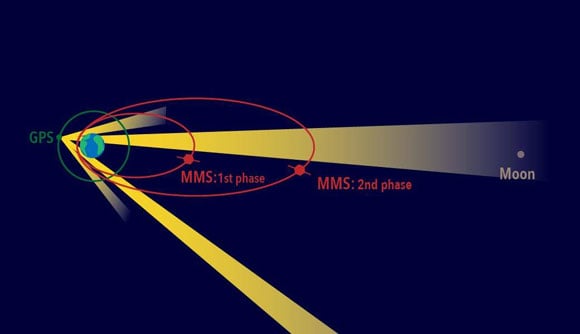
After its journey through the front of Earth’s magnetosphere, MMS will enter Phase 2, during which its orbit will steadily be enlarged, until it swings all the way out to 99,000 miles (160,000 kilometers) away from Earth. There it will move through an area of the magnetosphere behind Earth called the magnetotail – another area where magnetic reconnection is known to happen.
“We talk about the orbit of MMS as a whole and getting it to fly through the day and night side of the magnetosphere,” said Schiff. “But the fact is that each spacecraft is really on its own orbit. So we don’t just have to get a queen bee to fly through the right parts of the day side and night side, we have to keep the whole hive together.”
That means the team must think about not just how each spacecraft orbits Earth, but how it lies in formation with respect to the others – a job that will continue over the lifetime of the mission. When MMS was moved into its first tetrahedral formation in July 2015, the spacecraft were flying about 100 miles (160 kilometers) apart. The European Space Agency/NASA Cluster mission of four spacecraft had periods in which the spacecraft were that close, but MMS will move even closer. Over the course of the mission’s first phase, that spacing will drop in steps – first down to 40 miles (64 kilometers), then 15 (24 km), and then to just a little over six miles (10 km).
These distances will mark an orbital engineering triumph: so many spacecraft have never before flown so close together for an extended period of time. To accomplish this feat MMS makes use of another record-breaking engineering achievement. The spacecraft house the highest working GPS receivers ever flown. GPS – the familiar system you might use to drive to a new place – uses several satellites in orbit about 12,000 miles (19,000 kilometers) above Earth to triangulate one’s location. GPS has been used to track spacecraft in lower orbits, but MMS is the first mission to use GPS from above. For comparison, MMS’ flies at maximum height of about 48,000 miles (77,000 kilometers) – about four times the height of GPS satellites. As such, it carries extra sensitive GPS sensors in order to receive its signals from the satellites flying on the other side of Earth.
All this attention to orbit planning is of course for a single goal: to gather the best science observations possible.
“Moving MMS into its tetrahedron formation is a really huge milestone,” said Moore. “We are all incredibly excited to be getting on with the science analysis after years of anticipation!”
MMS is currently in commissioning – a phase when its systems and instruments are tested — and it will start official science observation in September 2015. MMS is the fourth NASA Solar Terrestrial Probes Program mission. Goddard built, integrated, and tested the four MMS spacecraft and is responsible for overall mission management and mission operations. The Southwest Research Institute in San Antonio, Texas, leads the Instrument Suite Science Team, with the University of New Hampshire leading the FIELDS instrument suite. Science operations planning and instrument command sequence development will be performed at the MMS Science Operations Center at the University of Colorado’s Laboratory for Atmospheric and Space Physics in Boulder.
Never miss a breakthrough: Join the SciTechDaily newsletter.
Follow us on Google and Google News.