
Key Points
- Revealing Theia’s composition: A new study in Science identifies the likely chemical makeup of Theia, the ancient planetary body that struck early Earth.
- Clues to its birthplace: Theia’s reconstructed composition points to an origin in the inner Solar System, probably forming even closer to the Sun than Earth.
- Apollo samples provide evidence: Researchers analyzed Moon rocks brought back by the Apollo missions and, for the first time, used their iron isotope ratios to trace where Theia originally formed.
A Collision That Reshaped the Young Earth
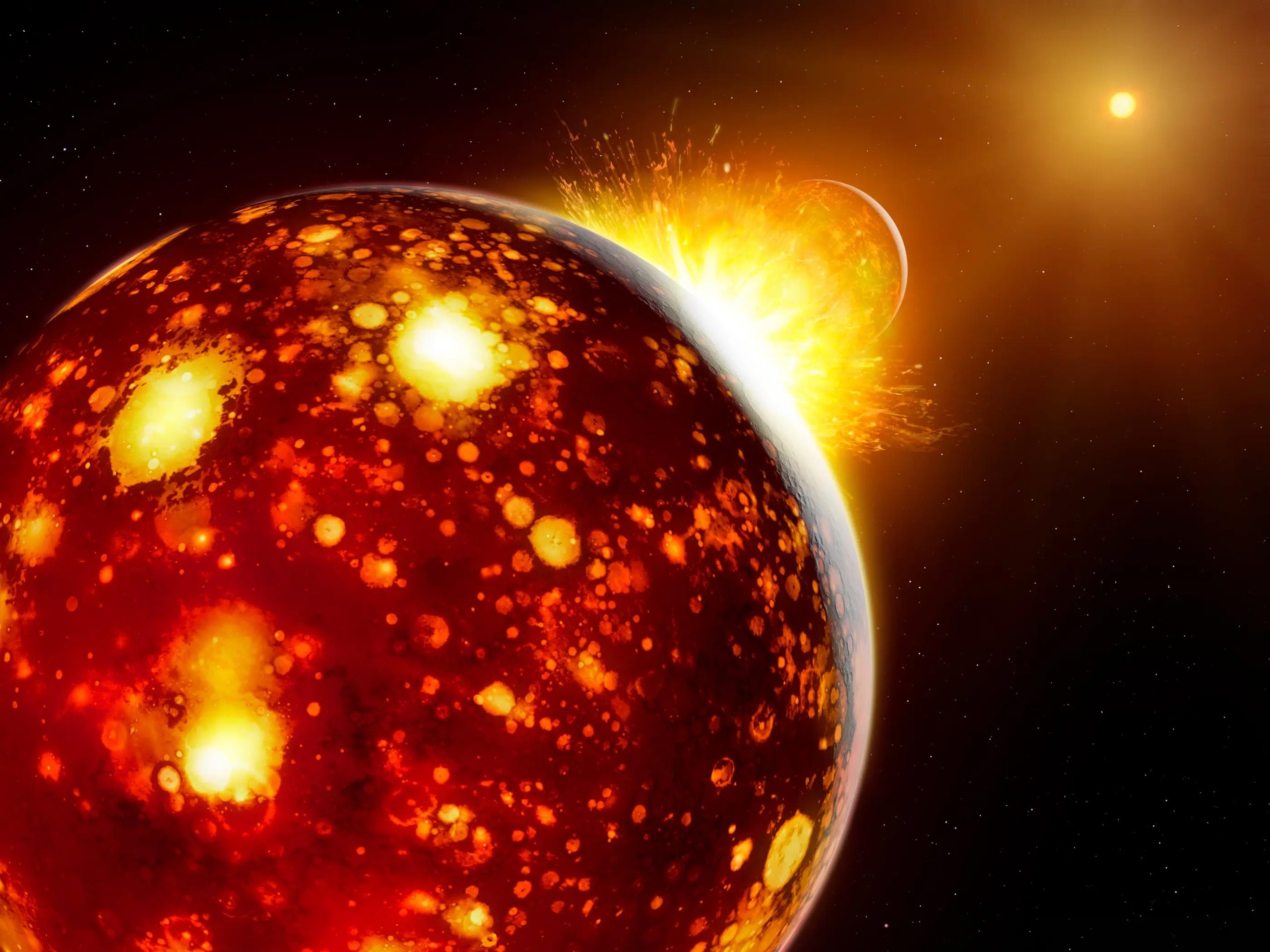
Around 4.5 billion years ago, an enormous protoplanet known as Theia struck the early Earth in what may have been the most influential event in our planet’s history. The precise sequence of the impact and the aftermath is still uncertain, but scientists agree on its consequences. The collision altered Earth’s size, structure, and orbital path, and it also led to the formation of the Moon, which has remained Earth’s constant partner ever since.
This raises several long-standing scientific questions. What kind of world was Theia before the crash? How large was it, what materials did it contain, and from which part of the Solar System did it originate? Although Theia itself was completely destroyed, its chemical fingerprints live on in both Earth and the Moon. A new study published on November 20, 2025, in Science by researchers from the Max Planck Institute for Solar System Research (MPS) and the University of Chicago uses these remaining clues to reconstruct Theia’s likely composition and identify where it was formed.
“The composition of a body archives its entire history of formation, including its place of origin.”
Thorsten Kleine, Director at MPS and co-author of the new study
Isotopes as Tracers of Planetary Origins
The distribution of metal isotopes within a planetary body can reveal a great deal about its past. Isotopes are forms of an element that differ only in the number of neutrons in the atomic nucleus – and therefore in their mass. In the early Solar System, isotopes of the same element were not spread evenly. Materials that formed far from the Sun often developed slightly different isotope ratios compared with those that formed closer in. Because of this, the isotopic signature preserved in a body’s rocks contains information about where its building blocks originally came from.
Analyzing Earth and Moon Rocks for Theia’s Clues
In the new study, researchers measured iron isotope ratios in terrestrial and lunar samples with unprecedented precision. Their dataset included 15 rocks from Earth and six samples from the Moon collected during the Apollo missions. The results matched earlier findings for chromium, calcium, titanium, and zirconium: Earth and Moon share essentially identical isotope ratios.
This similarity, however, does not immediately reveal details about Theia. Many collision models could produce the same outcome. Some scenarios propose that the Moon formed largely from Theia’s material, while others suggest the Moon consists mainly of material from Earth’s early mantle, or that both bodies’ materials became so thoroughly mixed that their signatures merged.
Reconstructing Theia Through Planetary Reverse Engineering
To gain new insight into Theia, the research team approached the problem like a reverse engineering challenge. By starting with the nearly identical isotope signatures in Earth and the Moon today, they calculated which combinations of Theia’s size, composition, and early Earth properties could have produced this final match.
Their analysis included several elements, not only iron but also chromium, molybdenum, and zirconium. Each one reflects a different stage in planetary formation. Long before the collision, Earth itself had already undergone internal differentiation. When Earth’s iron core formed, elements such as iron and molybdenum sank inward and became concentrated there. As a result, the iron present in Earth’s mantle today must have arrived later, potentially delivered by Theia. Elements like zirconium, which remained in the mantle, record the full timeline of Earth’s formation.
Meteorite Data and the Search for Theia’s Birthplace
The calculations allowed the researchers to eliminate some possible Earth–Theia combinations as unrealistic.
“The most convincing scenario is that most of the building blocks of Earth and Theia originated in the inner Solar System. Earth and Theia are likely to have been neighbors.”
Timo Hopp, MPS scientist and lead author of the new study
While the early Earth’s composition can be modeled largely as a mixture of known meteorite groups, Theia does not match any single class as closely. Meteorites provide valuable reference points because they formed in specific regions of the Solar System and preserve the chemistry of those areas. Theia, however, appears to have included material not represented in current meteorite collections. Based on the isotopic results, the researchers conclude that this material likely formed even closer to the Sun than Earth did. Their calculations point to Theia originating in an inner region of the Solar System before eventually colliding with our planet.
Reference: “The Moon-forming impactor Theia originated from the inner Solar System” by Timo Hopp, Nicolas Dauphas, Maud Boyet, Seth A. Jacobson and Thorsten Kleine, 20 November 2025, Science.
DOI: 10.1126/science.ado0623
Never miss a breakthrough: Join the SciTechDaily newsletter.
Follow us on Google and Google News.
1 Comment
Prvi sam prije 4 g. komentirao dolazak Theie od Sunca Perihela orbite i sudar zbog “Velike Konjukcije” više planeta, uključujući Zemlju, što nije razlog da bi Theia i nastala u unutarnjem dijelu Akrecija blizu Sunca. Znanstvena ekipa spominje obimni posao istrage izotopa, pa su možda započeli ranije, ali su pobrkali Mjesec [kao da je sav sastava isti Thei-e, pa i uz izvinjenje da to biti ne mora, zapravo ne istražuju detalje nego lobiranju “predviđeno”. Sudar prije cca 4,5 milijardi g., a otkriće u međuvremenu podataka kristala Cirkona da je Mjesec star 4,555 milijardi g. zanemaruju, [Zemlja 4,5 milijardi prema kristalu Cirkona, još je raštrkani plin Akrecije Diska Sunca planeta]. Za Zemlju napominju rast težine, i promjenu orbite sudarom, ali nije jasno kojeg materijala kad svi izračuni Mjesecu daju više 90 % Blasta samo pod uvijetom brzog Spina vrtnje Theie, koja veličinom Marsa doprinosi svoje težine ukupno samo 20 % mase Zemlje, pa joj i 1 % rast ne ostavlja masu za Mjesec kada se formira prirodnim korištenjem 8 do 15 % od ukupne raspoložive mase u vremenu 10 – 90 miliona g. Nikako ne uključuju fosilne magnetske tragove [poravnanja smjera silnica polarnog magnetizma Zemlje i Mjeseca]. Nisu istražili dužinu dan noć rotacije i utjecaj plimne sile na zagrijavanje vidljive strane Mjeseca. Dakle samo Lobi starosti cca 4,5 milijardi godina. Odakle Zemlji Voda, S Sumpor, P Fosfor, W Wolfram, duboko ispod Tektonike, i AU Zlato, He Helij, I 3He Orto Helij, ovi zadnji [iza Wolfram-a cureći iz mućkave Jezgre]. Odakle prilagodba dvostruko zaključane rotacije Mjeseca, odakle Tektonika. Mislim, ima posla za mnoge ekipe.