
Fifty-five years after our giant leap, scientists continue to learn about both the Moon and Earth from our celestial neighbor.
A recent ISS photo captures the Moon’s crescent and Earthshine, offering insights into Earth’s decreasing albedo and climate trends, highlighted by NASA’s CERES project.
Since NASA first landed humans on the Moon during the 1969 Apollo 11 mission, we have continued to revere our nearest celestial neighbor. Whether for its role in solar eclipses, the way it lights up long winter nights, or the mysteries of its far side, the Moon inspires awe and intrigue.
Earthshine and the Moon’s Perspective
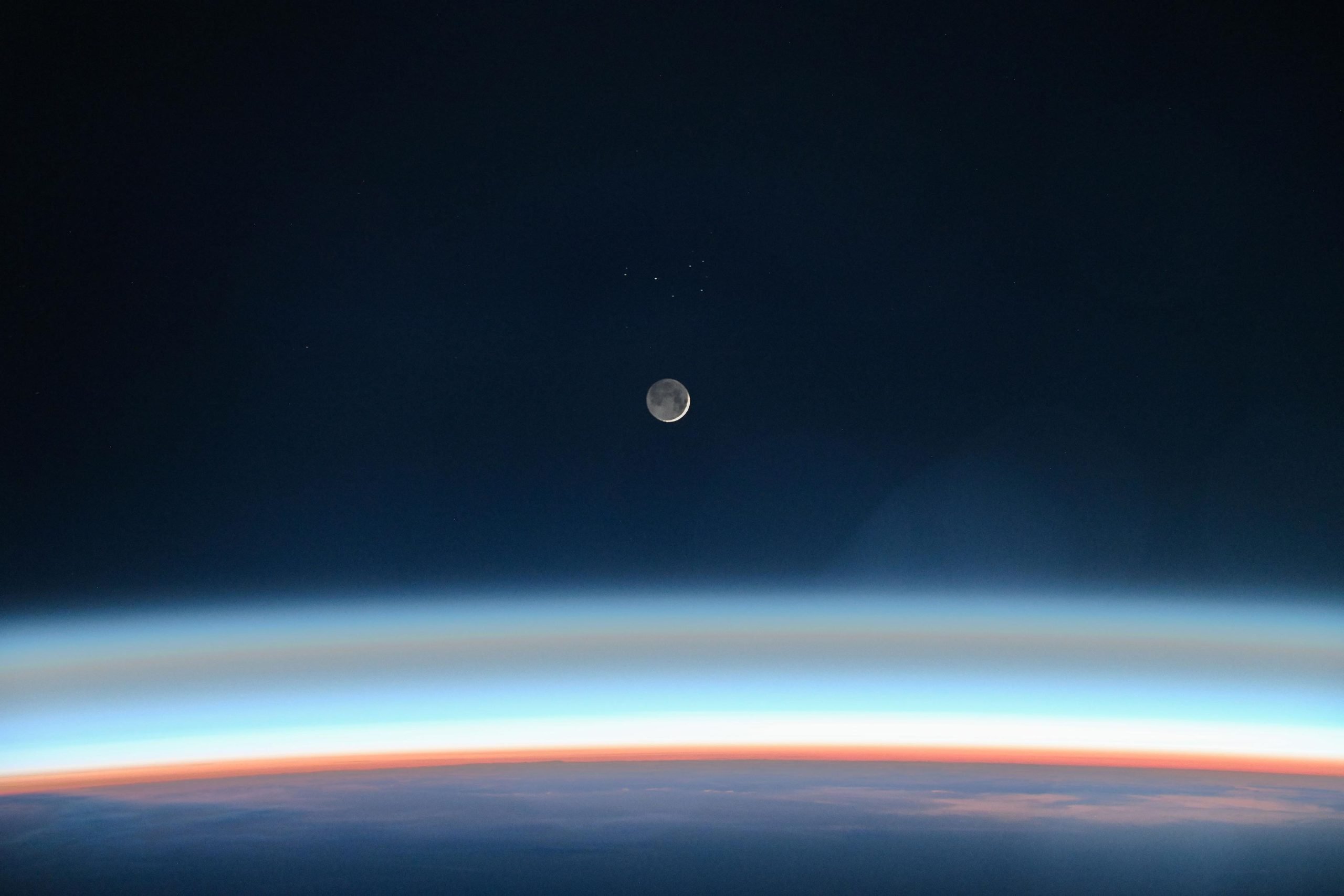
An astronaut aboard the International Space Station captured the feeling of lunar wonder in this image from May 2024. The photograph shows the Moon in the waxing crescent phase, with only a small sliver of the Sun-illuminated side visible on its right side. The rest of the Moon glows, albeit much less brightly, by the light of the Sun after it has been reflected off of Earth—a phenomenon called earthshine.
Below the Moon, Earth’s bright horizon, or limb, arcs across the bottom of the image. This photo’s perspective offers a cross-section of the planet’s atmospheric layers, including the orange troposphere nearest to the surface and the thicker, light-blue stratosphere above that.
Climate Insights From Lunar Observations
Scientists can learn about our home planet by studying the Moon. Among other insights, it offers clues as to how life on Earth may have begun and what earthquakes were like in the planet’s early history. The Moon also helps scientists track Earth’s brightness, or albedo, via earthshine.
Climate scientists are interested in albedo because it is a key component in Earth’s energy budget—the balance of energy entering and leaving the Earth system. Ice cover, cloudiness, airborne pollution, and land cover all factor into albedo, or how much light the Earth reflects back into space.
Earthshine observations made by scientists at Big Bear Solar Observatory from 1998–2017 point to an overall decrease in albedo over that time, according to a 2021 study. Warming sea surface temperatures, which reduced low-level, highly reflective cloud cover, particularly over the eastern Pacific, may have contributed to the trend, the authors noted.
The Earth’s reflection on the Moon offers a seemingly elegant measure of albedo. However, NASA scientists are building a more detailed long-term record of Earth’s brightness using a suite of satellite instruments combined with meteorological, aerosol, and other data. Since the 1990s, the CERES (Clouds and the Earth’s Radiant Energy System) project has been measuring the solar energy absorbed and reflected by Earth, the heat the planet emits into space, and the role of clouds in that process.
CERES has found a decrease in Earth’s albedo in the first two decades of the 2000s, as well as a doubling of Earth’s energy imbalance between 2004 and 2019, meaning that the Earth system is gaining energy and therefore heating. A decrease in low clouds, in particular, is a leading candidate behind these trends, said CERES principal investigator Norman Loeb of NASA’s Langley Research Center. However, the reasons for varying cloud cover—including sea surface temperature changes, shorter-term natural variability, and aerosol pollution—are difficult to disentangle. “It’s not a settled issue at this point,” he said.
NASA’s Continued Lunar Exploration
NASA’s interest in lunar exploration remains keen 55 years after Apollo 11. With the Artemis campaign, NASA will send astronauts to the Moon’s South Pole region, advance scientific discovery, and prepare for human missions to Mars.
Astronaut photograph ISS071-E-67226 was acquired on May 10, 2024, with a Nikon Z 9 digital camera using a 116 millimeter lens and is provided by the ISS Crew Earth Observations Facility and the Earth Science and Remote Sensing Unit, Johnson Space Center. The image was taken by a member of the Expedition 71 crew. The image has been cropped and enhanced to improve contrast, and lens artifacts have been removed. The International Space Station Program supports the laboratory as part of the ISS National Lab to help astronauts take pictures of Earth that will be of the greatest value to scientists and the public, and to make those images freely available on the Internet.
Never miss a breakthrough: Join the SciTechDaily newsletter.
Follow us on Google and Google News.