
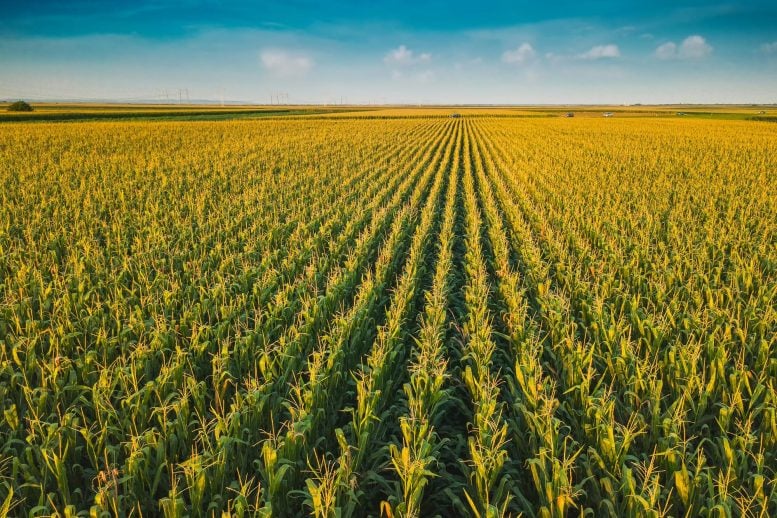
UMass Amherst researchers used remote sensing to quantify the previously underestimated erosion.
More than one-third of the Corn Belt in the Midwest – nearly 30 million acres – has completely lost its carbon-rich topsoil, according to University of Massachusetts Amherst research that indicates the U.S. Department of Agriculture has significantly underestimated the true magnitude of farmland erosion.
In a new paper published in the Proceedings of the National Academy of Sciences, research conducted by UMass Amherst graduate student Evan Thaler, along with professors Isaac Larsen and Qian Yu in the Department of Geosciences, developed a method using satellite imagery to map areas in agricultural fields in the Corn Belt of the Midwestern U.S. that have no remaining A-horizon soil. The A-horizon is the upper portion of the soil that is rich in organic matter, which is critical for plant growth because of its water and nutrient retention properties. The researchers then used high-resolution elevation data to extrapolate the satellite measurements across the Corn Belt and the true magnitude of erosion.
Productive agricultural soils are vital for producing food for a growing global population and for sustaining rural economies. However, degradation of soil quality by erosion reduces crop yields. Thaler and his colleagues estimate that erosion of the A-horizon has reduced corn and soybean yields by about 6%, leading to nearly $3 billion in annual economic losses for farmers across the Midwest.
Tillage Erosion: A Hidden Driver of Soil Loss
The A-horizon has primarily been lost on hilltops and ridgelines, which indicates that tillage erosion – downslope movement of soil by repeated plowing – is a major driver of soil loss in the Midwest. Notably, tillage erosion is not included in national assessments of soil loss and the research highlights the urgent need to include tillage erosion in the soil erosion models that are used in the U.S. and to incentivize adoption of no-till farming methods.
Further, their research suggests erosion has removed nearly 1.5 petagrams of carbon from hillslopes. Restoration of organic carbon to the degraded soils by switching from intensive conventional agricultural practices to soil-regenerative practices has the potential to sequester carbon dioxide from the atmosphere while restoring soil productivity.
Reference: “The extent of soil loss across the US Corn Belt” by Evan A. Thaler, Isaac J. Larsen and Qian Yu, 23 February 2021, Proceedings of the National Academy of Sciences.
DOI: 10.1073/pnas.1922375118
Never miss a breakthrough: Join the SciTechDaily newsletter.
Follow us on Google and Google News.
9 Comments
So, has the down-slope movement of the organic-rich soil increased the fertility and productivity of the lower elevations, compensating for the hill/ridge top losses?
If the farmer sees that the higher elevations aren’t producing well, he/she has the option of not bothering to till, plant, and fertilize those areas, thus saving those costs.
We can afford to lose a lot of corn productivity by just not converting food into ethanol.
For additional insight on this claimed problem:
https://www.sciencedirect.com/science/article/abs/pii/S0308521X2100038X
This study is rediculous and completely made up so that Bill Gates can promote his BS farming techniques. Idiots!!!
Spencer the protein in all left in the distillers grain because distillers has 3 times more protein than the original bushel of corn.
Let me see if I understand you correctly. Fermenting the corn to produce ethanol, which is taken away from the original corn, results in increasing the protein content 3X in the residue, which weighs as much as it did when first harvested.
That sounds like a ‘perpetual motion machine.’ Can corn bread or tacos be made from the residue? Is it usable for the ubiquitous high-fructose corn syrup?
The loss of topsoil due to constant tillage also means the loss of a valuable carbon sink which removes carbon from the atmosphere, and negates and reduces global warming. There reduction of topsoil all around the world is one of the reasons CO2 is increasing globally. However, pre-planting dense short ground cover plants that sequester carbon in their roots, and planting food crops through this ground cover creates a valuable symbiotic relationship where the ground cover turns carbon in the air back into soil which the food crops can use for nourishment, the whole process stripping the atmosphere of CO2 and decreasing the world temperature in the process. It’s the only win-win solution to global warming that I have seen to date, and the short documentary called “Kiss the Ground” explains it fully. However, planting new crops into land previously treated with glyphosate herbicides in a tricky proposition, as residual glyphosate in the soil may tend to choke out the new ground cover; in my opinion it’s time to get back to farming that doesn’t make people sick in the process; the number of court cases surrounding the herbicide’s use should be a good indicator that it’s time to move on from a failed agricultural experiment and to bring back the lost topsoil all over the world, so that countries everywhere can provide for their populations, and growing food can be a sustainable procedure. Maybe farmers will regain the right to harvest their own seed in the process, and not be beholden to parasite corporations creating realities where the rest of the world suffers while they gain billions for their officers and investors.
The article says, “The A-horizon has primarily been lost on hilltops and ridgelines, which indicates that tillage erosion – downslope movement of soil by repeated plowing – is a major driver of soil loss in the Midwest.”
If it is only being removed from hilltops and ridgelines, then the implication is that it is not lost, but simply moved to the areas with more gentle slopes. Thus, the carbon sequestration effect is not completely lost. The apparent loss might be reduced by creating a thicker A-horizon in the downslope areas. However, tillage aerates the soil and helps to sequester CO2.
Clyde the phd, remember the dust bowl there pardner? You’d think farmers would learn from their ancestors. ag land looks like parking lots, very little wildlife, native plants, etc. All winter the snow in ditches is covered with topsoil blowing off the plowed fields. The topsoil is leaving your fields, running into the streams, etc. Bottom line is today’s farmers are selfish, bottom line. The mentality of “Well this is how we’ve done it since I was a kid” is bullsh*t.
mofo
No, I’m not old enough to remember the Dust Bowl. I’m not sure that you are familiar with it either: https://en.wikipedia.org/wiki/Dust_Bowl
I’m not sure what area you are describing, but it doesn’t resemble what I see here in Ohio.