

Study explains increased risk of metabolic disorders in children born to obese mothers.
Children born to obese mothers face a higher risk of developing metabolic disorders, even if they eat healthily themselves. A new study from the University of Bonn provides an explanation for this effect.
In obese mice, certain cells in the embryo’s liver are reprogrammed during pregnancy, causing long-lasting changes to the offspring’s metabolism. The researchers believe these findings may also apply to humans. The study has been published in Nature.
The researchers focused on Kupffer cells, a type of macrophage or “big eater” involved in the body’s innate immune system. During embryonic development, these cells migrate to the liver, where they permanently reside. In the liver, they help defend against pathogens and remove aging or damaged cells.
“But these Kupffer cells also act as conductors,” explains Prof. Dr. Elvira Mass from the LIMES Institute at the University of Bonn. “They instruct the surrounding liver cells on what to do. In this way, they help ensure that the liver, as a central metabolic organ, performs its many tasks correctly.”
Changing the tune: From Beethoven to Vivaldi
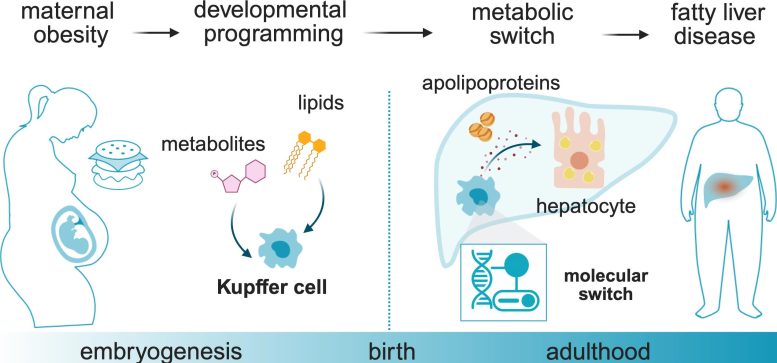
Obesity appears to alter the regulatory role of Kupffer cells. This conclusion comes from mouse experiments conducted by Mass and collaborating research groups at the University of Bonn. “We were able to show that the offspring of obese mothers frequently developed a fatty liver shortly after birth,” says Dr. Hao Huang from Mass’s lab. “And this happened even when the young animals were fed a completely normal diet.”
The disorder seems to result from a type of “reprogramming” in the Kupffer cells of the offspring. These cells begin sending molecular signals that prompt liver cells to absorb more fat. Figuratively speaking, they stop conducting a Beethoven symphony and instead switch to a piece by Vivaldi.
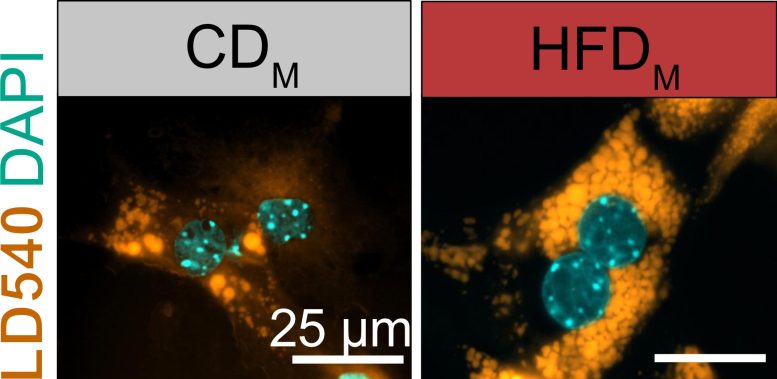
This shift already seems to occur during embryonic development and is triggered by metabolic products from the mother. These activate a kind of metabolic switch in the Kupffer cells and change the way these cells direct liver cells in the long term. “This switch is a so-called transcription factor,” says Mass. “It controls which genes are active in Kupffer cells.”
No fatty liver without the molecular switch
When the researchers genetically removed this switch in the Kupffer cells during pregnancy, the offspring did not develop a fatty liver. Whether this mechanism could also be targeted with medication is still unclear. The teams now plan to investigate this in follow-up studies.
If new treatment approaches emerge from this, it would be good news. The altered behavior of the Kupffer cells likely has many negative consequences. Fat accumulation in the liver, for example, is accompanied by strong inflammatory responses. These can cause an increasing number of liver cells to die and be replaced with scar tissue. The result is fibrosis, which gradually impairs liver function. At the same time, the risk that liver cells degenerate and become cancerous increases.
“It is becoming ever more evident that many diseases in humans already begin at a very early developmental stage,” says Mass, who is also spokesperson for the transdisciplinary research area “Life & Health” and a board member of the “ImmunoSensation2” Cluster of Excellence at the University of Bonn. “Our study is one of the few to explain in detail how this early programming can happen.”
Reference: “Kupffer cell programming by maternal obesity triggers fatty liver disease” by Hao Huang, Nora R. Balzer, Lea Seep, Iva Splichalova, Nelli Blank-Stein, Maria Francesca Viola, Eliana Franco Taveras, Kerim Acil, Diana Fink, Franzisca Petrovic, Nikola Makdissi, Seyhmus Bayar, Katharina Mauel, Carolin Radwaniak, Jelena Zurkovic, Amir H. Kayvanjoo, Klaus Wunderling, Malin Jessen, Mohamed H. Yaghmour, Lukas Kenner, Thomas Ulas, Stephan Grein, Joachim L. Schultze, Charlotte L. Scott, Martin Guilliams, Zhaoyuan Liu, Florent Ginhoux, Marc D. Beyer, Christoph Thiele, Felix Meissner, Jan Hasenauer, Dagmar Wachten and Elvira Mass, 18 June 2025, Nature.
DOI: 10.1038/s41586-025-09190-w
In addition to the University of Bonn, the German Center for Neurodegenerative Diseases (DZNE), the University of Vienna (Austria), Ghent University (Belgium), and Shanghai University (China) were involved in the study. The research was supported by the German Research Foundation (DFG, in particular SFB 1454 Metaflammation), the European Research Council (ERC), the Jürgen Manchot Foundation, the Boehringer Ingelheim Fonds and the European Molecular Biology Organization (EMBO).
Never miss a breakthrough: Join the SciTechDaily newsletter.
Follow us on Google and Google News.