
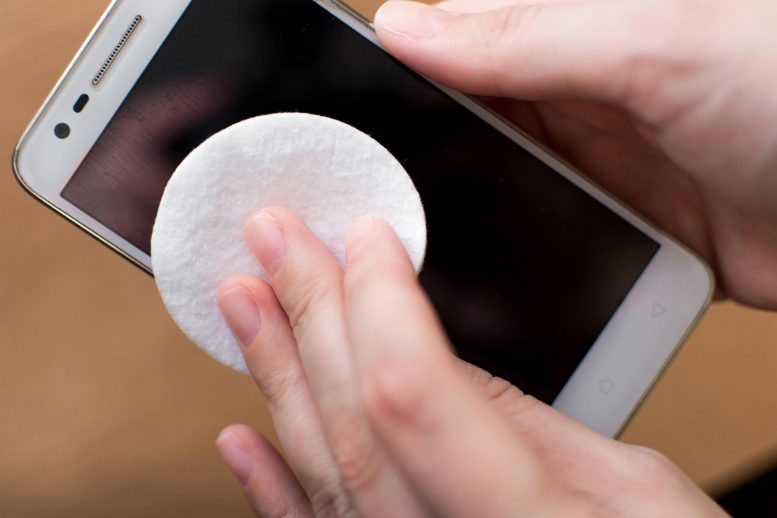
Phone Screen Testing offers a painless, low-cost way to detect COVID-19 from mobile screens, with accuracy similar to antigen tests.
An accurate, non-invasive, and low-cost method of testing for COVID-19 using samples taken from the screens of mobile phones has been developed by a team led by UCL researchers at Diagnosis Biotech.
The study, published in eLife and led by Dr. Rodrigo Young (UCL Institute of Ophthalmology), analyzed swabs from smartphone screens rather than directly from people, and found that people who tested positive by the regular nasal swabbing PCRs were also positive when samples were taken from phone screens.
The new method — known as Phone Screen Testing (PoST) — detected the COVID-19 virus on the phones of 81 to 100% of contagious people with a high viral load, suggesting it is as accurate as antigen lateral flow tests.
Globally active screening for COVID-19 is still a priority as new variants keep emerging and the vaccination rollout is not guaranteed in many countries. However, testing is expensive and can be physically unpleasant, both of which are significant hurdles on the road to an effective test and trace system.
Advantages of Non-Invasive Environmental Testing
As PoST is an environmental test, rather than a clinical test, it is both non-invasive and less expensive that a traditional nasal swabbing PCR. This means not only is it suitable for rollout in lower-income countries, but it also removes the discomfort of current COVID-19 testing options, potentially increasing take-up of regular testing among the general population. In addition, PoST sampling takes less than a minute and does not require medical personnel, which eases mass adoption in big facilities and large-scale applications.
Dr. Rodrigo Young said: “Like many, I was very worried about the economic and social impact that the pandemic would leave behind, particularly in lower-income countries. We knew that the only effective way to stop the spreading is to regularly test as many people as possible, but this was not happening because it’s too expensive and uncomfortable.
“We immediately knew this was something special, as PoST is a method that would not only make COVID-19 mass testing much easier but could also be used to contain outbreaks of new naturally occurring and man-made viruses, to avoid future pandemics.”
Diagnosis Biotech, a Chilean startup founded by UCL’s Dr. Young, has been performing COVID-19 screenings in companies and schools in Chile to avoid outbreaks and maintain operational continuity, as frequent measurement of all workers or students allows the early identification of asymptomatic people and helps to control the spread of the virus.
A machine is currently under development by Diagnosis Biotech which will build on this research, safely taking a phone for PoST sampling and deliver the results directly via SMS to minimize contact.
Reference: “Smartphone Screen Testing, a novel pre-diagnostic method to identify SARS-CoV-2 infectious individuals” by Rodrigo M Young Is a corresponding author, Camila J Solis-Cascante, Andres Barriga-Fehrman, Carlos Abogabir, Alvaro R Thadani, Mariana Labarca, Eva Bustamante, Cecilia V Tapia, Antonia G Sarda, Francisca Sepulveda, Nadia Pozas, Leslie C Cerpa, María A Lavanderos, Nelson M Varela, Alvaro Santibañez, Ana M Sandino, Felipe Reyes-Lopez, Garth Dixon, Luis A Quiñones, 22 June 2021, eLife.
DOI: 10.7554/eLife.70333
Never miss a breakthrough: Join the SciTechDaily newsletter.
Follow us on Google and Google News.
2 Comments
Yep, let’s just swab that lamppost over there to see if you have Covid!
What a load of garbage.
If they can swab your phone screen to detect it, they should be able to easily detect it with a cheek swab.
So what is the real reason for cramming that stick up into your sinus cavity so close to your brain, where damage can weaken the blood brain barrier to infectious pathogens?
The whole thing is highly suspect.