
Close Menu
    Facebook X (Twitter) Instagram
    SciTechDaily
    • Biology
    • Chemistry
    • Earth
    • Health
    • Physics
    • Science
    • Space
    • Technology
    Facebook X (Twitter) Pinterest YouTube RSS
    SciTechDaily
    Home»Physics»MSU Researchers Develop Nanostructured Gas Sensors
    Physics

    MSU Researchers Develop Nanostructured Gas Sensors

    By Moscow State UniversityNovember 10, 2017No Comments2 Mins Read
    Facebook Twitter Pinterest Telegram LinkedIn WhatsApp Email Reddit
    Share
    Facebook Twitter LinkedIn Pinterest Telegram Email Reddit
    Scientists Develop Nanostructured Gas Sensors
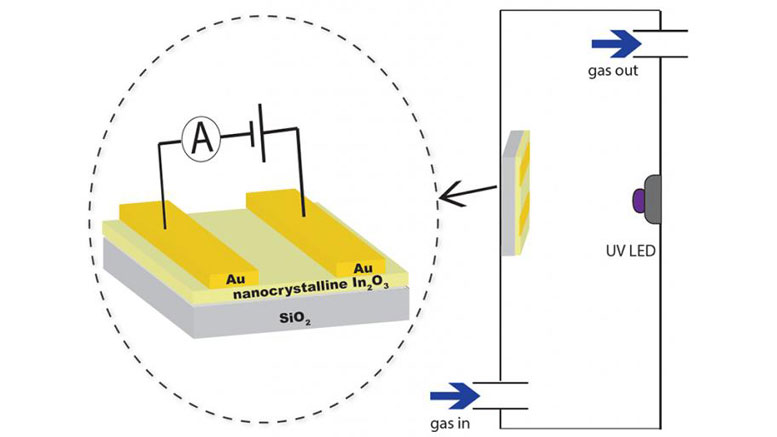
    This is a hydrogen sensor scheme. Credit: Alexander Ilyin

    Scientists from the Physics Department of Moscow State University and their colleagues have discovered a mechanism that allows gas sensors, based on nanocrystalline metal oxides, to work at room temperature. This invention will raise the efficiency of environmental monitoring at nuclear power plants, on submarines and spacecrafts. The discovery is published in Scientific Reports.

    Researchers have proposed a new fundamental principle of operation of hydrogen sensors. Unlike most resistive gas detectors, it does not need to be heated and only requires visible light. This discovery will significantly reduce the energy consumption of the sensor and expand its scope.

    “Such sensors can be used in explosive environments or be built into mobile devices without constructing additional heat sink systems,” said Alexander Ilyin, a co-author of the study, a Ph.D. student at the Physics Department of Moscow State University.

    Scientists have found out that composites based on zinc and indium oxides can significantly increase the sensitivity of the sensor to hydrogen. Physicists have also proposed an explanation for the hypersensitivity of the designed composite. In their opinion, the sensor response mechanism consists of a change in the processes of generation and recombination of nonequilibrium electrons when the composite is interacting with hydrogen. Composites with a certain structure provide a more significant change in these processes.

    Samples for the sensor were made from nanocrystalline indium and zinc oxide powders. The structure and particle size were studied by the means of transmission electron microscopy and x-ray diffraction. The electrical and sensor characteristics of the structures were studied in the newly designed setup, in which the required temperature of the composite and the concentration of hydrogen were well controlled.

    The obtained results would allow the scientists to develop a new type of resistive hydrogen sensor that works under additional illumination without heating. Such sensors are promising not only for effective monitoring of environmental pollution in industrial plants, but also for constant monitoring of air in closed facilities (submarines, mines, spacecraft) where the slightest change in the chemical composition can lead to human casualties.

    Reference: “Green light activated hydrogen sensing of nanocrystalline composite ZnO-In2O3films at room temperature” by A. S. Ilin, M. I. Ikim, P. A. Forsh, T. V. Belysheva, M. N. Martyshov, P. K. Kashkarov and L. I. Trakhtenberg, 22 September 2017, Scientific Reports.
    DOI: 10.1038/s41598-017-12547-5

    Never miss a breakthrough: Join the SciTechDaily newsletter.
    Follow us on Google and Google News.

    Lomonosov Moscow State University Nanoscience Nanotechnology
    Share. Facebook Twitter Pinterest LinkedIn Email Reddit

    Related Articles

    Physicists Discover the Temperature at Which Carbon Nanotubes Become Superconductors

    New Approach May Enable Portable Atomic Clocks

    Physicists Discover Negative Photoconductivity in Monolayer MoS2

    Nanoparticles Allows Physicists to Select the Direction of Light

    Nanoparticle Temporarily Violates the Second Law of Thermodynamics

    PEPs Might Make Quantum Condensation Possible at Room Temperature

    Ultrashort Pulses of Infrared Light Trigger Changes in Magnetism

    Path to Magnetic Vortex RAM Might be More Difficult Than Previously Assumed

    Researchers Explain Mysterious Nanoscale Crop Circles

    Leave A Reply Cancel Reply

    • Facebook
    • Twitter
    • Pinterest
    • YouTube

    Don't Miss a Discovery

    Subscribe for the Latest in Science & Tech!

    Trending News

    Scientists Uncover Potential Brain Risks of Popular Fish Oil Supplements

    Scientists Discover a Surprising Way To Make Bread Healthier and More Nutritious

    After 60 Years, Scientists Uncover Unexpected Brain Effects of Popular Diabetes Drug Metformin

    New Research Uncovers Hidden Side Effects of Popular Weight-Loss Drugs

    Scientists Rethink Extreme Warming After Surprising Ocean Discovery

    Landmark Study Links Never Marrying to Significantly Higher Cancer Risk

    Researchers Discover Unknown Beetle Species Just Steps From Their Lab

    Largest-Ever Study Finds Medicinal Cannabis Ineffective for Anxiety, Depression, PTSD

    Follow SciTechDaily
    • Facebook
    • Twitter
    • YouTube
    • Pinterest
    • Newsletter
    • RSS
    SciTech News
    • Biology News
    • Chemistry News
    • Earth News
    • Health News
    • Physics News
    • Science News
    • Space News
    • Technology News
    Recent Posts
    • Researchers Uncover Source of Strange Deformation in Earth’s Largest Continental Rift
    • Scientists Solve Mystery of Where the Colorado River Vanished Millions of Years Ago
    • Not Just Alzheimer’s: Scientists Uncover Clues to a Second, Overlooked Disorder
    • Scientists Uncover Dangerous Connection Between Serotonin and Heart Valve Disease
    • Scientists Discover a “Protector” Protein That Could Help Reverse Hair Loss
    Copyright © 1998 - 2026 SciTechDaily. All Rights Reserved.
    • Science News
    • About
    • Contact
    • Editorial Board
    • Privacy Policy
    • Terms of Use

    Type above and press Enter to search. Press Esc to cancel.